

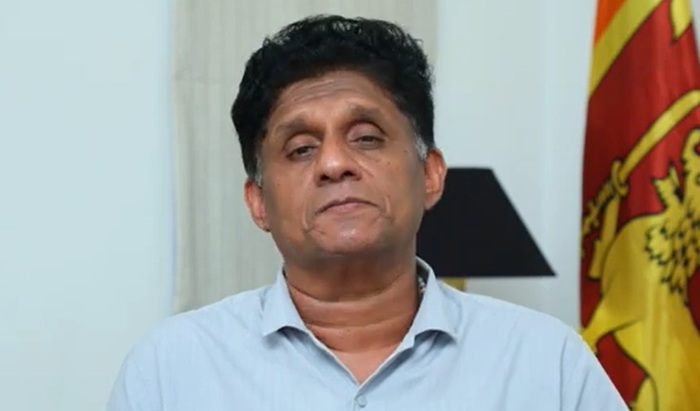
Opposition Leader Sajith Premadasa marked World Menstrual Hygiene Day today (28) by urging urgent reforms to tackle period poverty and cultural taboos, stressing that Sri Lanka must commit to building a “#PeriodFriendlyWorld”.
Issuing a statement, Premadasa warned that inadequate access to menstrual hygiene products has created a public health emergency, with 70% of Sri Lanka’s 4.2 million menstruating individuals lacking reliable supplies.
He noted that adolescent girls face widespread school absenteeism due to poor facilities, while working women endure labour market penalties that suppress productivity.
Highlighting what he called a “Taxation Paradox,” Premadasa criticized the government for spending Rs. 1.44 billion to subsidize sanitary napkins for schoolgirls while continuing to impose five layers of taxes on all women.
He pledged to push for zero taxation, support local manufacturing, explore Scotland’s free‑product model, and amend the Constitution to enshrine health and education rights.
Premadasa emphasized that menstrual equity is not just a women’s issue but a national imperative, affecting public health, education, and economic growth.
He called for a comprehensive national policy to ensure no woman or girl is held back from her true potential.
Full statement :
World Menstrual Hygiene Day, May 28
Today, as we observe World Menstrual Hygiene Day, Sri Lanka unites under the global movement and theme: “Together for a #PeriodFriendlyWorld”. Our collective mission is to ensure that by 2030, menstruation is accepted as a normal, healthy fact of life. To achieve this, our first step must be to break free from the outdated, regressive cultural taboos that have forced us to speak about a natural biological process in whispers.
We can no longer afford to treat period poverty as a hidden issue. It is a multi-sectoral national crisis that strikes at the heart of our public health, our education system, our labour market, and our macroeconomic stability.
The Public Health Emergency
The medical community has made it abundantly clear that improper menstrual management creates a catastrophic environment for female health. Yet, the scale of our crisis is staggering: out of 4.2 million menstruating individuals in Sri Lanka, 70%, nearly 3 million people, lack reliable access to disposable menstrual hygiene products. Women are forced into unhygienic practices, yet because of the deep-seated cultural stigma and shame surrounding menstruation, only a mere 12.6% of women who experience severe menstrual issues ever seek clinical medical care.
Educational Disenfranchisement
Period poverty acts as a massive structural barrier to human capital development. Currently, between 50% and 60% of our adolescent girls miss school during their menstrual cycles. They face a hostile environment, lacking proper Water, Sanitation, and Hygiene (WASH) infrastructure, and suffer profound psychological stress due to the fear of staining their uniforms and being subjected to mockery. We are systemically paralysing the potential of our future generation simply because they are female.
Labour Market Penalties and the Imperative for Period Leave
Women constitute 52% of Sri Lanka’s population, yet our female labour force participation remains unacceptably low at around 35%, compared to over 45% in many developed nations. In our factories and the apparel sector, working women face dismal hygiene facilities and severe discomfort. This lack of proper facilities and workplace empathy directly suppresses their economic productivity, acting as a massive, self-inflicted drag on our Gross Domestic Product (GDP). This is exactly why I convened stakeholders to push for a national policy on period leave, ensuring that women in the workforce do not have to endure structural gender discrimination.
Economics, the Taxation Paradox, and Our Vision for Reform
Before we brought this issue to the political forefront, there was no national dialogue. Today, the government has allocated Rs. 1.44 billion to provide sanitary napkins to schoolgirls. However, this exposes a massive “Taxation Paradox”. It is utterly illogical for the state to spend Rs. 1.44 billion to subsidise these products for students, while simultaneously penalising all women with five layers of crippling taxes: a 15% General Duty, an 18% VAT, a 10% PAL, a 15% CESS, and a 2.5% SSCL.
As a nation, we must look to global standards. India and Bangladesh maintain a zerotax policy on these items. South Africa has abolished VAT, the UK has scrapped the tampon tax, and Scotland has taken the historic step of providing these products for free.
My Commitments for a #PeriodFriendlyWorld:
- Zero Taxation and Local Industry: We must immediately reduce the taxes on menstrual products to zero. Furthermore, as proposed by medical experts, we must support the local manufacturing of high-quality, affordable sanitary products, transforming this into a domestic industry that creates jobs and saves foreign exchange.
- The Scotland Model: My party and I are committed to exploring the “Scotland Model” to provide free menstrual products across the board, ensuring no citizen has to reject their dignity due to poverty.
- Constitutional Reform: Currently, our Constitution’s Fundamental Rights chapter only covers civil and political rights. I pledge to amend our Constitution to include Economic, Social, and Cultural rights, expressly including the rights to Health and Education, so that the state is legally bound to provide sustainable health solutions for all its citizens.
Let us commit today to drafting a comprehensive National Policy on menstrual equity. Together, we will build a Sri Lanka where no woman or girl is held back from her true potential. (Newswire)