

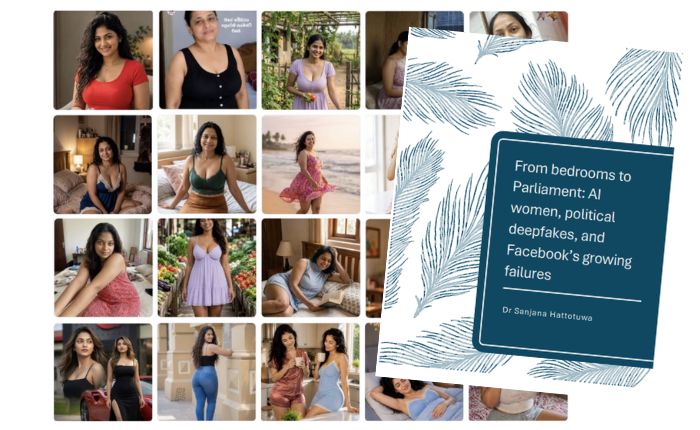
A new report on artificial intelligence-generated content on Facebook has warned that synthetic personas and political deepfakes are emerging as a threat to Sri Lanka’s democratic and electoral integrity, after videos impersonating Prime Minister Harini Amarasuriya attracted more than 1.2 million views.
The report, From bedrooms to Parliament: AI women, political deepfakes, and Facebook’s growing failures, by independent researcher Dr. Sanjana Hattotuwa, builds on an earlier study of AI-generated profiles presenting themselves as Sri Lankan women.
The new report says what began as fabricated personas used to attract engagement and direct users toward adult chat, gambling, cryptocurrency and other financial destinations has expanded into political content.
According to the report, 10 AI-generated videos impersonating Amarasuriya placed words in her mouth that she had never said. One video, which falsely depicted the prime minister promising to address dengue by making mosquitoes homosexual, received about 324,000 views. Together, the 10 videos surpassed 1.2 million views.
The report said Facebook displayed no platform-native AI-content notice on the individual video pages when they were inspected, despite some carrying a visible watermark from the AI platform used to generate them. It also found that comments on the videos included misogynistic abuse directed at the prime minister, while some users appeared to accept or endorse the fabricated statements.
Hattotuwa warned that the same infrastructure used to build audiences around synthetic women could be adapted for political influence campaigns. The executive summary said such capabilities could affect future presidential and parliamentary elections, political debate and governance between elections as increasingly sophisticated synthetic media becomes easier to produce and distribute.
The findings have also been formally brought to Prime Minister Amarasuriya’s attention. In a letter dated Sept. 7, Hattotuwa sent the report to the Prime Minister’s Office and urged it to seek an accountable response from Meta, Facebook’s parent company. The letter called for an urgent review of the documented impersonations and clearer measures to identify and label deceptive synthetic media in Sinhala and Tamil, address gendered abuse and strengthen platform integrity in Sri Lanka.
The letter said the issue extends beyond attacks on any single political party, noting that AI-generated accounts have been used both to attack the government and to defend it while targeting political opponents.
Hattotuwa urged sustained engagement between Meta, Sri Lankan authorities, the Election Commission and independent researchers to address the risks posed by synthetic political content. (Newswire)