

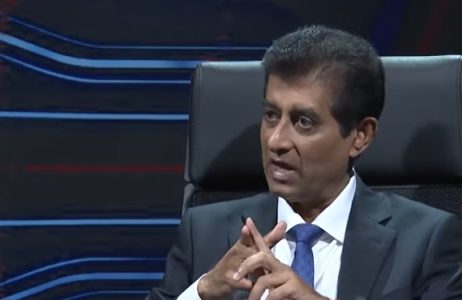
Senior Economic Adviser to the President Duminda Hulangamuwa has acknowledged that a significant number of income earners in Sri Lanka remain outside the tax net, highlighting the need for stronger mechanisms to identify individuals who are not paying their required taxes.
Speaking to journalist Kalindu Karunaratne on Ada Derana 360, Hulangamuwa said the government was taking several steps to broaden the tax base but admitted that it was difficult to estimate how much additional revenue these measures would generate.
He explained that taxes on salaries, bank interest and dividend income were relatively easy to collect because employers, banks and companies already had mechanisms to deduct taxes and report information to the Inland Revenue Department.
However, he identified certain professionals, small businesses, wholesale traders and individuals earning income through private transactions as groups whose earnings were more difficult for tax authorities to track.
Hulangamuwa said some professionals operating under Sri Lanka’s self-assessment tax system could declare income below their actual earnings, resulting in lower tax payments.
He stressed that it would be unfair to suggest that all professionals were avoiding taxes but acknowledged that a proportion of income earners could be paying less tax than required.
Responding to a question on whether a significant number of Sri Lankans remained outside the tax system, Hulangamuwa said he believed there was a considerable group whose income was not being adequately captured by existing mechanisms.
He explained that while individuals could earn and retain money without immediately attracting the attention of tax authorities, major purchases and financial transactions could provide opportunities to identify undeclared income.
Hulangamuwa highlighted vehicle purchases, land transfers, property acquisitions and banking transactions as key areas where authorities could monitor the movement of money.
However, he acknowledged that Sri Lanka currently lacked a fully integrated system capable of connecting such information across different government institutions.
He said linking databases maintained by the Inland Revenue Department, Sri Lanka Customs, banks and land registration authorities could significantly improve the government’s ability to identify previously unreported income.
According to Hulangamuwa, such an integrated system would allow tax authorities to compare declared income with financial transactions and identify individuals who should be brought into the tax net.
Nevertheless, he acknowledged that it was difficult to determine precisely how much Sri Lanka’s overall tax revenue could increase by expanding the tax base.
Asked whether improved tax compliance could significantly increase the country’s tax revenue, Hulangamuwa said a reliable estimate could not be provided without sufficient information about currently unreported income.
He explained that calculating potential revenue from individuals whose earnings were not recorded in existing systems remained particularly challenging.
Hulangamuwa said that while some revenue streams, such as bank interest, could be assessed using available financial data, estimating the tax potential of unreported professional and business income was considerably more difficult.
He emphasised that developing a comprehensive digital system linking information across government institutions would be an important step towards improving tax compliance, expanding the tax base and strengthening government revenue collection. (Newswire)