

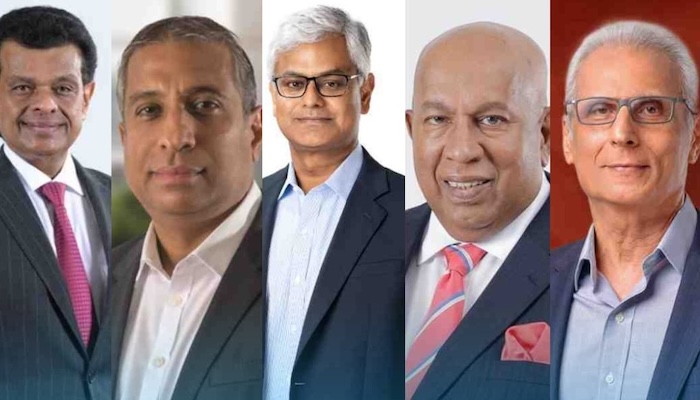
The Law and Society Trust has urged the government to reconsider the composition of the newly formed Management Committee for the Rebuilding Sri Lanka Fund, describing its all‑male, corporate‑heavy makeup as a troubling departure from promises of inclusivity and accountability.
In a statement, the group welcomed the president’s calls for a comprehensive “rescue, relief, recovery and reconstruction” programme that draws on all sectors of society. They said the re‑iteration of an inclusive, citizen‑driven approach in his address had been “reassuring.”
However, the civil society representatives said they were “appalled” to learn that the 11‑member Management Committee is composed entirely of men — a few from government and the remainder drawn from the corporate sector’s top echelons. They argued this reflects an outsourcing of the nation’s post‑disaster recovery to a “Colombo‑centric corporate sector,” risking further misalignment with the needs of the wider population.
Of the six non‑corporate positions on the committee, four are direct presidential appointees — a move the group described as undermining the president’s stated commitment to gender and political inclusion. They noted an absence of transparent criteria for appointments beyond personal trust and confidence.
The statement also highlighted a broader pattern of exclusion, pointing to recent all‑male appointments to other high‑level bodies such as the Clean Sri Lanka Presidential Task Force and the Archaeological Advisory Committee, which the group said disregards gender balance and ethnic diversity.
“These high‑level committee/task‑force appointments are without precedent in the history of this country,” the statement said, warning that such hasty and unrepresentative appointments risk eroding public confidence just when credibility and trust are most needed.
Civil society members also cautioned against potential conflicts of interest, noting that most private‑sector appointees continue to lead profit‑driven businesses, and under the committee’s broad mandate, could both award and benefit from reconstruction contracts.
The group questioned what safeguards exist to prevent preferential treatment or abuse of state resources.
The full statement:
We, the undersigned members of civil society, welcome any efforts by the President to engage with all sectors of society to develop a coherent rescue, relief, recovery and reconstruction program in response to the disaster that has struck Sri Lanka. His re-iteration on inclusivity and for an approach that called for commitment from all citizens in his address to the nation was reassuring.
Therefore, we were appalled to receive notice that the recently-appointed Management Committee for the ‘Rebuilding Sri Lanka Fund’ is constituted entirely of men, a few from the Government and the rest entirely drawn from the top echelon of Sri Lanka’s for-profit private sector. This can only be seen as outsourcing of the complex post-disaster national response to the Colombo-centric corporate sector – a recipe for further disaster.
In addition, of the 6 non-corporate positions in the 11-member Management Committee, 4 are direct appointees of the President himself, which belies his claim for inclusivity on both gender and political grounds. There appears to be no clear or transparent criteria for these appointments, except the personal trust and confidence of the President, which again foregrounds the concern that no women have been included.
Regrettably, this is not an isolated incident, since, for instance, both the 18-member Clean Sri Lanka Presidential Task Force and the recently-appointed 19-member Archaeological Advisory Committee shockingly disregard Sri Lanka’s gender balance and ethnic diversity in favour of an exclusive majoritarian representation.
Such high-level committee/task force appointments are without precedent in the history of this country, and it is in this context that we express our strong concern of the potentially even greater erosion of confidence and credibility regarding the crucial tasks ahead to respond to this crisis, due to the hasty appointment of the Management Committee without due consideration to its real and perceived implications.
In this light, we reiterate that the individuals appointed from the private sector have excelled in making profits and almost all of them currently have a primary responsibility to enhance the shareholders’ or business partners’ wealth in their respective companies. The potential for conflict of interest is imminent and in our view incurable without them stepping down from their current corporate responsibilities.
It would be less problematic if the committee’s role is short-term and limited to targeted fundraising from the private sector for the humanitarian response. But this committee as per the notice, is much more than that. It is empowered to manage the fund, set priorities, allocate and disburse funds for approved recovery activities. What kind of development trajectory will such a committee envisage for Sri Lanka? What kind of development is such a committee capable of conceptualising, given the commercial orientation by all of its non-government members? It would be a tragedy if the government and private sector allowed this opportunity to transform the country into “Sri Lanka Inc.” at a time when the people are battered and bruised and unable to protest.
The broad mandate given to this committee, stacked with business leaders from selected blue-chip companies, can obviously lead to conflicts of interest. The companies controlled by these business leaders on the management committee will surely be engaged in post-recovery development on a commercial basis.
What checks and balances are in place to ensure that tenders and procurement contracts are awarded with proper oversight, and not simply to benefit a small, well-connected group? What controls are in place to ensure that state largesse, like compensation, is not abused for private company gain?
Responding to a complex crisis of this nature is deeply political. The role requires a multifaceted team at the helm with diverse technical expertise. The absence of women in the committee is glaring, and, shockingly, the Cabinet approved it. Any committee we believe should have non-partisan individuals experienced in humanitarian response and those who could bring in hands-on technical expertise from various sectors that this response demands.
We cannot perpetuate our past “development” mistakes where we ignored environmental protections, sustainable development through investments in agriculture and livelihoods and infrastructure development going beyond highways. Having a mix of people from different ethnic groups and with relevant areas of expertise is also key in a country like Sri Lanka.
It is deeply troubling that this government, swept into office with a huge mandate, on promises to establish transparency, accountability, inclusion and a people-centred development, should give up on these promises and principles so easily.
We insist that the government revisit the composition of this committee and its mandate and ensure that Sri Lanka’s recovery is based on the principles of gendered social justice, equity and sustainability. (Newswire)