

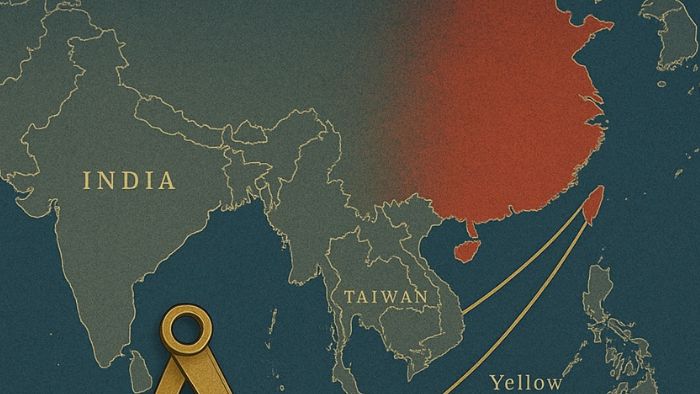
(IN BRIEF) China is steadily building a “Pax Sinica” in the Indo-Pacific through its aggressive maritime expansion, economic leverage, and coercive actions — especially toward Taiwan — while the world remains fixated on the Taiwan Strait. Yet India is emerging as the only Asian power with the scale, naval ambition, and strategic autonomy to challenge Beijing at sea. Through its central role in the Quad and its growing network of naval partnerships, bases, and patrol infrastructure, India aims not to replace China with its own dominance but to preserve an open, multipolar maritime order. China’s grey-zone tactics against Taiwan, island militarization, and expansive territorial claims stand in contrast to India’s emphasis on rules-based navigation and regional balance. As this competition moves from land to sea, the United States increasingly sees India as an essential counterweight, while Europe — vulnerable to semiconductor supply shocks and dependent on Indo-Pacific trade stability — is being pushed toward strategic alignment with New Delhi. A future Indo-Pacific may hinge on India’s persistence, shaping the region’s power balance not through force but through steady, patient resistance to unilateral Chinese control.
(NEWS) ATHENS, 8-Dec-2025 — /EuropaWire/ — While the world obsessively monitors every move around Taiwan, another, quieter but equally consequential geopolitical drama is unfolding in the shadow of the Yellow Sea. Much like the Romans of the first century AD imposed the Pax Romana not through treaties but through roads, legions, and maritime trade routes, China today seeks to enforce its own version of maritime order — a Pax Sinica. It is a “peace” built not on consent, but on technological dominance, economic penetration, and an increasingly assertive presence across the Indo-Pacific.
Against this backdrop, recent analysis by the South China Morning Post suggests that the epicenter of global power is drifting toward Beijing, even as Washington searches for new strategic counterweights. What is often overlooked, however, is that India — the only Asian actor with the scale, population, and naval ambition to seriously contest China’s maritime expansion — has already begun redrawing the map of the Yellow Sea. Not as a reactive power, but as one intent on preventing the consolidation of a Chinese “maritime Roman peace.”
This brings us to the Quad, whose origins lie in maritime cooperation. Its first major undertaking was the collective response to the 2004 Indian Ocean tsunami, and since its formation in 2007 (and relaunch in 2017), maritime security has remained at the heart of its mission. The Quad is not — nor does it present itself as — a NATO-style alliance. Instead, it is a loose coalition of “like-minded partners” committed to freedom of navigation, adherence to international maritime law, and preservation of a rules-based Indo-Pacific open to all.
Within this framework, India occupies a distinctive place. Its location astride the Indian Ocean, its historic maritime ties to East Asia, and its role as a connective hub between the Indian and Pacific Oceans give New Delhi a pragmatic posture — less as an adversary of China per se, and more as a guarantor of stability, navigation, and rules. Indian strategists often resist framing the Quad through a hard-security lens, rejecting its militarization and instead emphasizing multi-layered regional governance — spanning security, technology, critical infrastructure, and legal norms.
By contrast, for China, rising power translates into increasingly aggressive and often unilateral maritime projection — territorial claims in the South and East China Seas, island militarization, extended continental shelf assertions, and coercive maritime sanctions. The Quad — particularly through India’s stance — functions as an indirect but meaningful constraint on Beijing’s ambitions. India’s strategic philosophy of balance, cooperation, and autonomy collides fundamentally with China’s logic of unilateral expansion.
In this context, Taiwan serves as the clearest mirror reflecting Beijing’s most coercive methods. The relationship between Beijing and Taipei is defined by persistent intimidation, military pressure, and systemic erosion of Taiwan’s international space. The 1995–96 Taiwan Strait Crisis remains the most vivid illustration: China fired missiles near Taiwan, simulated invasion operations, and triggered the deployment of two U.S. carrier battle groups to stabilize the region.
Following Taiwan’s 2016 election of a government rejecting Beijing’s “One China” orthodoxy, China imposed economic sanctions, restricted tourism flows, severed official communication channels, and began routine incursions into Taiwan’s air defense zone to normalize coercion. In 2022, Nancy Pelosi’s visit to Taipei prompted the largest military exercises in the Strait’s history — with missiles landing inside Japan’s EEZ for the first time and rehearsals for a full blockade of Taiwan’s imports of food, energy, and semiconductors.
Since 2023, Beijing has intensified “grey-zone tactics”: daily air incursions, cyberattacks on critical systems, disinformation campaigns, diplomatic pressure forcing nations to derecognize Taiwan, and economic coercion against firms engaging with Taipei. Simultaneously, China has legally codified the right to employ “non-peaceful means” for “national reunification” — signaling an intent not merely to restrict Taiwan’s international role but to eliminate its right to exist as an independent political entity.
After Galwan, this rivalry expanded well beyond the Himalayan frontier. China now seeks maritime spheres of influence through port access, strategic investment, and dual-use naval infrastructure. The theater of competition has decisively shifted: the sea — not the land — is becoming the principal arena of power.
India is responding by laying down naval assets, bases, patrol architecture, and strategic partnerships — constructing an active “security net” in a region Beijing seeks to dominate. This marks a historic shift: India is no longer merely defensive — it is assertive. China’s attempt to engineer a maritime Pax Sinica now meets a multi-layered counterstrategy. Through diplomatic, economic, and naval instruments, India aims to reshape the Indian Ocean into a space reflecting multipolar, not Sino-centric, order.
As India gains strategic autonomy at sea, the Quad becomes increasingly dependent on New Delhi’s ability to restrain China — not only across the Indo-Pacific, but especially in the Indian Ocean. Should India falter, China could consolidate a maritime hegemony reminiscent of Pax Romana — forcing nations to adapt to Beijing’s rules.
This dynamic inevitably draws in the United States, which now regards China as its primary strategic rival — militarily, technologically, economically, and at sea. Yet Washington views India as indispensable: the only Asian actor capable of counterbalancing China without manifesting expansionism of its own. Hence the strengthening of defense agreements, intelligence sharing, technological partnerships, and investment in India’s naval capacity.
The shifting balance of power extends well beyond Asia — reaching Europe directly. Although preoccupied with Russia and the Middle East, Europe is increasingly dependent on stability in the Yellow Sea and broader Indo-Pacific. A maritime Pax Sinica would render Europe not merely dependent, but hostage to Beijing’s strategic discretion — over energy flows, rare-earth supplies, and high-tech manufacturing.
Europe, therefore, cannot afford passive neutrality between China and India; it must pursue strategic alignment with India — a democratic, populous, and maritime-ambitious counterweight. Economically, Europe has the opportunity to re-site portions of semiconductor production from vulnerable Taiwan to an emerging Indian chip ecosystem — leveraging European capital, expertise, and co-research frameworks.
Such a shift would not only hedge against disruptions triggered by a Taiwan crisis capable of freezing European industrial supply chains within weeks — it would empower Europe to co-shape a multipolar maritime architecture. By cooperating with India on naval security, port investments, and chip supply chains, Europe reduces its vulnerabilities while accessing a rising technology market.
As the world fixates on Taiwan, the real strategic pivot may be emerging further north, where India’s maritime doctrine increasingly collides with China’s ambitions. For Europe, caught between dependence on Chinese supply chains and vulnerability to Taiwanese semiconductors, the choice has become existential: to cooperate with India, to participate in a genuinely multipolar Indo-Pacific, and to invest in shared technological ecosystems capable of safeguarding its autonomy and future prosperity.
India does not seek hegemony yet it seeks equilibrium. And that makes it invaluable for any power seeking open seas over closed spheres of control. This is why Ovid’s ancient truth resonates with renewed force today:“Gutta cavat lapidem, non vi sed saepe cadendo.”In a world where empires do not fall through siege but through persistence, patience, and strategic consistency, India may be the drop capable of reshaping the stone of Asian geopolitics. (EuropaWire)