

The measures implemented by the Sri Lankan Government and health authorities to prevent the spread of communicable diseases during the recent disaster situation have been commended by the Director‑General of the World Health Organization (WHO).
Today marks the second day of the WHO’s Second Global Summit on Traditional Medicine. The summit began yesterday (17) at Bharat Mandapam in New Delhi, India.
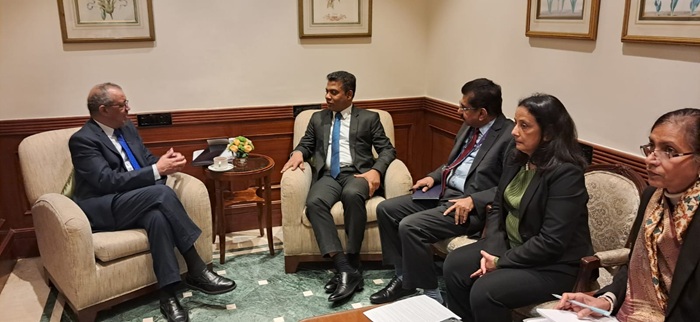
Representing Sri Lanka, Minister of Health Nalinda Jayatissa met with WHO Director‑General Tedros Adhanom Ghebreyesus this morning (18) on the sidelines of the summit.
Joining the meeting were Health Ministry Secretary Dr. Anil Jasinghe, WHO South‑East Asia Regional Director Dr. Razia Pendse, and other delegates.
Minister Jayatissa expressed gratitude to Dr. Tedros for WHO’s interventions, assistance, guidance, and support in maintaining strong and uninterrupted health services in Sri Lanka during the recent disaster.
During the discussion, Dr. Tedros inquired about Sri Lanka’s post‑disaster management efforts. Minister Jayatissa explained that the Government is carrying out recovery activities under a systematic and planned program, ensuring that health services prevented any outbreak or spread of communicable diseases among affected communities, thereby safeguarding public health.
The Director‑General praised the Government and health authorities for their disaster response and post‑disaster measures, stressing the importance of keeping communicable diseases under control during such crises and warning of the severe consequences if outbreaks were to occur.
The WHO’s Second Global Summit on Traditional Medicine, which began yesterday (17), continues today and will run until tomorrow (19) in New Delhi.
Organized jointly by WHO and India’s Ministry of Ayush, the summit aims to advance evidence, integration, and innovation in traditional medicine. It brings together ministers, scientists, indigenous leaders, and professionals from over 100 countries.
The summit will announce key scientific priorities and new commitments to implement and advance WHO’s Global Traditional Medicine Strategy 2025–2034, focusing on stronger evidence, better regulation, system integration, collaboration, and community participation.
Around 90% of WHO member states (170 out of 194) report that between 40–90% of their populations use traditional medicine. (Newswire)