

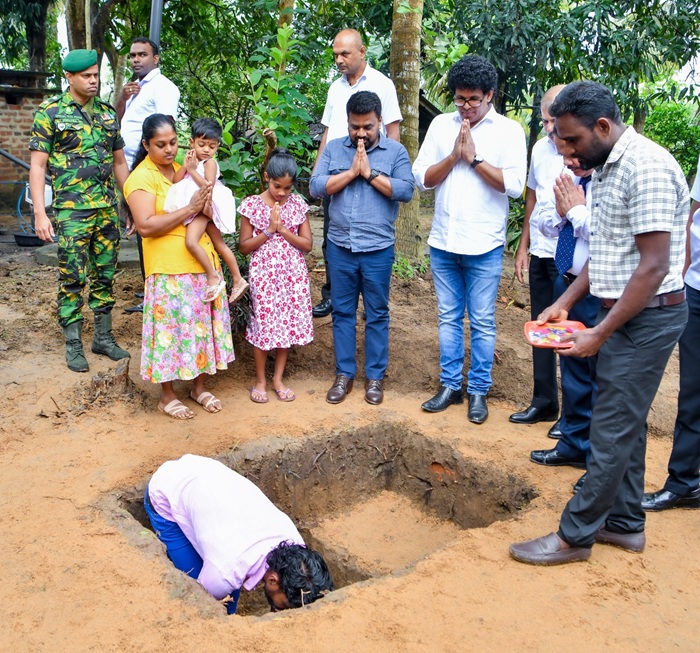
President Anura Kumara Dissanayake says 2026 will mark the year in which the highest number of houses are built with state assistance in Sri Lanka’s history.
He explained that approximately 20,000–25,000 new houses will be constructed for those affected by disasters, and together with the 31,000 houses already planned under the Housing Development Authority, a total of 50,000–55,000 houses will be built this year.
The President made these remarks at the launch of PROJECT 5M under Rebuilding Sri Lanka, held in Alubadda village, Malbeligala, in the Galnewa Divisional Secretariat of Anuradhapura District today (09 Jan).
Under the first phase of the programme to rebuild homes lost in Cyclone Ditwah, families whose houses were completely destroyed and certified for reconstruction at the same location will receive new homes.
Accordingly, compensation and construction work began for 26 such houses in Galnewa, Palagala, Palugaswewa, Ipalogama, and Thirappane divisions of Anuradhapura District, under the President’s leadership.
The President pointed out that never before in Sri Lanka’s history have leaders intervened to provide such large compensation, and emphasized that the present government has resolved to stand by the people and ensure they enjoy a higher standard of living than before.
He further noted that to provide a good quality of life, people need decent income, good education for children, healthy lives, proper housing, and mental well-being, and stressed that the government is committed to fulfilling these five essentials.
“Therefore, for the first time in history, we have presented a major plan to rebuild disaster‑affected areas. Rs. 500 billion has been allocated for recovery in 2026, with Rs. 72 billion already allocated in December 2025. We must stand by the people and rebuild the economy. Compensation is being paid for crop losses, including amounts never before given to farmers. Relief is also being provided to those in the livestock and industries. Data is being collected from other affected sectors. This government has resolved to stand by the people,” the President said, addressing the event.
President Dissanayake further said the government has focused particularly on housing.
“Reports show about 6,000 houses were completely destroyed, and another 17,000–18,000 are uninhabitable. Thus, about 20,000–25,000 new houses will be built. Additionally, Rs. 31,000 houses have been allocated in the 2026 budget. Under the Housing Development Authority, 10,000 houses are planned for those unable to rebuild. Sixteen years after the end of the war, some people still live in displacement camps. Rs. 2 billion has been allocated to build 2,500 houses for them. Under Indian assistance, houses will also be built for plantation workers. Altogether, 31,000 houses were planned, and now, with the disaster response, another 20,000–25,000 will be added. These homes will be built to provide people with a better life than before,” he added.
Full statement of President Anura Kumara Dissanayake:
About three years ago, our country was forced to endure an extremely devastating economic crisis. Fuel and gas shortages brought the entire nation to the brink of economic collapse. We all know that this collapse was not caused by a natural disaster. Instead, it was the result of economic policies pursued for decades by successive rulers, coupled with the concentration of national wealth in the hands of a very small group, at the expense of the wider public.
Although the Treasury accumulated large sums of money, those resources were confined to a privileged few. It was for these reasons that the national economy collapsed. As a direct consequence, for the first time in Sri Lanka’s history, the people took to the streets and drove out leaders who once wielded unquestioned power.
After we came together to form a government, our first and most urgent challenge was to stabilise the country’s collapsing economy. We have been largely successful in achieving that objective. We must build a country where our children will not have to endure the hardships experienced by our parents. We cannot allow the suffering of one generation to be passed on to the next. Therefore, our responsibility at this moment is to create a country in which our children can live with dignity and opportunity.
Much of a country’s overall well-being depends on the strength of its economy. When an economy is strong, many other aspects of national life improve. Equally, when an economy collapses, crime, fraud and corruption increase and the rule of law weakens. That is why strengthening the economy is the most critical priority. Accordingly, we have worked steadily and systematically to rebuild Sri Lanka’s economy. By 2025, Sri Lanka achieved record highs across all major economic indicators. It marked the year with the highest government revenue, the lowest budget deficit since 1977, the highest export earnings, the largest remittance inflows from overseas Sri Lankans and the greatest number of tourist arrivals in the country’s history.
It was at a time when the economy was just beginning to recover that we were confronted with this natural disaster. While we cannot fully control natural calamities, we had to establish an economy strong enough to withstand their impact. This challenge, however, came at a moment when the economy was already on the rise. A World Bank survey had already highlighted that the damage to infrastructure alone amounted to USD 4.1 billion.
This posed a severe blow to the recovering economy. Yet, the government had no right to abandon those affected by the disaster or tell them to simply wait. As a government, we introduced a comprehensive recovery plan, the largest of its kind in Sri Lanka’s history, to rebuild the areas hit by the disaster. For the year 2026 alone, LKR 500 billion was allocated for disaster recovery, while LKR 72 billion was set aside in December 2025. We were committed to protecting the people and reviving the economy. Compensation was provided for crop losses and previously unclaimed subsidies were distributed to farmers. Relief was also extended to individuals engaged in livestock management and various industries. We continued to gather data on other affected areas to expand assistance. We were a government determined to prioritize the people. Nowhere in Sri Lanka’s history had rulers intervened in such large-scale relief efforts with this level of public focus. We carried out these efforts to ensure that the people were truly supported.
We have focused significant attention on the housing issue. Reports indicate that approximately 6,000 homes were completely destroyed, while an additional 17,000–18,000 homes, though not fully damaged, were deemed uninhabitable. Consequently, it will be necessary to construct an estimated 20,000–25,000 new homes to accommodate those affected.
In addition, the 2026 budget has allocated funds to construct another 31,000 homes. For those unable to build homes independently, the Housing Development Authority has planned an additional 10,000 homes under its ongoing projects. Moreover, even 16 years after the end of the war in 2009, there are still people living in camps without proper housing. To address this, the government has allocated LKR 2 million for a home to construct 2,500 homes for these families. Similarly, for the people in estate areas, the government is facilitating housing construction with assistance from India. It is in this context, while planning 31,000 new homes that the current disaster has made it necessary to construct additional 20,000–25,000 homes. Our goal is to provide housing that ensures a better quality of life for affected families. The allocated funds are being used specifically for this purpose and we urge the affected communities to cooperate so that construction can begin promptly.
We have several fundamental needs a decent income, quality education for our children, a healthy and fulfilling life, a good home and mental well-being. Without at least these five essentials, we cannot truly live as human beings. Therefore, the primary objective of our government is to ensure that these needs are met.
For a long time, no one has been satisfied with our country’s education system. It has been a burden for parents and a source of frustration for children. If the education system had been effective, we would have achieved far better outcomes. Educators have debated and analysed reforms to the system over extended periods and we have now implemented these new changes. However, some have begun spreading baseless criticisms and misinformation about these reforms. Our focus remains on providing children with quality education. We are committed to ensuring that even children growing up in poverty have access to a strong, effective education that equips them for the future.
Therefore, we must provide our children with internationally recognized, high-quality education. No matter the attempts to undermine these reforms, we are determined to implement them.
Today, we are launching this housing programme. We had originally planned to build 31,000 homes and with the current initiative, this number will increase to between 50,000 and 55,000. This will mark the highest number of homes constructed under government support in a single year in Sri Lanka’s history. Providing our citizens with quality housing is our foremost priority.
Dr. Harshana Suriyapperuma, Secretary to the Ministry of Finance
The government has launched a programme to promptly provide compensation for fully and partially damaged homes, business premises and agricultural lands, ensuring the restoration of affected livelihoods. Today marks an important step in this initiative.
To clean and rehabilitate homes damaged by flooding, LKR. 25,000 have already been disbursed, along with an additional grant of LKR 50,000. Thanks to prudent financial management and funds retained in the Treasury, the government was able to act swiftly to provide this vital assistance to the public.
Mr. Ranjith Wimalasuriya, Divisional Secretary, Anuradhapura District
A total of LKR. 05 million will be allocated per household for reconstruction, disbursed in three installments. Today, the first installment of LKR. 02 million is being released, followed by the second and third installments of LKR. 1.5 million each. I urge beneficiaries to use these funds solely for their intended purpose. Strict oversight will ensure that the assistance achieves the expected results.
The event was attended by Minister of Trade, Commerce, Food Security and Cooperative Development, Wasantha Samarasinghe, Governor of the North Central Province, Wasantha Jinadasa, Members of Parliament Thilina Tharuka Samarakoon, Susanta Kumara Navaratne, P.B.N.K. Palihena and Bhagya Sri Herath, as well as local Divisional Secretaries, government officials and community members from the region. (Newswire)