

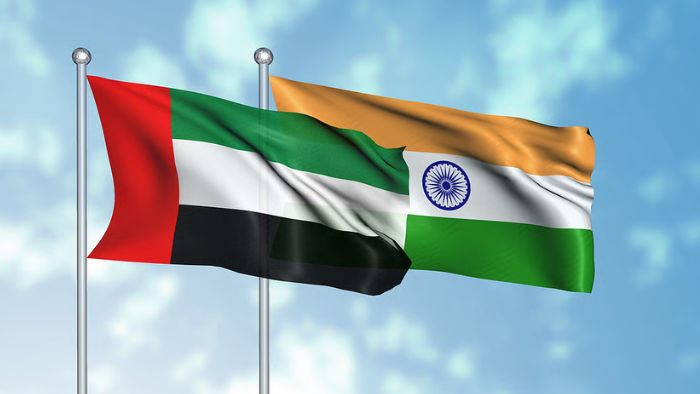
Indian Prime Minister Narendra Modi hosted UAE President Sheikh Mohamed bin Zayed Al Nahyan, in New Delhi, a meeting that lasted barely a few hours but has strategic reverberations extending well beyond diplomatic courtesy. The visit culminated in a suite of concrete agreements across trade, energy, defence, technology, and infrastructure, marking a defining evolution in India–UAE relations and signalling a recalibration of geopolitical alignments in the Indo-Pacific and West Asia.
The Comprehensive Economic Partnership Agreement (CEPA) signed in 2022 laid the foundation for an extraordinary expansion in economic ties. Since then, bilateral trade has surged, reaching US $100 billion in fiscal year 2024–25, making the UAE one of India’s most important trading partners in West Asia. Building on this momentum, both leaders announced a target to double bilateral trade to US $200 billion by 2032.
This ambition is not rhetorical. It reflects a recognition that India’s growth story and the UAE’s investment and logistics capabilities are complementary. To support this vision, officials have outlined initiatives to link Micro, Small and Medium Enterprises (MSMEs) across both markets through platforms like Bharat Mart, Virtual Trade Corridors, and the Bharat-Africa Setu, expanding Indian entrepreneurial footprints across the Middle East, Africa, and Eurasia.
The UAE’s First Abu Dhabi Bank (FAB) and global port operator DP World will also expand operations into GIFT City, Gujarat, strengthening India’s position as a regional financial and trade services hub, a step toward deeper integration of Gulf–South Asian economic infrastructure.
Energy has been the backbone of India–UAE economic engagement. In a landmark move, India signed a 10-year liquefied natural gas (LNG) supply agreement worth about $3 billion, under which UAE’s ADNOC Gas will export 0.5 million metric tons annually to Hindustan Petroleum Corporation (HPCL) starting 2028. This deal not only strengthens India’s energy security but also makes India the UAE’s largest LNG customer.
The agreement expands the total portfolio of UAE LNG contracts with India to more than US $20 billion and positions the Gulf state as a key node in securing diversified energy supplies for India, a critical strategic objective amid global volatility in energy markets.
Against a backdrop of shifting regional dynamics, the two countries signed a Letter of Intent (LoI) to establish a Strategic Defence Partnership, broadening collaboration beyond conventional diplomacy to include defence industrial cooperation, advanced technologies, cybersecurity training, interoperability frameworks, and counter-terrorism cooperation.
Officials clarified that this defence cooperation should not be read as entanglement in regional conflicts but rather as a mechanism to build collective capacities for peace and security, especially as traditional power structures in West Asia undergo realignment.
High-tech cooperation
Innovation featured prominently in the talks. Both nations agreed to deepen cooperation in Artificial Intelligence (AI) and supercomputing capabilities, including plans for a supercomputing cluster in India with UAE support and joint initiatives in space infrastructure and technology development.
This strategic high-tech collaboration reflects how both countries see a future shaped by digital and knowledge economies. For India, with its massive digital population and cutting-edge IT talent, a UAE partnership opens access to capital and global networks. For the UAE, it’s a pathway to diversify beyond hydrocarbons into knowledge-intensive sectors.
The visit also propelled cooperation in next-generation infrastructure. A Letter of Intent between the Government of Gujarat and the UAE Ministry of Investment envisages a Special Investment Region in Dholera, incorporating an international airport, smart urban township, MRO hubs, and energy infrastructure, a bold blueprint for industrial and economic growth.
At the same time, agreements in food safety and agri-export facilitation promise to ease Indian agricultural exports, particularly in a region that is highly dependent on food imports, expanding market access and generating new export opportunities.
The partnership also acknowledges deep people-to-people links. An estimated 4.5 million Indians reside in the UAE, contributing significantly to its economy and creating vibrant cultural ties. The establishment of a “House of India” in Abu Dhabi, a cultural space focusing on Indian art and heritage, underscores how soft power and community bonds amplify strategic cooperation.
Looking forward
What emerged from this brief but consequential summit is not a singular deal but a multi-layered framework for sustained cooperation, one that dovetails economic, defence, technological, and human-capital imperatives.
For India, this partnership with the UAE is a centerpiece of its wider engagement with the Gulf, a region vital to India’s energy needs, diaspora linkages, and geopolitical balance. For the UAE, deepening ties with India diversifies its global partnerships beyond traditional Gulf frameworks and positions it strategically between East and West.
In an era where global alignments are increasingly fluid, the India–UAE strategic partnership stands out for its breadth, depth, and future-oriented vision. Its success, measured not merely in trade figures but in enduring cooperation across sectors, may well become a template for how rising Asian powers can build mutually reinforcing partnerships that shape the contours of 21st-century geopolitics. (Khaleej Times)