

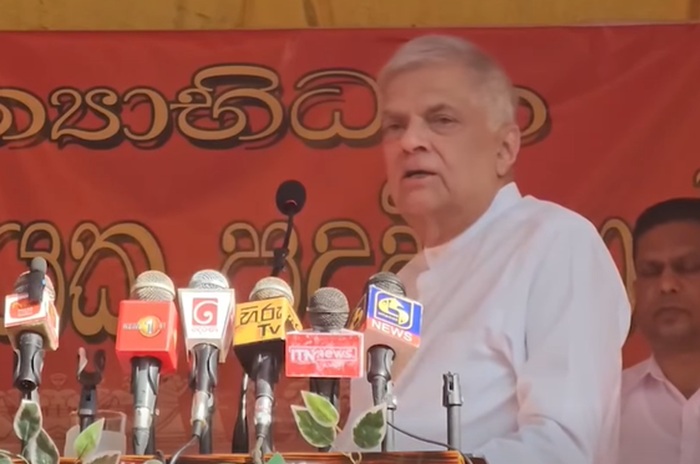
Former President Ranil Wickremesinghe said that religion remains essential even as artificial intelligence continues to advance, stressing that human consciousness cannot be replaced by technology.
He made these remarks while attending a religious ceremony held in Galle, where he reflected on the growing global influence of artificial intelligence and its relationship to the human mind.
Referring to the ceremony’s welcome song, he said he was informed that it had been generated using artificial intelligence. This prompted him to share his recent inquiries into AI and human cognition. He noted that some argue the rapid development of AI could eventually make religion unnecessary, a view he rejected.
“This idea is not limited to Buddhism alone, but applies to all religions,” he said, adding that spiritual traditions address dimensions of human experience beyond the reach of machines.
Wickremesinghe also highlighted the scale of global investment in artificial intelligence, noting that approximately $300 billion has been invested in the sector in the United States. He said this figure amounts to nearly four to five times Sri Lanka’s gross domestic product, adding that China is also making similar large-scale investments.
During his remarks, the former president described a recent interaction with ChatGPT, clarifying that his inquiry was not related to financial markets but to the broader question of safeguarding religion in societies increasingly shaped by AI. He said he posed a question about which holds a higher status, whether the human mind or artificial intelligence, citing the opening verse of the ‘Dhammapada’.
According to the AI system, Wickremesinghe said, it eventually acknowledged that the human mind is superior, as artificial intelligence operates with limited capabilities.
Looking ahead, Wickremesinghe said Buddhists should actively explore ways to integrate Buddhist philosophy with artificial intelligence to ensure long-term sustainability. He added that knowledge, rather than wealth, would be the key factor in navigating the future.
“These principles are not only relevant to Buddhism,” he said. “They apply equally to all religious philosophies.” (Newswire)