

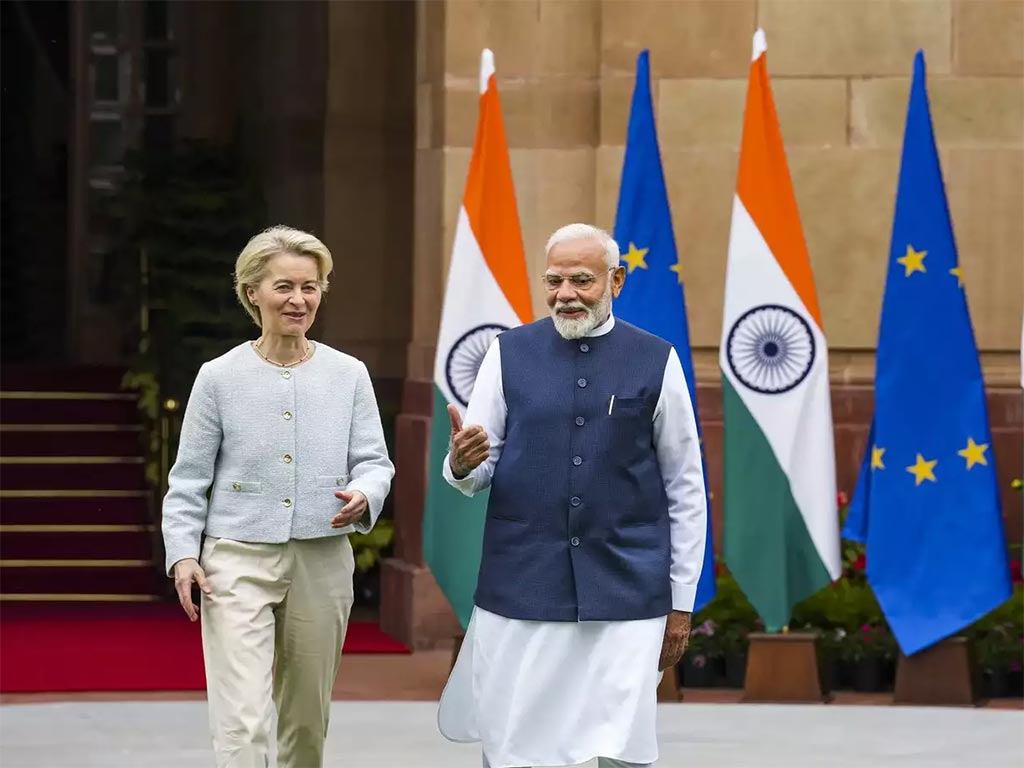
India and the European Union (EU) have agreed on a long-awaited Free Trade Agreement dubbed the “mother of all deals”, along with pacts on defence and worker mobility, amid a fracturing world order.
Indian Prime Minister Narendra Modi made the announcement ahead of a meeting with visiting European Commission President Ursula von der Leyen and European Council President Antonio Costa.
“Yesterday (Jan 26) a big agreement was agreed upon between the European Union and India. People are calling this the mother of all deals,” Mr Modi said in a video statement ahead of talks on January 27.
He added: “This agreement will bring major opportunities for the public in India and Europe. This is a perfect example of a partnership between two major economies of the world… This agreement represents 25 per cent of the global GDP and one third of global trade.”
The highly symbolic move marks a key strategic pivot for the middle powers looking to navigate a rapidly evolving geopolitical landscape by diversifying its economic reliance on China and the United States and strengthening strategic ties.
The FTA, in particular, marked the culmination of negotiations that stretched nearly two decades. The trade pact is expected to open up new opportunities in areas like automobiles, with India offering greater access to European car companies while seeking partnerships between Indian and European car companies.
Indian exporters, including those in areas like gems and jewellery, who have been hit hardest among all countries by a 50 per cent tariff from the US, are hoping to benefit from greater access to the European market.
Trade of goods between India and the EU stood at US$136 billion (S$172 billion) in financial year 2024-25, according to data from the Indian Ministry of Commerce and Industry.
According to European Commission data, India is the EU’s ninth-largest trading partner, accounting for 2.4 per cent of the EU’s total trade in goods in 2024, compared to the US and China, which accounted for 17.3 per cent and 14.6 per cent, respectively.
Decades in the making
India’s own impetus to find new markets was underscored by its lingering trade talks with the Trump administration, with New Delhi’s continued purchases of Russian oil, a sticking point with President Donald Trump.
Over the last seven months, India has finalised FTAs with the UK, New Zealand and Oman, and seeks to modernise older pacts like the 2010 India-Asean Trade in Goods Agreement.
The Europeans, on the other hand, face a fresh onslaught to their relationship with their main ally through Mr Trump’s willingness to ride roughshod in order to own Greenland.
For the European Union, closer ties with India open up a large consumer market and help strengthen its strategic footprint in Asia.
EU-India negotiations were only formally relaunched in 2021 amid supply chain shocks following the Covid-19 pandemic. They had stalled in 2013 due to disagreements over market access as the EU pushed for import duty cuts on automobiles, wines and spirits. India had wanted easier movement of its professionals and wanted greater access for its pharmaceuticals.
Managing differences
The US’ increasing protectionism and waning appetite for global leadership is spawning levels of uncertainty and unreliability in areas as wide-ranging as trade and security.
Against this backdrop, New Delhi and Brussels are also set to announce a defence pact on Jan 27.
Deeper strategic engagement notwithstanding, however, differences remain.
The EU remains critical of India’s longstanding friendship with Russia, and EU officials have indicated they hope Delhi will stop edging closer to Moscow through their deeper engagement.
“I think the message, of course, to the US would be that for all the uncertainties that Mr Trump has created here, there are like-minded partners that are still willing to bet on each other and work with each other,” said Professor Harsh V. Pant, vice-president of studies and foreign policy at the Observer Research Foundation in New Delhi.
“India and the EU represent two major economic powerhouses of today, and if they are coming together and building on economic ties and crafting a defence relationship, it shows how far their ties have evolved,” he said.
“It shows how far world order has evolved for an actor like the EU, which had been diffident about defence and strategic matters but suddenly now is willing to bet on India.” (StraitsTimes)