

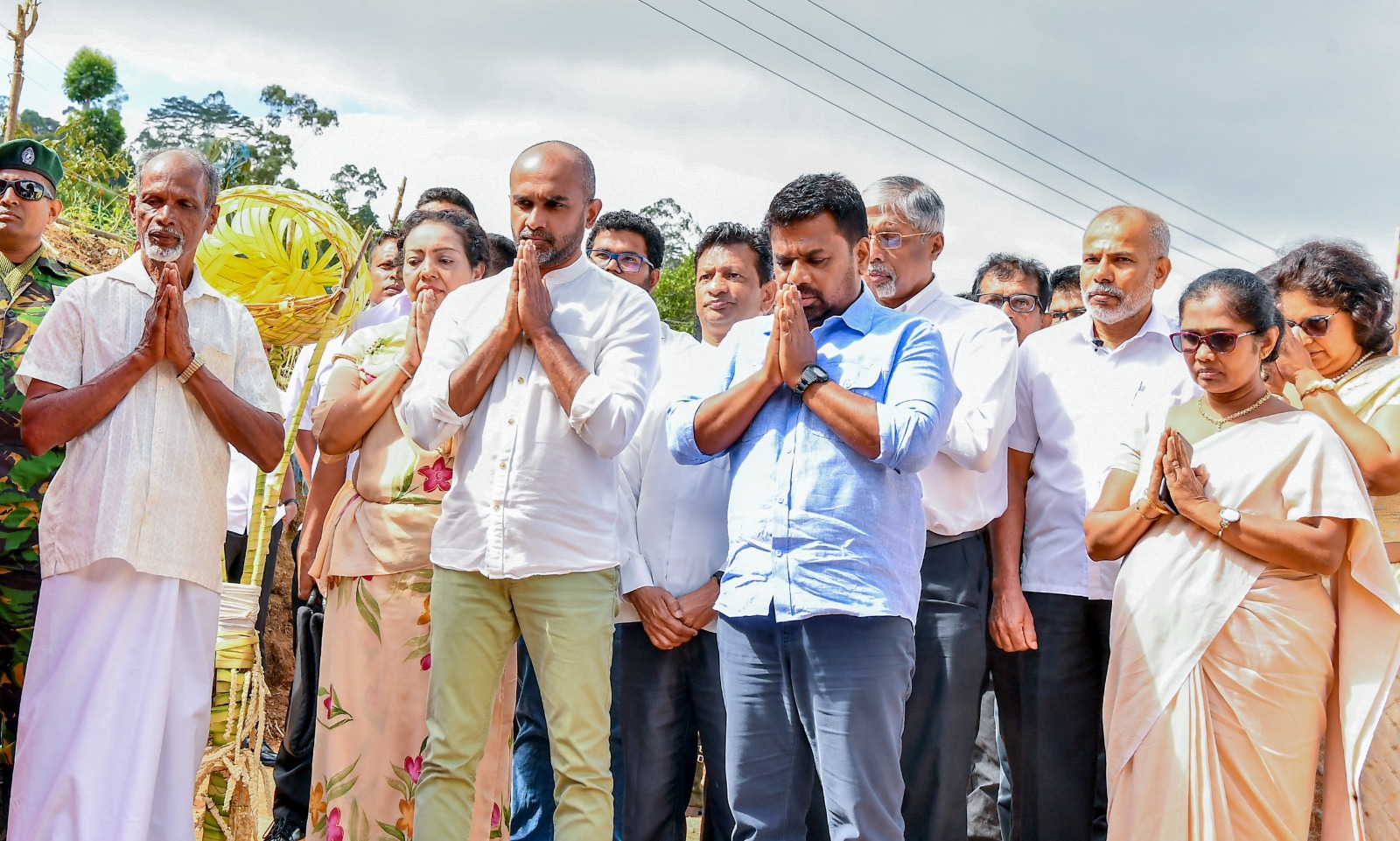
President Anura Kumara Dissanayake today launched the national programme ‘Godanagamu Adhishtanaye Sanhinda’ to restore religious sites damaged by Cyclone Ditwah, vowing to preserve their historical and cultural value.
The launch event took place at Sri Bodhirukkarama Viharaya in Doragala, Gampola, one of six religious sites in the Kandy and Udapalatha areas that were completely destroyed.
Another 15 sites sustained partial damage. The President said nearly 1,350 religious, cultural and archaeological sites across the country were affected by the cyclone and will be restored under this initiative.
“The bond between villages, temples, and religious sites is vital to daily life. Rebuilding them is essential for restoring normalcy,” President Dissanayake said.
In parallel, the President announced the creation of a new Authority to protect and manage the Central Highlands, citing serious environmental risks highlighted in a recent Asian Development Bank report. A legal framework has been established to support this initiative.
Full statement:
Our country recently faced a massive disaster one of the largest natural catastrophes in recent Sri Lankan history. On average, nearly two thousand landslides were reported. We also lost a large number of human lives. We lost a large number of properties, homes and economic opportunities. In restoring normalcy, the government, along with public officials, faced a tremendous challenge. I believe that, to a significant extent, we have successfully overcome that challenge. Yet, there is still much work ahead. Homes must be rebuilt for those who lost theirs and economic opportunities must be recreated. Comprehensive plans have been put in place to restore all sectors and rebuild the livelihoods of our people, ensuring that the nation not only recovers but emerges stronger.
Villages, temples and religious sites share a deeply rooted and intimate connection with the lives of the people. To fully restore normalcy and rebuild communities, these religious sites must be carefully rehabilitated and re-established in harmony with the daily lives of the people. Currently, approximately 1,350 religious and cultural sites across the country have suffered varying degrees of damage. Recognizing that the bond between communities and their temples is essential to the fabric of daily life, this restoration programme has been launched to ensure these sacred sites are rebuilt and the vital connection between people and their religious heritage is fully restored.
It was noted that many rural temples are sustained under extremely challenging conditions. In response, a rapid development programme has been planned to select and enhance these rural temples, with the initiative being coordinated by the Ministry of Buddhasasana.
The Asian Development Bank recently presented a survey report, which highlighted the current condition of the Central Highlands compared to its historical state. The report also projected potential future scenarios, indicating risks such as severe soil erosion and exposed rock surfaces if no intervention is undertaken. It further noted that several water reservoirs in the highlands are increasingly silted and at risk of degradation. In response to these findings, a new legal framework has been established to protect the Central Highlands, accompanied by the formation of a dedicated Authority to implement it. This Authority will consolidate all efforts across the highlands under a single management structure. Accordingly, a comprehensive programme for the restoration and preservation of the Central Highlands has been initiated, ensuring urgent and coordinated action to safeguard this vital ecological region.
In the aftermath of this disaster, significant efforts are being made to restore livelihoods by creating the necessary economic foundations and infrastructure. Under the Prajashakthi Programme, a total of LKR 24,000 million has been allocated for this purpose. The development of the road network is particularly critical. For this year alone, the Road Development Authority has allocated LKR 24,000 million specifically for the construction and improvement of minor roads at the provincial level. In addition, more than LKR 8,000 million has been earmarked for provincial councils. Local government institutions are also contributing a portion of their own revenue to improve these roads. With these resources in place, it is expected that reconstruction and rehabilitation of the road network will commence promptly, facilitating the rapid restoration of connectivity and economic activity.
Programmes to improve the livelihoods of the people are being actively implemented. Plantation workers will, for the first time in history, receive a daily wage of LKR 1,750 starting February 10. Efforts are being made to gradually increase this further. To facilitate this increase of LKR 400 per day, the government decided to contribute LKR 200, recognizing that we cannot move forward by completely dismantling those institutions and companies. This marks the initial step in ensuring that workers on plantations are protected and receive the support they need.
Ensuring rural prosperity remains a key priority. New economic opportunities must be created for these communities. For this purpose, substantial small- and medium-scale credit schemes have been prepared this year, with LKR 96 billion allocated to support rural development and uplift the livelihoods of the people.
Many rural underprivileged families still lack homes suitable for living. This year’s budget has allocated provisions for the construction of 31,000 new houses. In addition, approximately 20,000 new homes are being built to replace those destroyed in the Ditwa disaster. As a result, a total of 51,000 new homes are planned for construction this year. It is believed that with the active involvement of government machinery, these initiatives can be successfully implemented. The support and cooperation of Divisional Secretaries will also be essential to achieve these targets.
Rural poverty alleviation also prioritizes education. A transformative era in education is essential, as it represents the primary pathway to liberate rural communities from the cycle of poverty. Consequently, special attention is being given to strengthening the education sector.
Currently, around 38,000 students drop out of school before sitting for the G.C.E. Ordinary Level examination. Nearly 74% of individuals who have been imprisoned lacked education beyond Grade 10 and became involved in crime or substance abuse. Therefore, it is crucial to prevent school dropouts prior to the O-Level examination. Even after the examination, a significant number leave school, though some proceed to the G.C.E. Advanced Level and successful students gain entry to universities. Education remains the cornerstone of the nation’s path forward.
However, the educational path we have chosen is not just about access, it is about ensuring every child receives a full 13 years of compulsory education, a responsibility of the government. Today, we have launched a programme to enforce this. If a child fails to attend school, parents will receive a short notification indicating the absence. Accordingly, teams of officials will be appointed at the Divisional Secretariat level to investigate. If a child misses school for two or three consecutive days, these officials will determine the cause. Not a single child should be left without completing the full 13 years of education this is our expectation.
Furthermore, in our educational reforms, we have identified several critical factors. The out-dated curricula must be modernized and connected with contemporary global knowledge. To achieve this transformation, we have structured education into four continuous stages. Grades 1–5, 6–9, 9–11 and 11–13. These stages are designed to ensure continuity and a seamless learning experience for every student.
Through this educational reform, it is expected that the first students will graduate in 2032. By that time, the country will have established highly recognized vocational training centres nationwide. To achieve this, plans are underway to amend the relevant legislation, increase the salaries of instructors, and provide the necessary tools and equipment. For the first time, a budget allocation of 8 billion has been set aside specifically for vocational education.
Meanwhile, there were some who were waiting for an opportunity to create disruption, attempting to build false narratives. If that happens when we building a road, we would build the road. We cannot let such attempts halt progress. However, when it comes to decisions regarding children’s education, there must be no doubt or mistrust. Therefore, the reforms for Grade 6 have been scheduled for next year. Full confidence and support from parents are essential and it is our expectation that these reforms will be implemented with the complete trust of society. The new educational reforms for Grade 1 will commence on the 29th of this month, while the Grade 6 reforms are postponed until next year, accompanied by a comprehensive programme of awareness campaigns and parental engagement.
What is needed is a responsible and conscientious citizen, one capable of succeeding on the global stage. Even more importantly, we need a child who can build and uplift their own family. Poverty today is often determined by the level of education received. One of the key objectives of these educational reforms is to lift rural communities out of poverty.
At present, many of the fundamental human relationships in society have been severely weakened. What is needed is a society built on ethical, positive human connections. The relationships between government officials and the public they serve, between the Maha Sangha and Dayaka Sabha and between teachers and students have all deteriorated significantly. To rebuild the country socially, all these vital connections must be restored. In this effort, the responsibility entrusted to religious leaders, including the Maha Sangha, is immense.
As our Maha Sangha have emphasized, what is needed is a generation that fosters social harmony and brings positive contributions to society. It should not be groups that create conflict, but religious institutions that guide society in a constructive direction. Today, the role of these institutions has become more essential than ever. Our Maha Sangha is fulfilling this significant responsibility. I express my gratitude and appreciation for the role they play.
Minister of Buddhasasana, Religious and Cultural Affairs, Dr. Hiniduma Sunil Senevi
It has been two months since the country faced the devastating Ditwa cyclone. Today marks the launch of the national programme “Godanagamu Adhishtanaye Sanhinda”, aimed at rebuilding all religious sites damaged by the cyclone. The programme is being inaugurated from Kandy. This Doragala area is home to Sinhala, Tamil and Muslim communities and religious sites representing the four major religions Buddhism, Christianity, Hinduism and Islam suffered varying degrees of damage. The government has prioritized restoring all these sites, guided directly by the President.
Accordingly, the nationwide programme to rebuild the damaged religious sites is being implemented with strong oversight and commitment. The blessings and guidance of religious leaders provide significant strength and support to these efforts.
At this event, Venerable Bowala Wimala Dhamma Nayaka Thera, former Registrar of the Udapalatha Sasanarakshaka Bala Mandalaya and Chief Sanghanayaka of the Malwathu Chapter of the Siam Maha Nikaya, delivered a special sermon.
Venerable Siva Siri Selvam Kurukkal, representing the Tamil religious community, also delivered a religious discourse.
The event was attended by the Maha Sangha and other religious leaders of the province, Deputy Minister of Buddhasasana, Religious and Cultural Affairs, Gamagedara Dissanayake, Central Province Governor, Professor S.B.S. Abayakoon and political representatives including Members of Parliament from the Kandy District. Also present were Mr. W.P. Senadheera, Secretary of the Ministry of Buddhasasana, Religious and Cultural Affairs, District Secretary of Kandy, Mr. Indika Udawatta as well as Divisional Secretaries, government officials and a large gathering of local residents. (Newswire)