

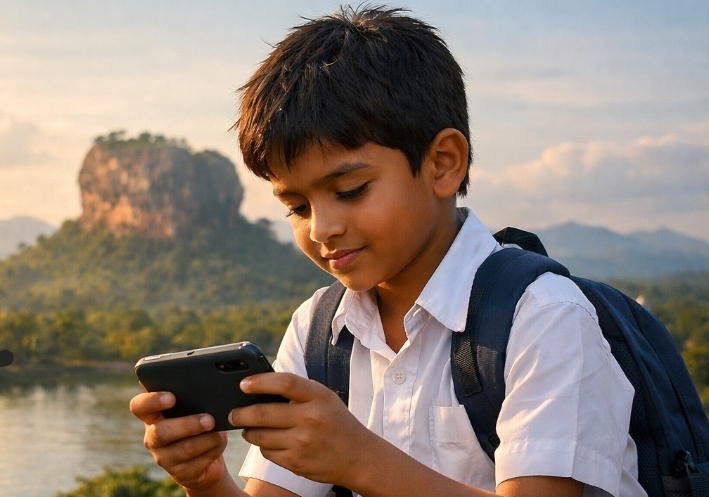
Sri Lanka is exploring a ban on social media and mobile phone use for children under the age of 12, following a growing global trend of governments intervening to protect young people from online risks.
The Minister for Women and Child Affairs, Savithri Paulraj, confirmed that the government is discussing proposals to curb digital exposure for the nation’s youth. The move targets both platform access and physical device ownership for younger children.
Mrs Paulraj first mooted the idea in October, suggesting that children under 12 should not own or use smartphones. Speaking to a group of students, she emphasised that the policy aims to safeguard children from “excessive screen time” and “harmful online content” while promoting face-to-face social development.
Sri Lanka plans to ban the use of smartphones by school children.
“We will take a decision that no child under 12 can get a phone,” said Child Affairs Minister Saroja Paulraj, speaking at a function attended by school children. 📵🇱🇰 pic.twitter.com/Wnq60e1UUL
— NewsWire 🇱🇰 (@NewsWireLK) October 26, 2025
While the proposals have sparked significant conversation across the island, they remain in the discussion stage. No formal legislation has yet been presented to the Cabinet.
- A global crackdown
The move places Sri Lanka within a widening circle of nations taking a “tough on tech” approach to parenting.
In late 2024, Australia passed landmark legislation banning social media for those under 16, a move that sent shockwaves through the tech industry. Similar debates are currently playing out across Europe:
* France and Norway have moved to strengthen age-consent rules.
* Spain and Denmark are exploring tighter controls on youth digital habits.
* India and Malaysia have recently discussed age-based limits to combat rising concerns over digital addiction and mental health.
- The case for intervention
Governments argue that current self-regulation by tech giants has failed. While platforms like TikTok and Instagram have nominal age limits—usually 13—critics say these are easily bypassed by children falsifying their birth dates.
Policymakers cite a growing body of research linking early, unsupervised social media use to:
* Increased rates of cyberbullying.
* Disrupted sleep and shortened attention spans.
* Exposure to predators and age-inappropriate content.
- Enforceability and ‘digital rights’
However, the proposal is not without its critics. Digital rights advocates and technology experts warn that outright bans are notoriously difficult to enforce and could drive children toward “darker,” unregulated corners of the internet.
There are also concerns regarding digital inequality. In a country where digital literacy is seen as a key economic driver, some educators worry that a blanket ban might hinder a child’s ability to navigate an increasingly tech-reliant world.
- What next?
Any formal policy in Sri Lanka will require a lengthy legislative process, including Cabinet approval and a technical framework for enforcement.
The government is expected to study the “Australian model” and other international examples before making a final decision. For now, the debate continues to divide opinion among parents and educators in Colombo and beyond. (Newswire)