

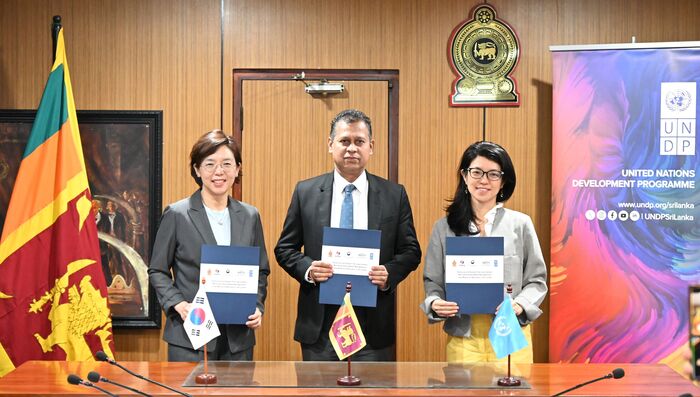
The Government of Korea and the United Nations Development Programme (UNDP) have launched a new $4.7 million initiative to improve municipal solid waste management in Sri Lanka, aiming to deliver low-carbon, inclusive, and climate-resilient solutions.
Funded by Korea’s Ministry of Climate, Energy and Environment through the Korea Environmental Industry and Technology Institute (KEITI), the three-year project—“Scale-up and Sustain the Low-Carbon Municipal Solid Waste Management and Resource Recovery in Sri Lanka”—will be implemented by UNDP Sri Lanka in collaboration with the Ministry of Public Administration, Provincial Councils and Local Government.
The project targets two local authorities in the Central and Sabaragamuwa provinces with demonstration sites in Gampola and Balangoda. Technologies such as anaerobic digestion, pyrolysis, and vermicomposting will be deployed to reduce over 269,000 metric tons of CO₂-equivalent emissions over a 10-year period.
Strategic waste management planning will also be expanded to four provinces—Northwestern, Central, Sabaragamuwa, and Southern—with a focus on decentralized systems, green financing, digital innovation, and gender inclusion.
Sri Lanka produces over 10,000 tons of municipal solid waste daily, with only half collected and minimal amounts properly treated. The initiative aims to address systemic gaps in technology, funding, and institutional capacity, especially in the wake of recent disasters like Cyclone Ditwah.
Korean and UNDP officials emphasized the project’s role in reducing emissions, strengthening local institutions, creating green jobs, and advancing Sri Lanka’s commitments under the Paris Agreement and Sustainable Development Goals. (Newswire)