

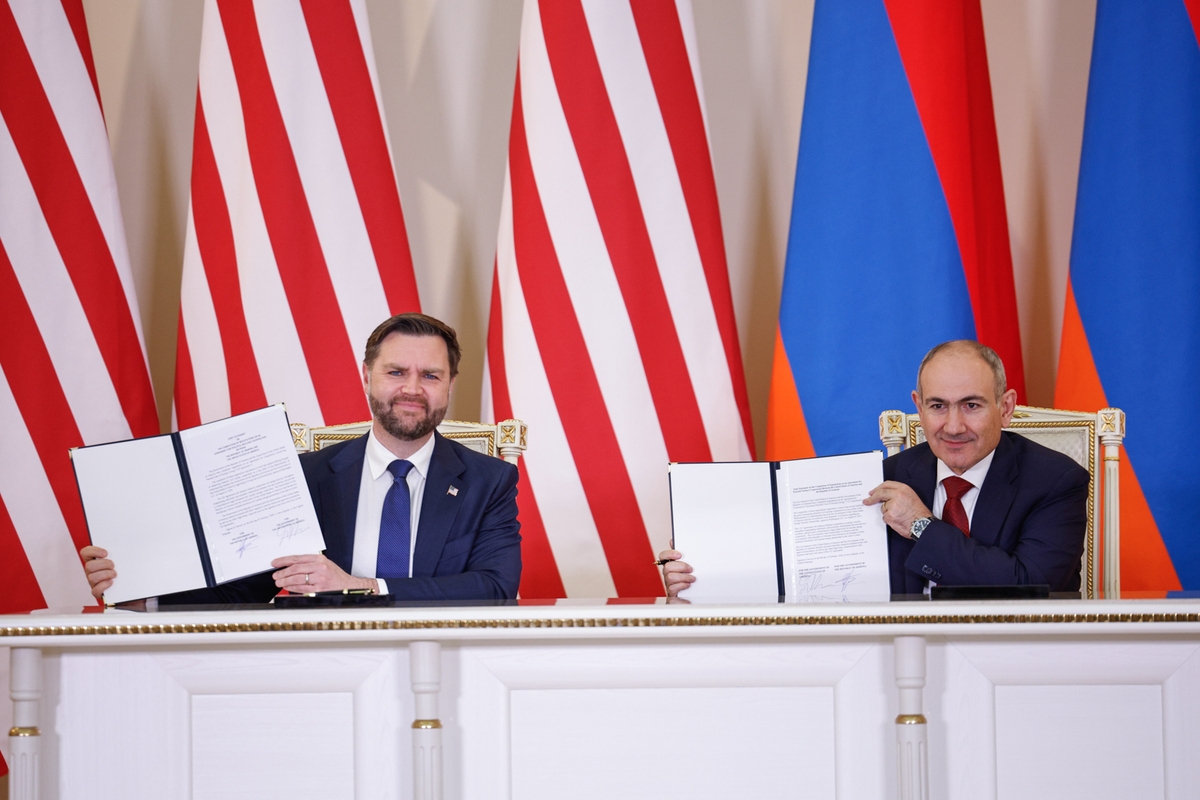
US Vice President JD Vance and Armenia’s Prime Minister Nikol Pashinyan have agreed to collaborate in the nuclear energy sector.
The two leaders said they completed negotiations on Monday on what is known as a “123 Agreement.”
What do we know about the nuclear deal between the US and Armenia?
123 Agreements allow the United States to license nuclear technology and equipment to other countries.
The deal relates to small modular reactors, Vance said after meeting Pashinyan in the capital, Yerevan.
The agreement would allow up to $5 billion (€4.2 billion) in initial US exports to Armenia, plus an additional $4 billion in longer-term fuel and maintenance contracts, according to Vance.
Nuclear diplomacy: Can the world catch up with Russia?
Armenia is seeking an alternative to its ageing Russian-built nuclear power plant, Metsamor.
The new US agreement doesn’t bind Armenia to purchasing a nuclear reactor from the US.
Rather, it gives Armenia the possibility of selecting the US from a list of options, which also includes Russian, Chinese, French and South Korean companies.
Vance also said the US was ready to export advanced computer chips and surveillance drones to the former Soviet republic.
US seeking to finalize Armenia-Azerbaijan peace agreement
Vance’s visit comes just six months after Armenian and Azerbaijani leaders signed an agreement at the White House in August 2025.
The deal was seen as the first step towards peace after nearly 40 years of war.
Speaking to reporters before meeting Pashinyan on Monday, Vance said, “The prime minister has been a great friend of ours and a real ally in peace and development in this region [of] the world.”
As for Pashinyan, he thanked both Vance and US President Donald Trump and said that Armenia and neighboring Azerbaijan are “very close” to achieving peace after decades of conflict.
US pushing for strategic transit corridor through Armenia
Vance was also advocating for the establishment of a major rail and road transit corridor through Armenia. Dubbed the Trump Route for International Peace and Prosperity, or TRIPP, the corridor would connect Azerbaijan with its Nakhchivan exclave.
The transit route in particular has been a major source of contention between Armenia and Azerbaijan.
The two nations have been in conflict over the Karabakh region, internationally known Nagorno-Karabakh, for nearly 40 years. Ethnic Armenian forces controlled the area from 1994 until 2020, when Azerbaijan regained control after a six-week war.
In September 2023, Azerbaijan launched a subsequent attack that dislodged separatists and forced most of Karabakh’s 120,000 Armenians to flee for safety.
Both sides agreed to renounce claims on each other’s territory as well as refraining from using force during their meeting with Trump, who promised that the new transit project would bring peace and prosperity to both nations.
Spooked by Russia aggression, Caucusus countries turn to US, EU
Vance will travel to Azerbaijan on Tuesday for further meetings.
The visit comes at a time in which former Soviet states like Armenia and Azerbaijan are drifting away from Russia’s sphere of influence in the aftermath of its war on Ukraine.
This has left the door open for the US to expand its diplomatic and economic footprint in the geopolitically important Southern Caucasus region, which neighbors Iran and Turkey.
Armenia, for instance, has frozen its security pact with Russia and instead sought to deepen ties with the US and the European Union. (DW)