

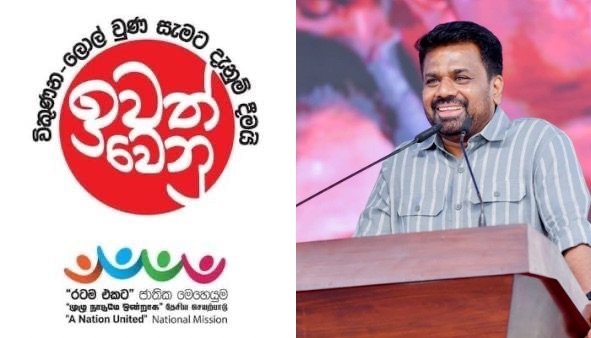
Emphasising that no country where the rule of law has collapsed has achieved development, and that in such countries power falls into the hands of criminals, the President Anura Kumara Dissanayake stated that the current government is committed to building a nation where the supremacy of the rule of law is firmly established, and that the year 2026 will be one that gives real meaning to the principle that all are equal before the law.
President Anura Kumara Dissanayake made these remarks this afternoon (11) while participating in the Central Province programme of the “A Nation United” national campaign to eradicate the drug menace, held in Nuwara Eliya.
The President emphasised that the objective of the current government is to build a country where the suffering endured by this generation is not inherited by its children and to create a nation where no child becomes a victim of the drug crisis.
Stressing that no one has a moral right to remain a passive observer in this effort, the President stated that he personally assures his commitment and called upon religious leaders, the political leadership, the security forces and the general public alike to unite in fulfilling the responsibilities entrusted to all.
To eradicate the drug menace, which has become a national disaster, the “A Nation United” national campaign is being implemented with national-level political leadership, an effective decision-making mechanism and broad public participation. Under this programme, society is being made aware of the menace through an extensive awareness campaign, networks linked to drug trafficking are being dismantled, rehabilitation facilities are being strengthened and opportunities are being provided for those willing to withdraw from drug use.
Identifying the drug menace as a major social issue faced by the entire society including Malayagam community, the Central Province programme has been designed with the aim of freeing them from this threat through a comprehensive, multi-stakeholder awareness mechanism and uplifting them socially and economically.
Since the launch of the “A Nation United” national campaign, more than 91,000 suspects connected to drug trafficking have been arrested. Investigations into over one hundred illegal assets have been initiated, 1,818 suspects have been detained under detention orders for long-term investigations and approximately 1,566 individuals have been referred for rehabilitation.
In appreciation of the active contribution made by the Sri Lanka Police during this short period, 62 police officers serving in the Nuwara Eliya District were commended by the President at the event.
Further elaborating on the matter, President Anura Kumara Dissanayake stated:
All of us gathered here shoulder different responsibilities. Whatever profession we may be engaged in, we all have expectations for this country and hopes for the future of our children. We must transform our country into one that is better than it is today. We must create a better future for our children. That is the responsibility and expectation entrusted to all of us. On this journey, we must achieve success in several areas. First and foremost, we must build a strong and resilient economy.
We know the kind of economy our country inherited. For thirty years, we spoke of the war and claimed that it caused the collapse of our economy. However, the economy collapsed around thirteen years after the war ended. So was the real cause the war itself? I do not think the real cause was the war alone. The economic policies pursued by our country, together with the fraud and corruption associated with them, were the factors that led to this economic crisis.
We often tried to attribute the economic crisis to various causes, at times the war, at times natural disasters, and at times pandemics. There is a history of attempting to assign responsibility for this economic collapse to different factors. However, we must build an economy capable of withstanding any situation.
You may recall that recently, when tensions arose between Pakistan and India, some believed our country would collapse. Then, when tensions emerged in the Middle East, it was again thought that our economy would fail. When the United States introduced tax measures affecting us, people assumed the economy would collapse. When Cyclone Ditwah struck, it was also believed that our economy would be destroyed. Yet, we are working with the aim of building an economy that remains resilient in the face of all such situations.
In particular, in the face of Cyclone Ditwah, we formulated strong fiscal and economic policies to ensure that the economy moved forward rather than backwards. According to current World Bank reports, the damage caused to our economy by Cyclone Ditwah amounts to approximately 4.1 billion US dollars. Destruction worth around 1.2 trillion rupees has been reported, which is about four per cent of our Gross Domestic Product. We were able to build an economy capable of absorbing this destruction without causing a major shock. We have allocated over Rs. 500 billion for reconstruction following Cyclone Ditwah. We did not borrow a single cent for this. We did not print money. Our Treasury account held around Rs. 1200 billion and from that we allocated Rs. 500 billion for this purpose. We still have a long way to go. We are rebuilding this country in the direction of establishing a strong economy.
Secondly, we expect our country to move towards a sound and strong foreign policy. We know that although the world appears peaceful on the surface, beneath it lies a world filled with contradictions and conflicts. There are wars over the division of markets. In this conflict-ridden world, we are working towards a none-aligned foreign policy that safeguards our stability without aligning ourselves with any side. This is an important factor in rebuilding our country.
Likewise, to rebuild the country, we need a strong public service. We are making every possible effort to establish a highly developed and robust public service. This includes digitalisation and the provision of essential facilities, including vehicles. By providing all these, we must build an efficient public service. The public service must be made an attractive place to work. We have implemented the highest-ever salary increase for the public service. We are spending Rs. 330 billion solely on salary increases. Our aim is not only to make the public service attractive but also to ensure that public servants are able to lead satisfying lives.
The state machinery is a vital factor in the survival of our country. Likewise, the police and the tri-forces are key pillars of the nation’s existence. I am aware that there are issues regarding your allowances. The food allowances for members of the armed forces and the risk allowance for police officers are all currently under review. Please give us a little time. After implementing the third salary increment in 2027, we will carefully examine the budget and consider the provision of the remaining allowances.
At the same time, we must firmly establish the supremacy of the rule of law in our country. When a citizen suffers an injustice, they go to the police expecting fairness. They go to the courts seeking justice in the face of injustice. To ensure that justice is delivered in the face of injustice, the supremacy of the rule of law must be upheld. This is extremely important in our journey towards rebuilding the country. Therefore, we are committed to strengthening the rule of law. There is a common saying that the law is like a spider’s web: small creatures get caught, while large ones escape. This has been the public perception of the law. However, if we are to build a nation, we must give real meaning to the principle that all are equal before the law.
It must not be allowed for the belief to take root that power or wealth can enable someone to evade the law. At the same time, people must have confidence that the law will be enforced regardless of wealth or power. Everyone must be subject to the law. There must be a sense of respect and fear of the law. Therefore, we will make the year 2026 one that truly gives life to the principle that everyone is equal before the law. No country in which the rule of law has collapsed has ever achieved development. Where the law breaks down, criminals rise to power.
We want a country where the suffering we endured is not passed on to our children. We want a country where our children do not have to face the crises that we faced. In that context, the main threat we face is illicit drugs. Today, illicit drugs have spread across villages and towns. When drugs take hold, the first victim is the child who becomes addicted. This disaster does not stop there. Crime begins to rise. The shootings that took place in recent times are driven by competition over control of the drug market. We cannot allow this situation to continue to grow.
We must therefore build a country where no child falls victim to the menace of drugs and a society where no mother or family is left to suffer as a result. We hold a strong and genuine hope for such a future. This menace does not end there, it gives rise to crime. The shootings that have occurred in various places in recent times are driven by competition to control and divide the illicit drug trade.
Illegal narcotics have fuelled the emergence of armed criminal groups. As a result, our children are being drawn into dealings involving illegal weapons. This does not stop there. These networks accumulate vast amounts of wealth, with large sums of money circulating within them. Some weak and compromised state officials fall prey to this money. In the end, this financial power erodes and undermines the state machinery itself. And it does not end there either. These groups then begin to enter politics. Some local government chairpersons have been directly linked to criminal activity. Others use this illicit money to form political parties. We have reached a dangerous point where political power risks becoming intertwined with drug-linked criminal networks. There are politicians who have provided protection and patronage to drug traffickers. If this is allowed to continue, before long, drug traffickers themselves will become politicians. In connection with this, several local government councillors have already been arrested. This situation cannot be allowed to grow any further.
As President, I, and indeed all of you as well could have chosen to look away and say that this was something beyond our control. But this crisis now threatens to spread across the entire nation, sparing no village, no home, no family. In such a situation, we must confront it head-on. None of us has the moral right to stand aside and remain indifferent. To defeat this menace, the involvement of everyone is essential. I can give my personal assurance on this matter. In the same way, our religious leaders, our government, are united in a firm and unwavering resolve. Our state officials, the Inspector General of Police and the entire law enforcement apparatus are aligned and working together with a single purpose. What we now need is the support of the public. Those who sell drugs in our villages are no longer hidden figures, they operate openly within society. Yet they spread fear among the people and have even intimidated our prison officers. We have already put plans in place to put an end to this. For those plans to succeed, public support is essential.
We respect democracy and human rights. Above all, however, we are accountable for safeguarding the lives and security of our people. Therefore, we are prepared to take decisive action. Across the country, public security committees have been established at the Grama Niladhari level. At village level, all of us must come together. Those most affected by this crisis are our children. None of them were born with the intention of becoming victims of drugs; rather, our society failed to protect them from falling into this trap. As such, this places an inescapable responsibility on all of us. We must therefore be ready, collectively, to fulfil our respective responsibilities. As the political authority, together with the Police and the three Armed Forces, we must rise as one force against this menace. This requires a sustained, long-term strategy over several years. We must disrupt the routes through which drugs enter the country. The Navy is carrying out this task with great dedication. At the same time, the distribution networks on land are being dismantled, with the Police playing a major role through continuous raids and operations. Many drug traffickers are currently based overseas, some of them have already been apprehended. At the same time, those who have fallen victim must be rescued. Funds have been allocated in this year’s Budget to establish rehabilitation centres across the country. In addition, a National Council has been formed with the involvement of the Maha Sangha and religious leaders. We must strive to restore to those affected by drugs the lives that rightfully belong to them.
At this moment in time, it is for us who are living through this crisis, and who understand its true danger, to recognise that we must protect our children from it. If those of us who are aware and concerned do not step forward now, then who will? This responsibility rests with us. Therefore, let us come together and defeat this menace, united.
I firmly believe that our Buddhist clergy and religious leaders have been entrusted with a vital role in this effort. If just five to ten minutes of your sermons are devoted to conveying a message to society about this menace, we can build a strong and powerful public conscience. Likewise, if schoolteachers and principals take this message to the wider community, it can take root as a shared social conviction. Therefore, this must not remain a responsibility of the Government, the Police or the Armed Forces alone, it must become a collective responsibility of society as a whole. We can defeat this menace, but only if we stand together. I therefore urge everyone not to remain passive, but to actively join in the effort to overcome this crisis.
We are a government that has completely withdrawn political protection once afforded to drug traffickers. We have granted the Police and the Armed Forces full freedom to carry out this task. There are no drug dealers or traffickers for us to shield or protect. Therefore, I urge you to act in accordance with your professional integrity, the responsibility of your position and your duty. We will provide you with all the protection and independence necessary to carry out this responsibility.
Dr Arumugam Jeyarajan delivered the keynote address on this occasion, while Manjula Suraweeraarachchi, Chairman of the Nuwara Eliya District Coordinating Committee, also expressed his views.
The event was attended by senior dignitaries including the Central Province Chief Sangha Nayaka and religious leaders, Minister of Public Security and Parliamentary Affairs Ananda Wijepala, Deputy Minister of Education and Higher Education Madhura Senevirathna, Governor of Central Province Prof. Sarath Abayakoon, Secretary to the Ministry of Defence, Air Vice Marshal Sampath Thuyacontha (Retd), Secretary to the Ministry of Public Security Ravi Seneviratne, Inspector General of Police Priyantha Weerasuriya, senior officers of the security forces, District Secretary R.A.D.T.N. Tennakoon, other government officials and a large gathering of local residents.
President’s Media Division (PMD)
11.02.2026