

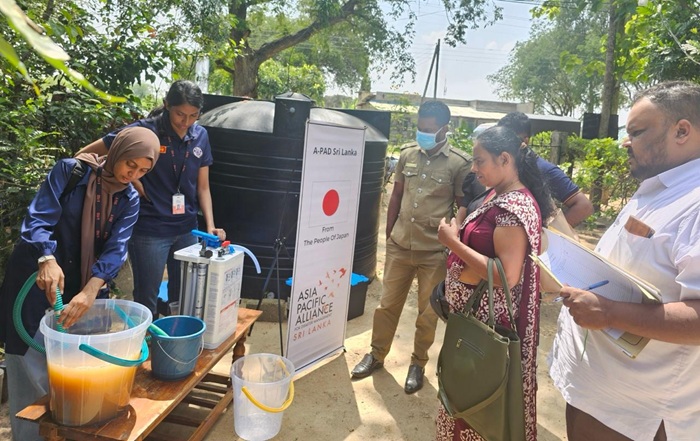
Reliable access to safe drinking water has been restored in cyclone-hit communities of Puttalam and Nuwara Eliya, through targeted interventions by the Asia Pacific Alliance for Disaster Management Sri Lanka (A-PAD SL) and its international partners.
According to the Asia Pacific Alliance for Disaster Management, Sri Lanka, in the aftermath of Cyclone Ditwah, access to safe drinking water quickly emerged as one of the most urgent humanitarian needs across Sri Lanka. Floodwaters contaminated water sources, disrupted supply systems, and left thousands of families, schools, and communities vulnerable to water-borne diseases during a critical period of recovery.
Responding to this need, the Asia Pacific Alliance for Disaster Management Sri Lanka (A-PAD SL), together with international partners, implemented targeted water security interventions in Puttalam and Nuwara Eliya districts, restoring reliable access to safe drinking water for vulnerable populations.
In Puttalam, A-PAD SL implemented a household and community water intervention in the Karuwalgaswewa Divisional Secretariat Division of Puttalam District, one of the areas hardest hit by flooding. With the generous donation of family and community water filters from Aquabox, and logistical coordination provided by Airlink, A-PAD distributed 360 family water filters to flood-affected households and installed 20 community filtration units at schools and public gathering centres. Each community unit can serve up to 400–500 people daily, contributing to sustained access to safe drinking water for communities.
In the Nuwara Eliya District, A-PAD SL partnered with Wine to Water, with logistical support from Airlink, to distribute 500 DROP water filters to schools across the Divisional Secretariat divisions of Nuwara Eliya, Walapane, Nildandahinna, and Kotmale. Post-cyclone assessments identified schools as priority locations, where limited access to clean water placed students and teachers at heightened health risk. Ensuring safe drinking water within schools not only protects health but also supports educational continuity, creating safer learning environments as communities recover. Training sessions with principals, teachers, and students ensured sustainable use and long-term impact.
The initiatives were carried out in close coordination with the Disaster Management Centre (DMC), the National Disaster Relief Services Centre (NDRSC), and local government authorities, whose support enabled efficient delivery of humanitarian assistance.
Through strong partnerships and community engagement, A-PAD SL continues to advance early recovery efforts – ensuring that access to safe water remains a foundation for health, dignity, and long-term disaster resilience. (Newswire)