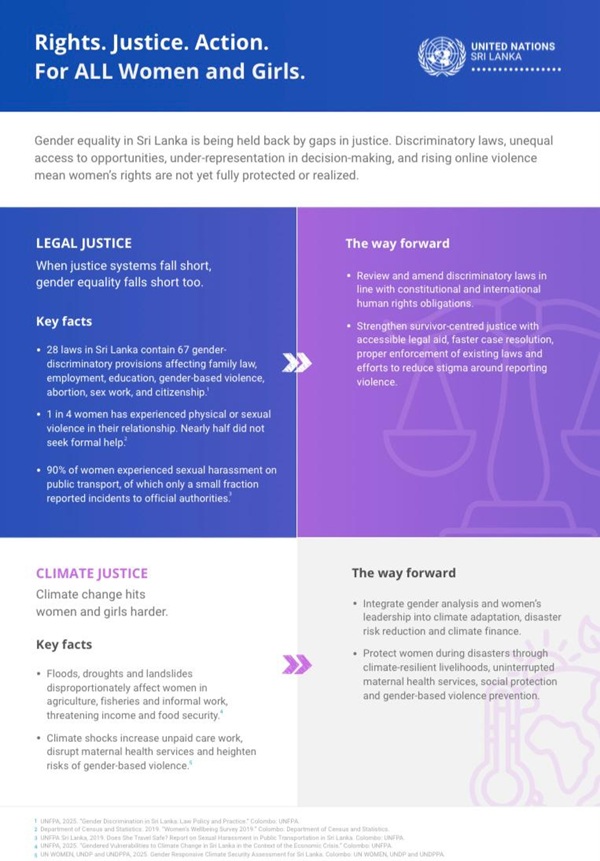

Ahead of International Women’s Day, the United Nations in Sri Lanka has released a factsheet outlining key challenges faced by women and girls in the country.
Under the theme “Rights. Justice. Action. For ALL Women and Girls”, the UN calls for closing the gap between legal rights and lived realities.
The overview highlights shortcomings in legal protections, climate impacts, economic participation, leadership, and digital access, stressing that gender equality continues to be held back by gaps in justice.
Legal Justice
- 28 laws contain 67 gender-discriminatory provisions affecting family law, employment, education, gender-based violence, abortion, sex work, and citizenship.
- 1 in 4 women has experienced physical or sexual violence in relationships; nearly half did not seek formal help.
- 90% of women have faced sexual harassment on public transport, with only a small fraction reporting incidents.
Climate Justice
- Floods, droughts, and landslides disproportionately affect women in agriculture, fisheries, and informal work.
- Climate shocks increase unpaid care work, disrupt maternal health services, and heighten risks of gender-based violence.
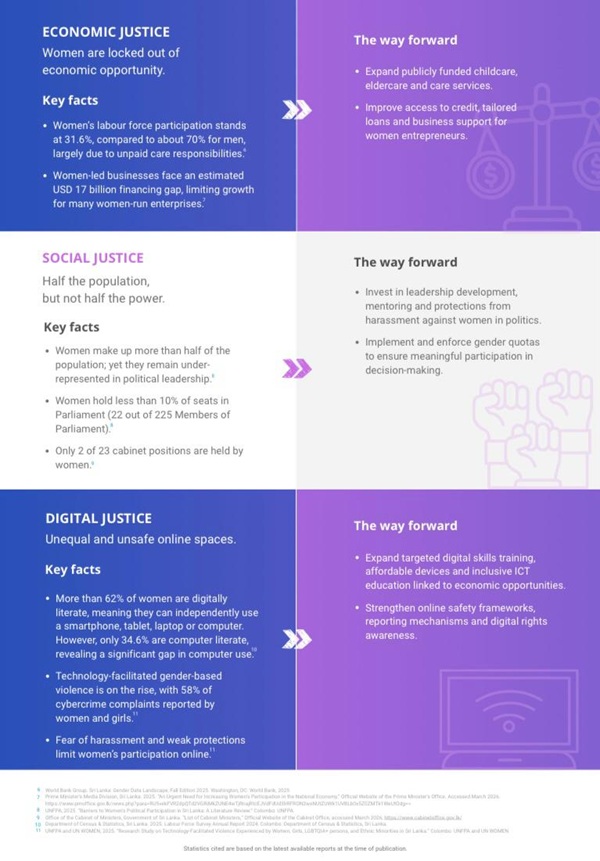
Economic Justice
- Women’s labour force participation is 31.6%, compared to about 70% for men, largely due to unpaid care responsibilities.
- Women-led businesses face an estimated USD 17 billion financing gap, limiting growth opportunities.
Social Justice
- Women make up more than half of the population but remain underrepresented in leadership.
- Less than 10% of seats in Parliament are held by women (22 out of 225 MPs).
- Only 2 of 23 cabinet positions are occupied by women.
Digital Justice
- 62% of women are digitally literate, but only 34.6% are computer literate, showing a significant gap.
- Technology-facilitated gender-based violence is rising, with 58% of cybercrime complaints reported by women and girls.
- Fear of harassment and weak protections limit women’s participation online.
The UN stresses that closing these justice gaps is essential to fully realizing women’s rights in Sri Lanka, urging stronger action across legal, social, economic, and digital spheres. (Newswire)