

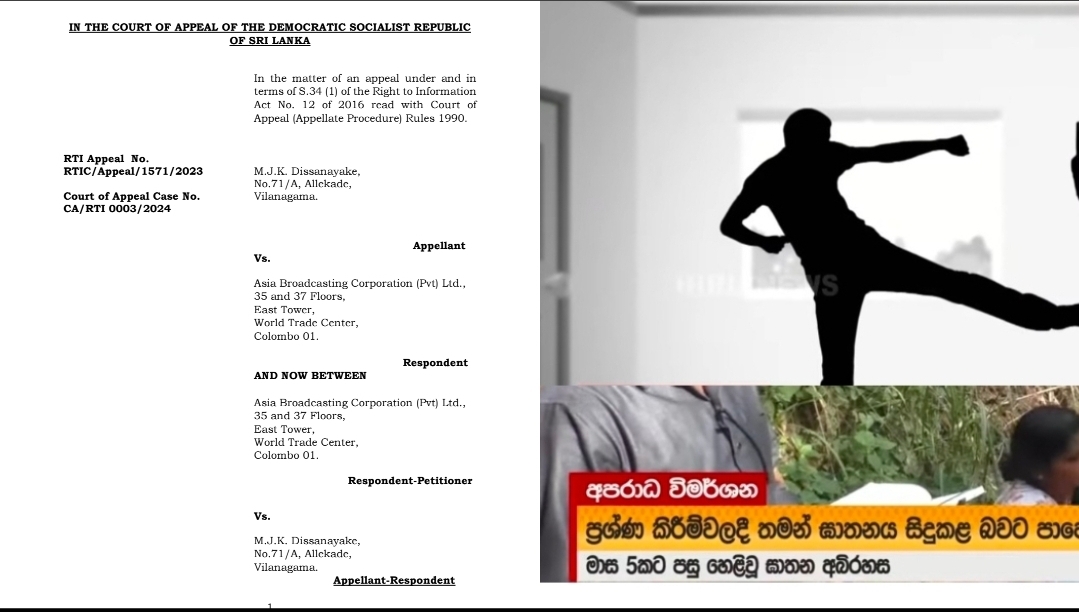
Sri Lanka’s Court of Appeal has upheld a ruling by the Right to Information (RTI) Commission that private television broadcaster Hiru TV falls within the scope of a “public authority” under the RTI Act and must disclose certain information requested under the law.
Delivering the judgment, the Court of Appeal noted that private television channels perform an important public function and are accountable not only for profit but also for the public interest.
The court said that broadcast frequencies are public property and therefore private media institutions using them must ensure accurate reporting and transparency.
The case arose after a woman sought information from Asia Broadcasting Corporation (Pvt) Ltd., which operates Hiru TV, regarding a news report aired on August 23, 2023 claiming that her son had confessed to a murder following his arrest.
According to the application, the news item titled “Alawathugoda murder mystery revealed – husband remanded” was broadcast during Hiru TV’s 6.55 p.m. and 10.00 p.m. news bulletins.
The woman later contacted the television channel requesting a correction, stating that the report was false. After receiving no response, she filed a request for information under the Right to Information Act on September 19, 2023 seeking details about the report.
When no response was received, she appealed to the designated RTI officer of the institution and subsequently filed an appeal with the RTI Commission on November 29, 2023.
Following an inquiry, the RTI Commission ruled on July 20, 2024 that Hiru TV qualifies as a public authority under the RTI Act. However, the Commission stated that information that could reveal journalistic sources need not be disclosed.
The Commission ordered that certain information be released, including whether the news report had been independently verified by the news editor and news director prior to broadcast, and the names of the individuals who served as news editor and news director for the two bulletins aired on August 23, 2023.
Hiru TV challenged the decision in the Court of Appeal, arguing that Asia Broadcasting Corporation is a private company operating for profit and therefore does not fall within the definition of a public authority under the RTI Act.
The Court of Appeal, however, dismissed the appeal and affirmed the RTI Commission’s decision.
The bench comprising Court of Appeal Judges R. Gurusinghe and Dr. Sumudu Premachandra held that private media institutions operating with broadcasting licences are subject to public interest obligations.
The court further observed that the public has a right to know whether information broadcast through public airwaves has been properly verified.
It also stated that the right to information forms part of the freedom of expression guaranteed under the Constitution and that access to information can only be restricted under the specific limitations set out in Section 5 of the RTI Act.
The Court of Appeal accordingly rejected the appeal filed by Hiru TV with costs and upheld the decision of the RTI Commission requiring the disclosure of the specified information. (Newswire)
Detailed Sinhala report on the judgment and the full copy of the Court of Appeal ruling can be found in the link below
මාධ්ය නාලිකාවලට බොරු කියන්න බෑ – හිරුට තරු පෙන්වූ සම්පූර්ණ තීන්දුව