

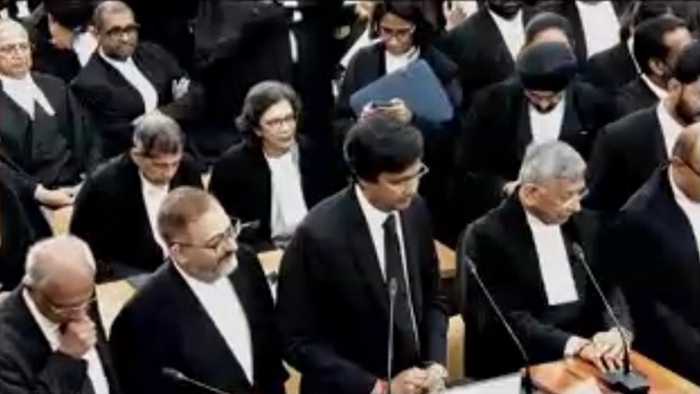
President of the Bar Association of Sri Lanka (BASL), Rajeev Amarasuriya, addressed the Supreme Court of India on Tuesday (10), marking a momentous occasion in contemporary history that members of the Sri Lankan Bar have formally appeared before India’s apex court as part of an official delegation.
In a statement, Amarasuriya expressed appreciation to the Chief Justice of India, His Lordship Justice Surya Kant, for the invitation, which was extended together with Supreme Court Justices R. Mahadevan and Joymalya Bagchi.
The Chief Justice warmly welcomed the Sri Lankan delegation, recalling his visit to Colombo in August last year and the ties between the two nations.
The event was attended by Attorney General of India R. Venkataramani, Solicitor General Thushar Mehta, President of the Bar Association of India Prashant Kumar, and the President of the Supreme Court Advocates Association, who all joined in welcoming the Sri Lankan representatives.
Full statement of BASL President Rajeev Amarasuriya:
My Lord the Chief Justice, His Lordship Justice Surya Kant, Supreme Court Justices Your Lordship Justice R. Mahadevan, Your Lordship Justice Joymalya Bagchi, Honourable Attorney General R. Venkataramani, Honourable Solicitor General Thushar Mehta, President and Office-bearers of Bar Association of India and the other Law Associations.
Distinguished Members of the Indian and Sri Lankan Bars,
On behalf of the Bar Association of Sri Lanka, the representative body of Attorneys-at-Law in Sri Lanka, it is my honour and privilege to extend warm greetings from Sri Lanka to Your Lordship the Chief Justice, to Your Lordships of the Supreme Court of India, and to our friends and colleagues of the Indian Bar.
Today marks a historic and meaningful moment for our two jurisdictions, jurisdictions that are closely connected not only by geography, but by centuries of shared history, common culture, and a long tradition of legal and constitutional development.
In my understanding, this is the first occasion, at least in the contemporary past, on which members of the Sri Lankan Bar have come before the Supreme Court of India in official delegation, as part of a structured exchange of thought, ideas, and professional engagement.
That alone makes this gathering a significant milestone in the continuing relationship between our two Bars and our two legal systems.
On a personal note, I also had the privilege of extending our warmest welcome to Your Lordship the Chief Justice on the 23rd of October last year, when Your Lordship visited Sri Lanka and joined the Bench of our Supreme Court.
During that memorable visit, Your Lordship delivered the Inaugural Bar Association of Sri Lanka Human Rights Oration on the theme “Strengthening a Legal Aid System to Achieve Human Rights of Marginalised and Minorities: The Indian Case Study.”
Your Lordship also honoured us by delivering the Keynote Address at the Inauguration of the Bar Association of Sri Lanka National Law Conference.
It is particularly memorable for us that during that same visit to Colombo, Your Lordship was formally nominated to be the 53rd Chief Justice of India. It is therefore a singular honour for me today to have the privilege of addressing Your Lordship, the distinguished Bench, and the members of the Indian Bar before this august Supreme Court of India.
This moment reaffirms the deep and enduring friendship between our two legal systems, systems that have evolved in parallel, influenced by common legal traditions, similar constitutional frameworks, and a shared commitment to the rule of law, judicial independence, and democratic governance.
But the connections between our two countries go far deeper than the legal and constitutional spheres. They are rooted in a civilisational relationship that spans over two thousand years.
More than two millennia ago, the message of Buddhism travelled from India to Sri Lanka through the historic mission of Arahat Mahinda Thero, the son of Emperor Ashoka.
That moment changed the course of Sri Lankan history and shaped the moral and philosophical foundations of our civilisation. The sacred Bo Sapling brought from Bodh Gaya and planted in Anuradhapura still stands today as one of the oldest living symbols of that enduring connection between our two nations.
Through centuries of cultural, intellectual, and spiritual exchange, the bonds between India and Sri Lanka have continued to deepen. These connections are not merely historical, they remain living and vibrant in the institutions, traditions, and values that continue to guide our societies.
In many ways, the values that flow from that shared heritage of compassion, fairness, balance, respect for truth, and the pursuit of justice are also values that lie at the heart of our legal traditions.
Today, as members of the legal profession from both our countries gather here in a spirit of friendship and cooperation, we continue that long tradition of exchange, not only of culture and ideas, but also of jurisprudence, professional learning, and institutional dialogue.
Our courts have often looked to each other’s jurisprudence. Our lawyers have learned from each other’s experiences. And our legal institutions have developed with an awareness that the rule of law is strengthened when legal communities engage across borders in a spirit of mutual respect and shared purpose.
It is my sincere hope that engagements such as this will further strengthen the relationship between the Bench and the Bars of our two countries, deepen professional collaboration, and contribute to the continued advancement of justice and the rule of law in our region.
May the friendship between the legal communities of India and Sri Lanka continue to grow stronger in the years ahead.
Thank you very much. (Newswire)