


The fuel QR code app’s relaunch: A capture of public commentary, and what it reveals about Sri Lanka’s readiness for digitalisation
By Dr Sanjana Hattotuwa
The Sri Lankan government started to ration fuel on Sunday morning. On Twitter alone, this resulted in considerable chatter around both the need for such a system, and very serious problems associated with the re-launch of a platform that was first developed, and deployed in August 2022.
In order to get a sense of public sentiment at a greater scale, I studied 4,000+ comments in Sinhala,and English linked to five posts on Facebook:
1. ඉන්ධන ලබා ගැනීමට QR කේතය ගන්නා ආකාරය මෙන්න.. Ada Derana Sinhala, 2,300 comments
2. ඉන්ධන ලබා ගැනීමට QR කේතය සකසා ගන්නා ආකාරය මෙන්න.. Newsfirst, 1,400 comments
3. The Ministry of Energy has announced the reimplementation of the National Fuel Pass system using QR codes, effective from 6.00 a.m. on March 15, in response to supply disruptions caused by the ongoing conflict in the Middle East and a sharp rise in domestic fuel demand. Newsfirst English, 223 comments.
4. The QR code process for obtaining fuel quotas through the National Fuel Pass system has now been fully restored and is currently operating normally. The public is hereby informed that the system is functioning at present. Newswire, 46 comments.
5. Notification on the Restoration of the National Fuel Pass (QR) System and the Fuel Distribution Process. Government Information Department, 37 comments.
The launch of the QR code app on Sunday morning overwhelmingly, in the comments studied, resulted in frustrated resignation, and the grudging acceptance that fuel rationing is necessary, coupled with adeep irritation at the government’s execution of it.
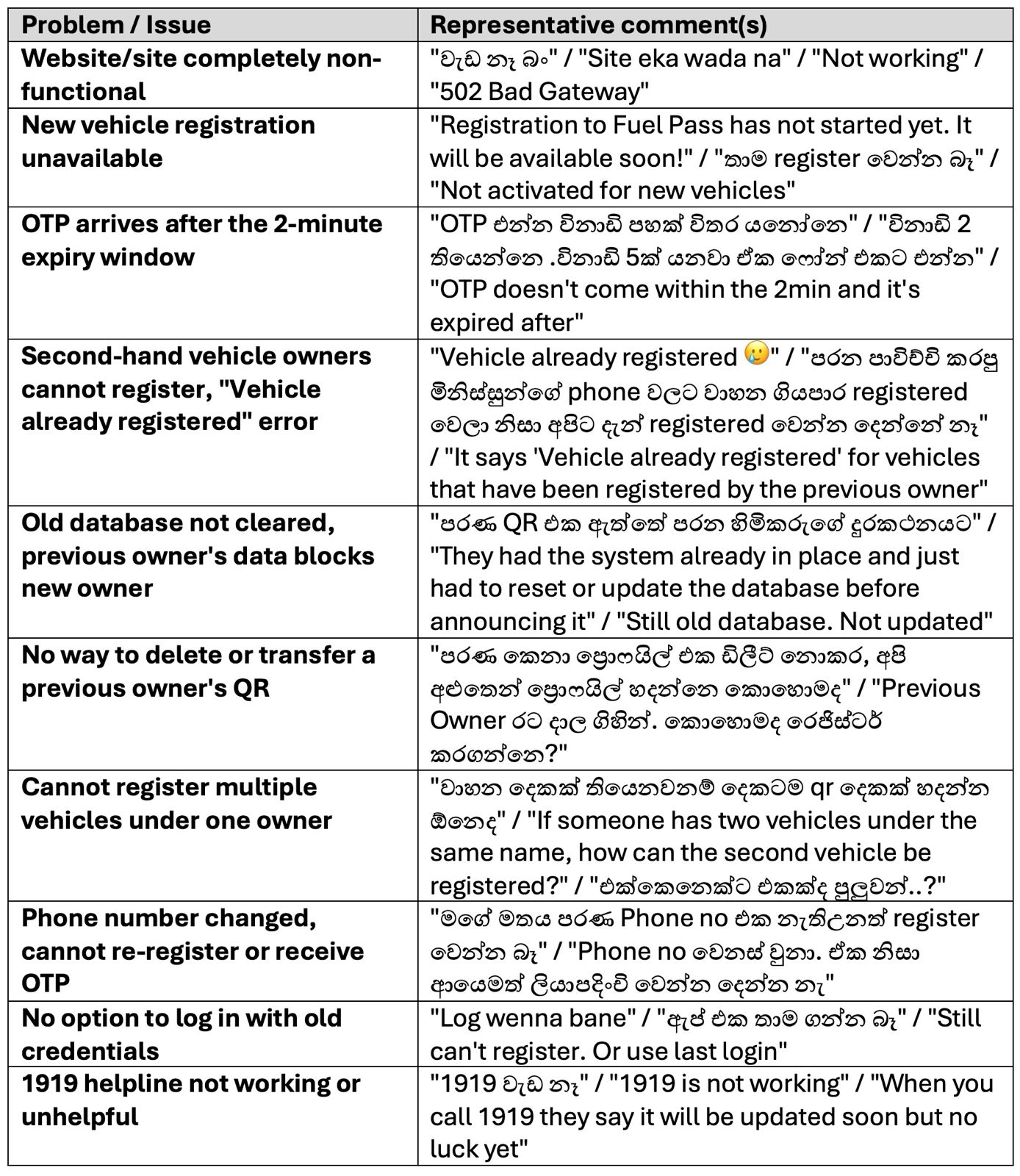
This frustration is evident in the hundreds of comments reporting that the NFP website (https://fuelpass.gov.lk) does not work, that registration for new vehicles remains unavailable, that OTPs arrive after the two-minute window expires, and that second-hand vehicle owners cannot register because the previous owner’s data has not been purged from the database. Comments like “Registration to Fuel Pass has not started yet. It will be available soon!” appear verbatim, often screenshotted and posted with exasperation. The gap between announcement and functionality, with the government telling citizens to register from 6 a.m. while the system remained offline well past midday, generates the most anger across every account, in both Sinhala and English.
There’s also a lot of schadenfreude directed at NPP/JVP supporters (referred to variously as “ජෙප්පො,” “ජෙප්පන්,” “බයියෝ,” “ඩෝබිලා,” and “මාලිමාව”). The core argument is that the current government has been forced to implement the very same QR system it mocked and attacked when Kanchana Wijesekera introduced it under the Ranil Wickremesinghe administration (and discontinued in September 2023). The phrase “දිට්ඨධම්ම වේදනීය කර්මය” (karmic retribution experienced in this very lifetime) appears repeatedly across multiple accounts as the key narrative frame for this perceived hypocrisy.
It’s not all anger, and partisan rhetoric. There’s also more considered, pragmatic support for the reintroduction of the quotas, and the QR app system itself. Many acknowledge that fuel rationing through a QR mechanism is sensible management during a global supply crisis. Comments such as “මේක මුළු ලෝකෙටම තියෙන ප්රශ්නයක්” (this is a problem for the entire world) and “ලෝකයේ හැම රටක්ම ඉන්ධන අරපිරිමැස්ම ගැන පියවර ගනිද්දි” (while every country in the world is taking fuel conservation measures) attempt to reframe the conversation away from hyperpartisan blame. Several explicitly credit former MP Kanchana Wijesekera for having originally built the system (which is erroneous, and conflates the minister in charge at the time with the platform’s actual developers), with some stating that without t/his prior work, the current government would have had nothing to deploy. The sentiment here is conditional approval: the system is good in principle, but the implementation remains very poor.
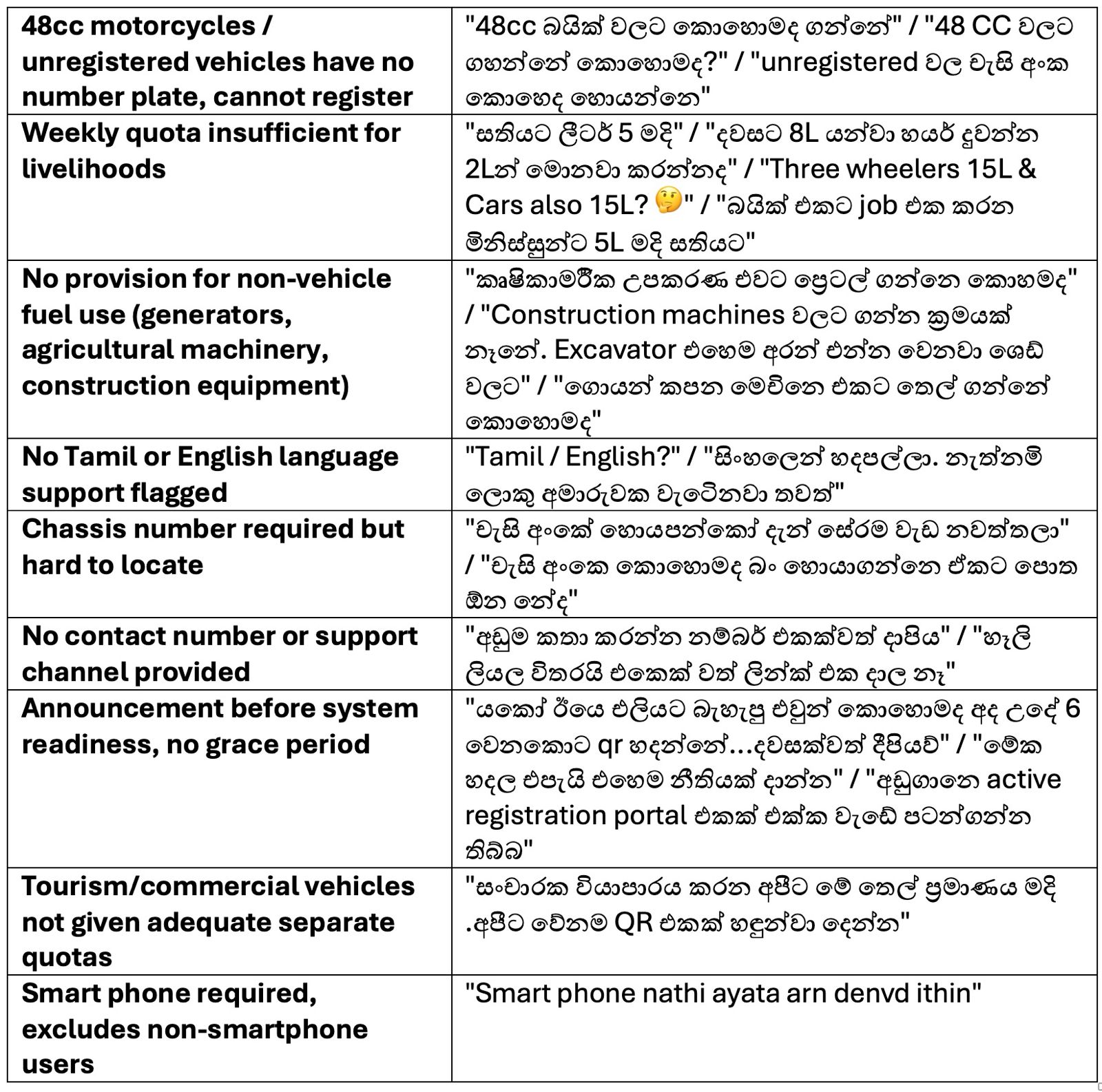
There’s a lot of disquiet registered regarding the (perceived) inadequacy of fuel quotas. Motorcycle riders, courier and delivery workers, three-wheeler operators, and those commuting long distances to work repeatedly point out that five litres per week for a motorcycle or fifteen for a car is wholly insufficient for their livelihoods. The complaint is not abstract: commenters calculate distances, fuel consumption rates, and work schedules to demonstrate the shortfall. “දවසට 8L යන්වා හයර් දුවන්න 2Lන් මොනවා කරන්නද” (I use 8L a day doing hire, what am I supposed to do with 2L?) captures the tone precisely. Tourism operators flag that their vehicle allocations cannot sustain their businesses. There is a distinct anxiety here about economic survival that sits beneath the political theatre, and related rhetoric across the posts/comments studied.
Contempt for perceived government incompetence is most evident in the English-language comments on NewsFirst English and Newswire, though it also appears across all accounts. These comments tend to be more specific in their technical criticisms: the database has not been updated, vehicle ownership transfers are not reflected, the system throws “vehicle already registered” errors, the 1919 helpline does not work, and no one has addressed the problem of multiple vehicles under a single owner. The Government Information Department’s trilingual post on Facebook draws the most operationally specific complaints, with many posting screenshots of error messages and describing precise failure modes, suggesting these are people actively trying to comply, register or re-register but were being prevented by clear system deficiencies.
There was also a pro-government leitmotif, attempting to defend the JVP/NPP administration. These comments typically argue that the fuel crisis is a global phenomenon beyond any single government’s control, that the Iran-US/Israel conflict and broader Middle Eastern instability are the real causes, and that critics are being unfair. Some explicitly contrast the current situation (fuel exists but must be managed) with the 2022 aragalaya-time (when the country was bankrupt, and had no dollars to purchase fuel at all). A few comments go further, arguing that those who stockpiled fuel in drums and cans during previous crises are precisely the reason rationing is now necessary. That said, these pro-government comments are, in the posts studied, substantially outnumbered by those which are critical of government, and mock it.
The commentary also exposes a substantial information vacuum around the policy rollout. Dozens of commenters ask identical basic questions: can we use the old QR code? do we need to register again? what about 48cc bikes without number plates? how do we find the chassis number? Ideally, these should have been prefigured, and answered in trilingual official, strategic communications before the system went live on Sunday morning. The Government Information Department page in particular reads as a litany of unanswered practical queries, many posted with screenshots of error messages, suggesting that the official channel meant to provide clarity is functioning instead as a complaints board. Several commenters explicitly note the absence of a working helpline number or any link to the actual registration portal in the original posts.
This is also linked to a post on LinkedIn I made earlier today, noting that “…that Asela Waidyalankara was the only individual I could see carefully, and competently fielding complaints, explaining system failures, and responding to frustrated users of the NFP/QR-code app. Asela was clearly doing this on his own dime, and time. No one from the Ministry of Power and Energy was online to officially help with onboarding, and related issues. No one from the development team behind the app was officially tracking or answering questions either. With no disrespect to Asela, who is one of the most vocal champions of digitalisation, and those who lead it in Sri Lanka, when no one in government is tasked with handling public complaints about a platform that processes the personal data of the country’s entire fuel-consuming population, the absence is feature, not a bug.”
The government’s complete absence from these comment threads (not a single official account responded to thousands of complaints across just the five Facebook posts studied) mirrors the absence of institutional architecture the PDPA demands: no privacy impact assessment, no lawful basis for processing, no informed consent worth the name. In a critical reading, what these comments reveal is that citizens already sense something is very wrong with how their data is being handled, and they just lack the more technical, regulatory or legal vocabulary of data protection to articulate it. They speak instead of “errors,” “glitches,” and “old owners’ details appearing on my account,” not realising these are symptoms of a system built without the safeguards the PDPA was enacted to guarantee.
As I noted earlier today, government’s accelerated push toward digitalisation, with the e-NIC programme chief among the president’s ambitions, demands a baseline competence in data governance that the NFP relaunch today spectacularly failed to demonstrate. If this is how the government is manifestly (un)able to handle a relatively contained database of fuel quotas and registration numbers, along with official communications to aid compliance, the prospect of it managing extremely sensitive PII data at far greater scale, including biometric data, permanent digital identities, and the critical national infrastructure those identities will eventually unlock should give us all pause.