

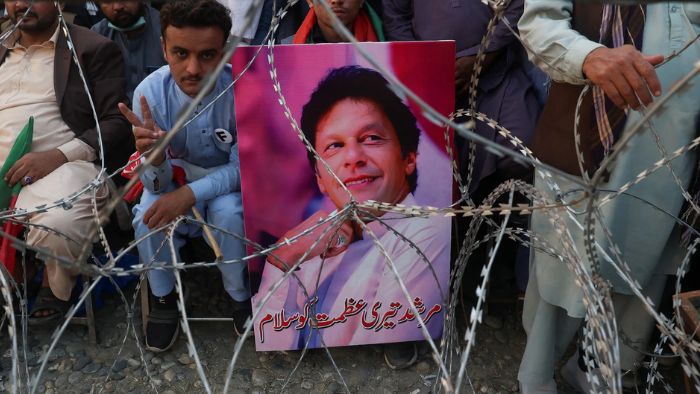
Former Pakistan captain found an eight-day spell in 2007 unbearable – he has now been held for almost 1,000 days
“The worst of it,” reckoned Imran Khan of his first spell in jail, “was that time would not pass. I thought I was going to die of boredom.”
Every morning, after being woken at dawn, Imran – a famously restless man who built a cricketer out of his unpromising early self, then a champion cricket team, then a cancer hospital for the poor, and finally a popular political party – would linger in bed, so the day might become a little shorter.
In the afternoon, he would read the newspaper front to back, hoping a whole day might have passed, only to discover he had whittled away an hour. The food was terrible, the cell tiny, the bathroom squalid. He didn’t know how long he was going to be in for, and he couldn’t bear it: “Here I was, removed from life, watching time that did not pass.”

He went on hunger strike, but realised after two days he didn’t have the strength to walk. Fortunately, on that second evening, the jailer entered his cell, and told him he was free. This account is from Imran’s 2011 memoir, Pakistan: A Personal History, recalling his imprisonment in 2007. He was locked up for eight days.
By contrast, he has been in Rawalpindi’s notorious Adiala Jail since August 2023, and he may be in for some time yet. Imran is serving 14 years for corruption, to be followed by 17 on a separate corruption charge. He has been held in solitary confinement, in a space measuring 8ft by 10ft, and referred to as a “death cell” by his lawyers and family.
He has had access to visitors, but privileges – including TV, books and newspapers – come and go. In some periods, as in late 2025, he has been so cut off from the outside world that there have been rumours of his death. How, one wonders, must he have watched, for so long already, a time that will not pass?
Political martyr is the latest twist for Imran in a life so full of turns they have come to define him. He changed himself from a middling young talent into one of the great fast bowlers and all-rounders; from playboy cricketer to warrior captain; from philanthropist to politician; and from rabble-rousing opposition to divisive prime minister.
He has invested so much in each incarnation that the previous one seems a mirage, as if he never existed in any other way. This moment comes with a greater sense of finality. Now 73, his political career has spanned far longer than his cricket career, which – at 21 years – was hardly short. And political martyrdom is not a choice.

The corruption charges are not entirely without substance, yet it is clear why he is inside: in Pakistani politics, it is the army who giveth, and the army who taketh away. And having helped Imran to the premiership in 2018, the military establishment helped remove him in 2022. He was dismissed through a parliamentary vote of no confidence for misgovernance, but an ego-driven rift with senior military leadership mattered more.
Imran’s will and stubbornness in the face of tough odds were legendary. But even he may struggle to defy this ultimate reality of Pakistani power.
Perhaps this was the fate he had envisaged when turning down several offers to join politics, including from the military dictator Zia-ul-Haq in 1988 while he was still a cricketer. Such offers were usually made in the hope that his popularity and integrity might rub off by association.
Equally, however, when he finally launched his own political party in 1996, Pakistan Tehreek-e-Insaf (Movement for Justice), it had an inevitability. His cricket career was over and, now married to Jemima Goldsmith, so were his bachelor days. He had no interest in coaching or broadcasting. The hospital was built. What else was left? His eldest sister, Rubina Khan, told me how, late in his playing career, Imran had struggled with impostor syndrome.

He felt that the acclaim he received far outweighed the value of what he did as a cricketer. It was only in pursuing more meaningful causes – such as the hospital, set up in memory of his mother – that he felt the gap narrow between the adulation and his work’s value. For a man of such ambition, the next cause came naturally: fixing Pakistan.
He found there was no easy solution. The principles of presiding over a successful sports team or building a career can hardly be transplanted to running a country of more than 240 million people. Even so, it has been sobering. As an athlete, Imran was near superhuman. For the last 10 years of his Test career, he averaged more than 50 with the bat and under 20 with the ball. In that time, he led Pakistan to three epic drawn series against West Indies, the greatest side of the era. His last act in cricket was to take the winning wicket in the 1992 World Cup final.
Politics, by contrast, tarred him with mortality. The struggle of those early years when his party could barely win a seat. The compromises in aligning with tainted politicians he once disparaged. Winning the 2018 election with help from the army. The vindictiveness towards opponents once in power. And an ultimately underwhelming stint as prime minister that, like every stint before his, did not complete its term. He was not better or worse than the others: he was like them, which is the one thing he never was as a cricketer.
In August 2023, the Pakistan Cricket Board released a video celebrating the country’s most memorable moments. Naturally, they included images from the 1992 World Cup final: but the greatest Pakistani cricketer did not feature in a video about great Pakistani cricket moments, many of which he created.
He had been arrested days earlier, and a state-run campaign to purge him from mainstream media was under way. The PCB, run by a direct appointee of whoever is running the country, airbrushed him out. The public backlash was so severe the PCB had to edit him in a couple of days later.

It was a relief to know that this part of his legacy still mattered enough for people to demand it be honoured – because it was not a given. For one, the scale and overwhelming divisiveness of his political career has cast a long shadow over everything that came before. For another, nearly two-thirds of Pakistan’s population is under 30, and have never seen him in action. Since he rarely celebrated his own career – he was too busy motoring into the future to linger in the past – its richness has receded from the national memory.
His exploits survive mainly on YouTube, that modern scroll of history, with some variety if not necessarily depth. Here are the highlights of his celebrated feats against India or England, and also rarer glimpses, such as an innings for New South Wales or Sussex, or an invitational event pitting him against the world’s best all-rounders. Here, the easy grace and deceptive power of his batting, the athleticism and pace of his bowling, speak fluently to a modern age.
Here, as you watch him clear big boundaries or demolish stumps with reverse swing, he doesn’t feel like a relic. Here, down these rabbit holes, the light from his past helps lessen the darkness around his present. (The Daily Telegraph)