

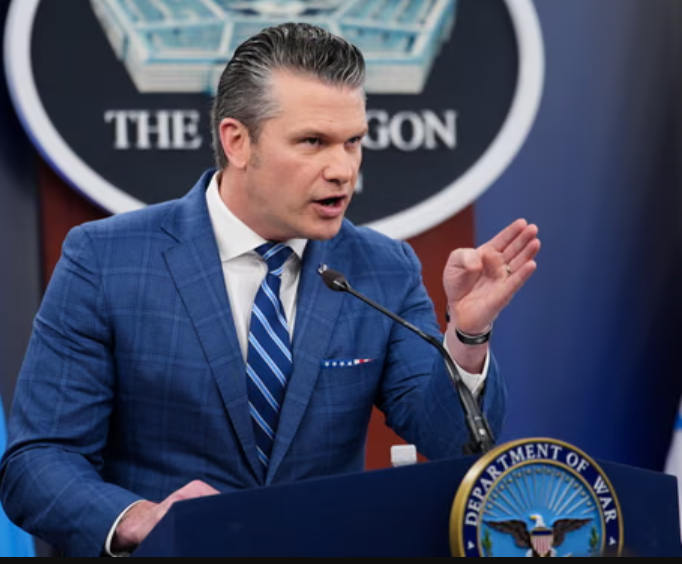
Pentagon chief Hegseth has warned that US forces are ready to restart combat if Iran rejects a deal. Meanwhile, Iranian state media reported that Pakistan’s army chief has met parliament speaker Ghalibaf.
If Iran doesn’t agree to a deal, “bombs dropping on infrastructure, power and energy” will resume, US Defense Secretary Pete Hegseth told a Pentagon briefing on Thursday.
“You, Iran, can choose a prosperous future, a golden bridge, and we hope that you do for the people of Iran,” he said.
“But if Iran chooses poorly, then they will have a blockade and bombs dropping on infrastructure, power and energy,” Hegseth added.
He also said that Washington will prevent all ships “regardless of nationality” from entering or exiting Iranian ports in the Strait of Hormuz for “as long as it takes.”
Following the failure of the Islamabad talks over the weekend to put an end to the war, US President Donald Trump ordered a naval blockade on Iranian ports in an attempt to force Tehran into accepting Washington’s terms for the peace deal.
Pakistan’s army chief Field Marshal Asim Munir on Thursday met with Iranian Parliament Speaker Mohammad Bagher Ghalibaf, Iran’s state television reported.
“Field Marshal Asim Munir, Commander of the Pakistan Army, who travelled to our country yesterday, met and held talks with Mohammad Bagher Ghalibaf… this Thursday morning, April 16,” the report said.
There were no other details about their meeting.
After the Islamabad talks over the weekend ended without any breakthrough, Pakistan has been pushing for a second round of peace talks between Washington and Tehran.
There has been no decision whether negotiations would resume. However, White House Press Secretary Karoline Leavitt told reporters on Wednesday that further talks “would very likely” take place in Islamabad.
Lebanon’s direct talks with Israel a ‘grave error,’ Hezbollah MP tells AFP
Lebanon’s decision to hold direct talks with Israel was a “grave error,” Hezbollah lawmaker Hussein Hajj Hassan told AFP on Thursday.
“Direct negotiations with the enemy are a grave sin and a grave error… and serve no interest for the country,” Hajj Hassan said from his parliamentary office.
He also urged Beirut to stop “this series of useless concessions” to Israel and the United States.
Lebanon was pulled into the Middle East conflict when the Iranian-backed militant group Hezbollah fired rockets at Israel shortly after the start of the joint US-Israeli attacks against Iran.
Israel says it has been targeting Hezbollah sites and strongholds in Lebanon.
Lebanese president refuses to speak to Israeli PM
Lebanese President Joseph Aoun on Thursday refused to speak to Israeli Prime Minister Benjamin Netanyahu, a government official familiar with the developments told The Associated Press.
The discussion would have been the first direct conversation between the leaders of both countries in more than 30 years.
US President Donald Trump had announced that Aoun and Netanyahu would speak about stopping the fighting between Israel and the Iran-backed militant group Hezbollah in Lebanon.
The official, speaking on condition of anonymity in line with regulations, said the remarks were made during a phone call with US Secretary of State Marco Rubio and that Washington was “understanding of Lebanon’s position.”
Earlier, Aoun said that a ceasefire would be “the natural starting point for direct negotiations between the two countries.” (DW)