

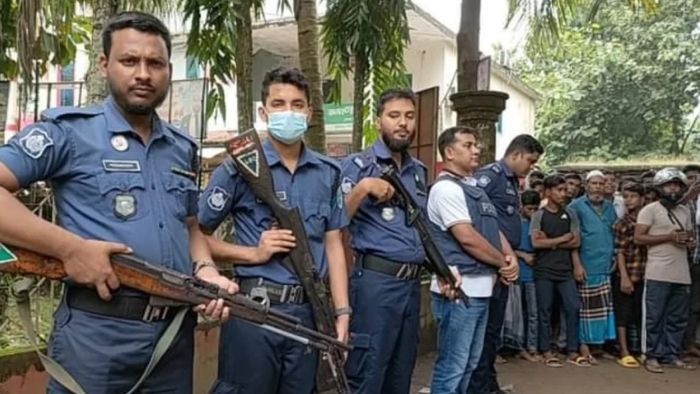
Bangladesh has been on a nationwide security alert following intelligence reports of possible militant attacks on country’s key installations, including Parliament building, security installations, places of worship, recreational centers and public areas. The alert has been issued by Police Headquarters after the arrest of a member of a banned extremist organisation who claimed to have maintained contacts with two dismissed military personnel. While the intel report has been kept ‘urgent confidential’ and did not mention the name of the extremist organisation, the advisory has sparked concerns about resurgence of extremism in Bangladesh.
The country shares a long history of extremism since the emergence of militant organisations like Harkat-ul-Jihad al-Islami Bangladesh (HuJI-B) and Jamaat-ul-Mujahideen Bangladesh (JMB) in the 1990s. The early millennium was marked by unprecedented violence by these transnational-linked extremist groups. 2013-2016 then witnessed a new wave of terror attacks targeting mostly secular bloggers, writers, publishers and activists. Al-Qaeda affiliated Ansarullah Bangla Team (ABT) was the main perpetrator of extremist violence in the country during this period. The 2016 Holey Artisan Bakery attack by five militants sent global shockwaves. While ISIS claimed responsibility for the attack, Hasina government denied the same and blamed it on neo JMB, an ISIS-inspired home-grown militant organisation whose militants did not travel to Syria and Iraq.
The Holey Artisan Attack led to the launch of Operation Thunderbolt and implementation of Bangladesh’s “zero tolerance” policy and counterterrorism measures through newly formed Anti-Terrorism Unit and Counterterrorism and Transnational Crime Unit, along with RAB operations. These strict crackdowns have been largely successful in suppressing large-scale coordinated extremist violence in Bangladesh. However, while extremist attacks were somewhat curtailed, extremist groups did not cease its activities. Following its 2015 ban, Ansarullah Bangla Team (ABT) resurfaced as Ansar al-Islam Bangladesh (AAI) to continue its covert activities within Bangladesh. A new militant group also emerged under the name Jama-atul Ansar Fil Hindal Sharqiya (JAFHS), a joint force (formally constituted in 2019) involving jailed leaders and workers of several militant groups like JMB, AAI and HuJI-B. JAFHS’s aim is to create an Islamic Caliphate in Bangladesh and fight non-Muslims in India, Pakistan and Myanmar, its long-term goal is to create ‘Ghazwatul-Hind’, implying its regional (and not just domestic) threat.
Bangladesh, post July Uprising, was marked by a prolonged phase of severe security vacuum. In the immediate aftermath of overthrow of Hasina’s rule, complete security lapse ensued with mob violence, lootings, and mass prison breaks. Over 70 militants are believed to have escaped prisons, along with weapon lootings from prison guards. During the interim government, 11 top criminals, as well as 174 linked to militant organisations were released on bail. The most disturbing case has been the release of ABT chief Jashimuddin Rahmani on bail in August 2024, who was arrested for the murder of blogger and Shahbagh activist Rajib Haider in 2013. Following his bail, Rahmani has reportedly made a series of anti-India statements, threatening to incite separatist movements across India. In December 2024, eight ABT-linked militants (including one Bangladeshi national) were also apprehended in initial operation in India’s Assam, West Bengal and Kerala.
Following Hasina’s exile, another transnational-linked militant organisation, Hizb ut-Tahrir Bangladesh (HuT-B) (banned in 2009 for national security threat) made headlines for demanding the interim government to withdraw the ban imposed by Awami League government. Later, a procession holding ISIS flag in Dhaka by urban educated college students, demanding for the establishment of Islamic Caliphate in Bangladesh, put banned HuT-B again on spotlight, while 10 linked to this procession, as well as the organisation’s media coordinator were arrested. Nevertheless, the interim government appointed alleged Hizb ut-Tahrir founding member Nasimul Gani as Home Secretary by Bangladesh’s interim government in December 2024. In March 2025, HuT-B held a ‘March to Khilafat’ protest near Dhaka’s Baitul Mukarram mosque, although stalled by law enforcers, reflected the unapologetic public resurgence of Islamist extremism in the country under the interim rule.
The curious case of Bangladeshi nationals joining extremist networks added another dimension to this perpetual threat. In April 2025, a Bangladeshi national was reported to be killed along 54 militants by Pakistan military forces for links with Tehrik-e-Taliban Pakistan (TTP) that has intensified its attacks in Pakistan since 2024. At least eight Bangladeshi nationals reportedly moved to Afghanistan to join TTP during that time. Another case of killing of a TTP-linked Bangladeshi national came in September last year, along with 17 militants killed in a Pakistan’s operation in Khyber Pakhtunkhwa province. It was reported that the slain militant had moved to Dubai to earn a living from where he eventually moved to Afghanistan. Pakistan authorities further claimed to have killed two or three Bangladeshi militants in earlier operations, who all travelled to Afghanistan on pretext of religious work, whereby they joined TTP. Inside Bangladesh, two nationals—Ahmed Faisal and Shamin Mahfuz were also arrested in July 2025 for alleged TTP links, while Mahfuz is revealed to be a former JMB leader who later founded JAFHS who was previously detained on multiple terrorism charges and released on bail in October 2024. Faisal’s confession shed light on Imran Haider as the key player in influencing Bangladeshi youth for TTP operations (25 more preparing to leave Bangladesh to reach Pakistan via Saudi Arabia). The detainment of 36 Bangladeshi nationals in Malaysia on alleged militant links has been another noteworthy development around this time. Despite these reports, home advisor of the interim government continued to deny the existence of militants in Bangladesh.
While it is not officially revealed that recent security threat came from which extremist organisation, suspicion is leaning towards the TTP given its emerging trend of luring Bangladeshi nationals in its organisation. Political leaders, are however, divided on recognising extremist activity in Bangladesh. This, however, does not erase the fact that Bangladesh’s problem with Islamist extremism is structurally embedded rather than episodic. The BNP government inherited a grave security challenge due to incompetence of the interim government, that not only solely threatens Bangladesh but also signals wider regional security threat. Security, especially counterterrorism, would be a litmus test for the new government. (Dhaka Tribune)