

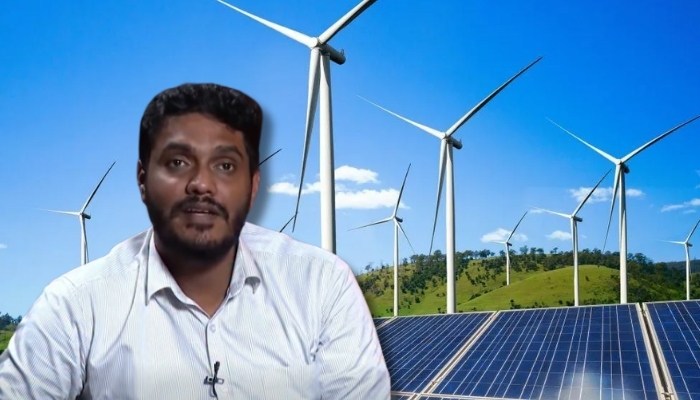
Deputy Minister of Energy Arkam Ilyas says Sri Lanka cannot rely on battery storage alone for its energy transition, stressing the need for expanded solar and wind development along with major improvements to the national transmission network.
“Batteries alone cannot do this. A battery is just a medium,” Ilyas said. “We need more solar. We also need a greater share of renewable energy sources.”
He said the government is scaling up wind power development, with about 300 megawatts of projects already underway, including work in Mannar, where turbine components have recently begun arriving.
“By now, we have started around 300 megawatts of wind power projects,” he said. “In Mannar, we recently saw wind turbine blades arriving. There is 50 megawatts there, and in Mullikulam there are two projects of 50 megawatts each, making about 100 megawatts.”
Ilyas also highlighted ongoing studies into solar expansion, including floating solar systems installed on water bodies, alongside rooftop and ground-mounted projects.
“Special studies are currently being carried out on solar panel systems on water,” he said. “We expect to add around 200 to 250 megawatts from these projects, along with rooftop and ground-mounted solar systems.”
He said Sri Lanka is also moving forward with major renewable energy investments in partnership with development agencies, including a tripartite agreement with the Asian Development Bank for a 150-megawatt wind project in Kondachchi.
“We have reached an agreement with the Asian Development Bank and signed a tripartite agreement for the Kondachchi wind power project, which is 150 megawatts,” he said.
The deputy minister said the government aims to integrate about 300 megawatts of renewable energy into the national grid within the next 18 months.
“Within the next year and a half, we are planning to bring about 300 megawatts into our system,” he said.
However, he acknowledged significant constraints in the country’s transmission infrastructure, saying grid capacity remains a key challenge even as generation capacity expands.
“Even if we have the potential, there are major issues in our transmission system to deliver power to where it is needed,” Ilyas said. “We need to build new grids.”
He added that strengthening transmission infrastructure is essential to reducing overall electricity costs, which he said are largely driven by generation expenses.
“Production costs account for around 80% of electricity sector costs,” he said. “If we can reduce both production and transmission costs, we can significantly bring down overall electricity costs.” (Newswire)