

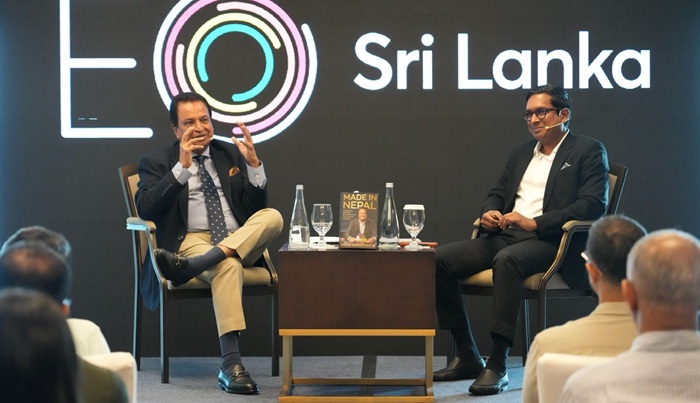
Chairman of CG Corp Global and Nepal’s only Forbes-listed billionaire, Dr. Binod Chaudhary, recently joined the Sri Lanka Chapter of the Entrepreneurs’ Organisation for a candid conversation on building businesses across some of the world’s most demanding markets.
Moderated by Haresh de Soysa, Director at Trade Promoters Limited and former President of EO Sri Lanka, the conversation ranged from the discipline of Japanese business culture to the mechanics of family succession, drawing on Dr. Chaudhary’s five decades of building a multi-billion dollar empire across 32 countries, starting from a landlocked nation of 30 million people.
His connection with Sri Lanka goes back nearly 25 years. He entered in 2001 during the civil war and has remained through every crisis the country has faced since, at one point announcing an additional USD 50 million investment when others were pulling back.
His group’s presence here today spans banking through a majority stake in Union Bank, hospitality through multiple properties including the Taj Samudra, a partnership with John Keells on the BYD agency, and a cement feasibility study currently underway – a footprint that reflects genuine long-term conviction in the country’s potential.
Following are five key insights from Nepal’s only Forbes-listed billionaire, Dr. Binod Chaudhary:
On operating in hard markets
The line that drew the most reaction from the room came when Dr. Chaudhary was asked about the advantage of building in difficult environments. “If you can figure out how to succeed in countries like Nepal and Sri Lanka, it is like you know how to get on a badminton court and be ready for a cricket ball to come at you,” he said.
His argument was straightforward: entrepreneurs who have survived currency crises, political instability, and regulatory uncertainty develop a shock-readiness that those who have only operated in stable markets simply do not carry. That reflex, he suggested, transfers well when you eventually move into easier terrain.
On Japan and the collective mindset
Dr. Chaudhary has long cited Japan as the education he never received in a classroom – a country whose business culture shaped his thinking during visits in the 1970s. He described three qualities he observed that have stayed with him: a deep organisational discipline, a resistance to individual grandstanding, and a willingness among those who lose an internal argument to give unconditional support to the outcome that was chosen.
The logic behind that last quality, he explained, is simple. “If we win, I win.” Individual and collective outcomes are treated as identical. His observation for the room was that this behaviour cannot be mandated – it can only follow from an environment where that belief is made economically real. Incentive structures, shared metrics, and genuine collective accountability must come first. The discipline follows naturally from there.
On partnerships
With partnerships spanning Marriott, Tata, and Mukesh Ambani’s Reliance – among many others – Dr. Chaudhary has built more joint ventures than most entrepreneurs will encounter in a lifetime. His advice on what makes them last came down to a single distinction. “For both sides to win, each side must bring something valuable and value-adding,” he said.
The difference between the two matters enormously. Value that is handed over in a transaction – a contract, a licence, a market introduction – is a stock. Once transferred, it depreciates. Value that keeps regenerating – a capability, a distribution network, a relationship that deepens – is a flow. Partnerships, he argued, do not die from betrayal. They die when one party stops being a flow and becomes a stock. His counsel was to run that test honestly on every partnership you are in.
On succession and family business
As a third-generation builder – whose grandfather arrived in Nepal from Rajasthan, and whose father opened the country’s first department store – the question of succession carries particular weight for Dr. Chaudhary. He spoke to it with a candour that is rarely heard in public settings.
His central point was structural. The instinct to divide responsibility among family members along functional lines tends not to work, he said. Each generation needs room to own an outcome completely – not a role within someone else’s business. It is a lesson he has applied within his own family. His eldest son Nirvana Chaudhary serves as Managing Director of Chaudhary Group in Nepal and is also Chairman of Union Bank of Colombo. Rahul Chaudhary, as Managing Director and CEO of CG Hospitality, leads the group’s ambition to reach 500 hotels by 2030. Varun Chaudhary serves as Managing Director of CG Corp Global with oversight of the group’s broader global operations. Three sons, three distinct domains – each with room to build something of their own.
Beyond structure, he spoke of the importance of a strong family constitution: a framework for ownership and governance that gives the business continuity regardless of which individuals happen to be leading it at any point in time.
On talent and credentials
Dr. Chaudhary was pointed in his view on how entrepreneurs should think about hiring. “No business school has a monopoly on bringing out the best in people,” he said. “The most average of schools can produce some of the best.” The implication was that credentials signal starting conditions, not ceiling. Drive, track record under pressure, and the rate at which someone learns from constraint are better predictors of who will grow with a business than the name of the institution they attended. His suggestion was to identify at least one or two high-potential people without the obvious CV and back them with intention.
The session was organised by Umayanga Nanayakkara, Learning Chair of EO Sri Lanka and Director of Asset Engineering Pvt Ltd.
EO Sri Lanka, currently chaired by Tarindra Kaluperuma, Executive Director of Stafford Motor Company (Pvt) Ltd, is part of a global network spanning 222 chapters and more than 19,000 entrepreneurs across 87 countries.
The session with Dr. Chaudhary, who later this year will break ground on a USD 100 million Ritz-Carlton in Kathmandu, reflected the kind of access the organisation makes possible: candid, specific, and rooted in real experience. (Newswire)