

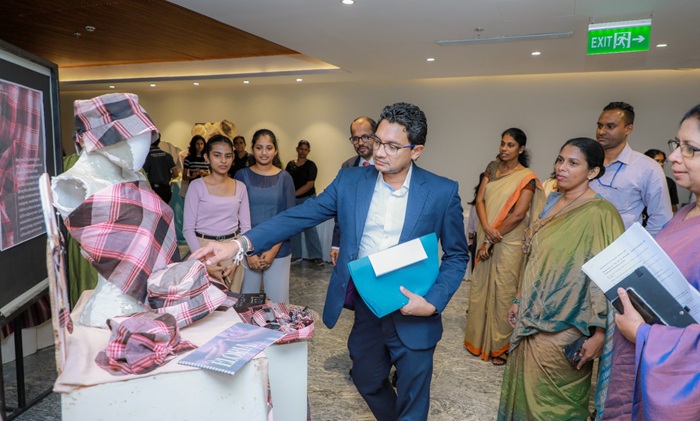
Sri Lanka’s handloom industry was placed firmly in the spotlight today as the “Art of Weaving” workshop and fashion showcase unfolded under the patronage of Deputy Minister of Industry and Entrepreneurship Development Chathuranga Abeysinghe, bringing together policymakers, academics, designers, artisans, and entrepreneurs.
Jointly organized by the Export Development Board (EDB), the Ministry of Industry and Entrepreneurship Development, and the University of Moratuwa, the initiative aims to revitalize the handloom sector by preserving cultural heritage, fostering innovation, and positioning Sri Lankan designs for greater value and visibility in global markets.
The EDB emphasized its commitment to elevating the industry to international standards through improving product quality, encouraging innovation, and attracting youth participation. The event highlighted the importance of transforming handloom weaving from a traditional art form into a sustainable export sector that contributes significantly to the national economy.
Addressing the gathering, Deputy Minister Abeysinghe stated that it is incorrect to regard handloom weaving as a declining industry and that it should instead be recognized as an “Industry of the Future.” He noted that as global consumers increasingly seek sustainable and natural products, Sri Lankan handloom products are gaining unique value in international markets.
The Deputy Minister further explained that, unlike the apparel industry, the handloom sector possesses uniquely Sri Lankan patterns, colors, and craftsmanship that cannot be easily replicated elsewhere, providing the country with a genuine unique competitive advantage.
Considering the growing global demand for high-value fashion products, he stated that the sector has significant potential to generate foreign exchange earnings. He pointed out that expanding beyond traditional sarees into casual fashion collections and athleisure/well-being-oriented fashion could enable Sri Lanka to capture rapidly growing international market segments.
Commending the creative interventions currently being undertaken by universities and the private sector, Deputy Minister Abeysinghe stressed that greater private sector investment is necessary to transform the handloom sector into a large-scale industry. He also emphasized the need to combine the creativity of young designers with business know-how to develop innovative business models.
The Deputy Minister further stated that the Government is taking steps to restructure institutions such as the EDB, the Department of Textiles, and state-owned enterprises including Laksala and Salusala to provide more effective support for the handloom sector.
He assured that the Government would continue to strengthen collaboration between the University of Moratuwa and the industry, while providing maximum support to transform Sri Lanka’s handloom heritage into an innovative export sector capable of competing globally. (Newswire)