

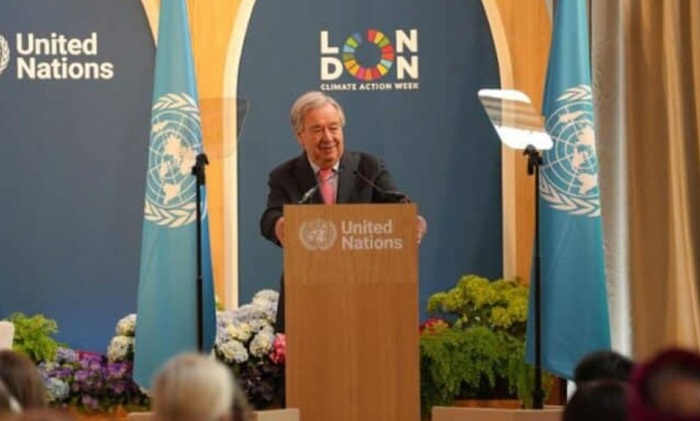
United Nations Secretary-General António Guterres called for urgent action to address what he described as two interconnected global crises: climate change and energy insecurity.
Speaking at London Climate Action Week, the UN Chief warned that continued dependence on fossil fuels is driving both rising temperatures and growing energy vulnerabilities, while underscoring that renewable energy offers a pathway to greater energy security, affordability and resilience.
“The verdict is in: energy independence cannot be built on fossil fuel dependence,” the Secretary-General said, highlighting that renewable energy is now the cheapest source of new electricity in most parts of the world and a cornerstone of long-term energy security.
Warning that climate impacts are already disrupting lives, livelihoods and economies around the world, the Secretary-General stressed that accelerating the transition to clean energy is essential to building a more secure, resilient and sustainable future. This message is particularly relevant for Sri Lanka, which is already experiencing the effects of climate change through more frequent floods, droughts and extreme weather events.
The Secretary-General also announced a global Call to Action on Methane, focused on accelerating emissions reductions across the fossil fuel, agriculture and waste sectors. Methane is responsible for around one-third of global warming, making it one of the fastest opportunities to slow climate change while delivering benefits for public health, food security and sustainable development.
He also highlighted the role of artificial intelligence, noting that while AI can help advance climate solutions, the systems that power it consume significant amounts of energy, water and land. The Secretary-General proposed an AI Environmental Transparency Initiative, calling on major AI companies to disclose the environmental footprint of their systems and transition data centres to renewable energy by 2030.
Responding to the rising threat of climate change, Sri Lanka has committed to reducing greenhouse gas emissions by 20.09 per cent by 2035 through its Nationally Determined Contribution (NDC 3.0). The country also aims to generate 70 per cent of its electricity from renewable sources by 2030, expand forest cover and reduce emissions from the waste sector through improved recycling and waste management. The transition also presents significant opportunities for Sri Lanka.
Commenting on the Secretary-General’s address, United Nations Resident Coordinator in Sri Lanka Marc-André Franche noted how recent global events have highlighted how vulnerable countries can be to disruptions in international energy markets: “Accelerating the shift to renewable energy is not only a climate imperative; it is also an investment in Sri Lanka’s energy security, economic resilience and long-term fiscal stability. With the right investments and partnerships, the transition can create jobs, strengthen communities, while mitigating the impacts of climate change”. (UN Sri Lanka)