

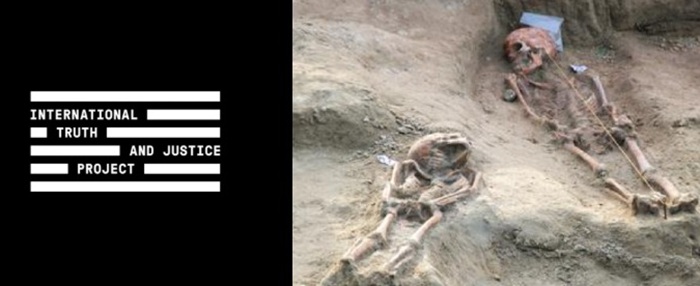
The International Truth and Justice Project (ITJP) has launched a new report underscoring Sri Lanka’s persistent failure to investigate enforced disappearances and deliver justice to families of the missing.
Titled “Chemmani Mass Grave: ‘We are Still Searching’”, the report stresses that Chemmani, now the largest known mass grave site in Sri Lanka, symbolizes decades of deliberate inaction by successive governments.
Drawing on witness testimony, judicial records, military information and prior investigations, ITJP argues the site should be treated not only as a forensic exercise but as evidence supporting renewed criminal investigations into enforced disappearances, unlawful killings and related international crimes.
The report notes that despite substantial evidence, no mid‑ranking or senior commander has been held criminally accountable. Instead, several officers linked to the area during the relevant period were later promoted, with some even deployed as UN peacekeepers.
Executive Director Yasmin Sooka emphasized that Chemmani remains a test of Sri Lanka’s commitment to truth and justice, pointing out that under international law enforced disappearance is an ongoing violation until the fate and whereabouts of victims are established.
Full statement:
The mass grave at Chemmani in the Jaffna Peninsula has become emblematic of the systematic, continuing and deliberate failure of successive Sri Lankan governments to investigate enforced disappearances, to establish the truth, prosecute those responsible where the evidence permits and provide justice and accountability to the families of the disappeared, said the International Truth and Justice Project (ITJP) launching a new report.
‘I would be shattered if the remains of my son were found buried at Chemmani, and I would be shattered if they were not,” commented Paramanathan Selvaraja whose son disappeared in 1999, “The only way I can be happy is if my son returns to me alive”.
The title of the new report “Chemmani Mass Grave: ‘We are Still Searching’” echoes the opening words of so many statements from the families of the disappeared who still haven’t learned the fate of their loved ones three decades on, let alone retrieved their remains.
The report concludes that Chemmani, now the largest known mass grave site in Sri Lanka, is exceptional because of the sheer scale of the grave, the length of time over which evidence has allegedly been concealed, and the substantial body of evidence linking the site to allegation of enforced disappearances, unlawful killings and other serious violations committed by the Sri Lankan military during the conflict.
Drawing on decades of witness testimony, judicial records, contemporaneous documentation, military information and previous investigations, the report argues that Chemmani should no longer be viewed solely as a forensic exercise but as evidence capable of supporting renewed criminal investigations into enforced disappearance, unlawful killings and related international crimes.
To date, no mid-ranking or senior commander has yet been held criminally accountable in relation to the violations associated with Chemmani. Instead, several officers who served in the area during the relevant periodd were subsequently promoted to positions of greater authority and responsibility.
During a visit to the site in June this year, Sri Lanka’s Minister of Justice and National Integration, Harshana Nanayakkara, stated that the government lacked information regarding events in 1998 and suggested families of the disappeared should identify those responsible.
The ITJP report argues that a prima facie case exists for the investigation and prosecution of crimes committed at Chemmani, and that the failure to commence such investigations reflects a continuing deficit in accountability rather than an absence of evidence.
An annexure to the report identifies seven army officers named as alleged suspects; two of those officers were subsequently deployed as UN peacekeepers to Haiti during the period when Sri Lankan soldiers were implicated in the widespread sexual exploitation and abuse of children. Others later became associated with separate allegations including the abduction, torture and assassination of journalists.
While these are distinct episodes, taken together, they illustrate how persistent failures of accountability can perpetuate cycles of abuse, erode public confidence in state institutions and allow individuals implicated in serious violations to continue exercising authority without meaningful scrutiny.
Chemmani is not merely a historical crime scene but is a continuing test of Sri Lanka’s commitment to truth, justice and accountability. Under international law, enforced disappearance remains an ongoing violation until the fate and whereabouts of the disappeared are established.
For families, uncovering human remains is only the beginning. Justice ultimately requires independent criminal investigations, identification of those responsible where the evidence supports it, and effective remedies for victims and their families. (Newswire)