

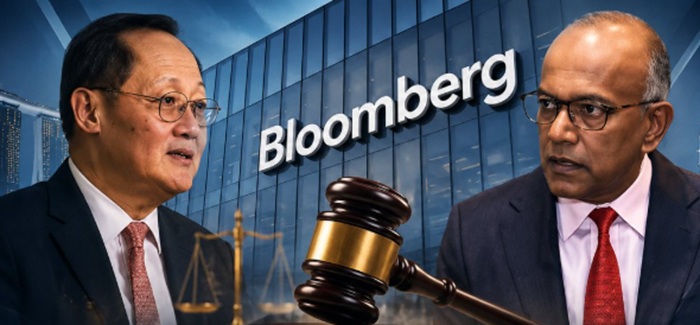
A Singapore court has awarded Home Affairs Minister K Shanmugam and Manpower Minister Tan See Leng damages of S$230,000 (US$177,874) each for defamation by news organisation Bloomberg and its reporter, Mr Low De Wei.
In a judgment released on Tuesday (Jul 14), Justice Audrey Lim found that the December 2024 article about Good Class Bungalow (GCB) transactions had defamed the ministers.
She rejected Bloomberg’s argument that the article merely examined a broader trend of non-caveated GCB transactions and that the ministers were cited only as examples.
Instead, she said the article, when read as a whole, linked the ministers’ transactions with claims about secrecy, opacity and money laundering, creating a defamatory impression.
Justice Lim also rejected Bloomberg’s reliance on a public interest defence known as the Reynolds defence in UK law, saying it is not part of Singapore law.
Even if it were available, the judge found that Bloomberg would not have satisfied the standard of responsible journalism and that the ministers were not given a fair opportunity to respond to the allegations ultimately published.
Justice Lim said internal correspondence from Bloomberg demonstrates that the dominant purpose behind the article was to publish a story about the ministers, in particular about their GCB transactions.
“The broader narrative of how wealthy individuals in Singapore use non-caveated transactions and trust structures to keep their dealings secret or ‘off-radar’ was the cover devised to carry that story,” said Justice Lim.
The Article
The Bloomberg article opened with a line that “Singapore’s ultra-rich are increasingly cloaking their purchases of mansions in the city-state in secrecy”.
After mentioning a S$3 billion money laundering scandal and how criminals linked to this case were convicted, jailed and deported, the article said buyers of high-end homes would rather keep their purchases under the radar.
The article then named Dr Tan and Mr Shanmugam and their respective GCB transactions.
Bloomberg and Mr Low had contested the claims, saying the article was about broader trends in Singapore’s GCB market rather than about the ministers personally, or any wrongdoing on their part.
In a 71-page judgment, Justice Lim said the test for determining the natural and ordinary meaning of offending words in a defamation action is well-settled.
The court decides what meaning the words would convey to an ordinary reasonable person or reader using their general knowledge and common sense.
It is irrelevant what meaning was intended by the maker or understood by the claimant.
The ministers’ case was that the article had defamed them in two ways. First, it made it to seem that the ministers had taken advantage of the absence of checks and balances or disclosure requirements to conduct their property transactions in a non-transparent manner.
Second, they sought to hide their transactions and avoid scrutiny, including scrutiny that might extend to the possibility of money laundering.
Justice Lim found that the first element was made out, as an ordinary reader would understand the article to mean that Singapore’s current system for non-caveated GCB or mansion transactions lacked checks, balances or disclosure requirements, allowing such transactions to be kept secret or non-transparent.
She pointed to the article’s headline, “Singapore Mansion Deals are Increasingly Shrouded in Secrecy”, as well as the first bullet point under the headline stating “More people buy homes with trusts, hiding owners’ identities” and the article’s opening line “Singapore’s ultra-rich are increasingly cloaking their purchases of mansions in secrecy”.
She listed several other paragraphs from the article in the same vein.
Justice Lim said the headline, bullet point and first paragraph immediately conveyed to a reader that GCB deals are being kept secret or hidden to avoid drawing attention to the purchaser’s wealth, social status and identity.
She also found that the article conveys to the reader that a buyer would pay a premium to a seller for a deal to be kept “quiet” or “off-radar”.
The editorial placement of Dr Tan’s transaction under the heading “Non-Caveated Deals”, read in context, would lead a reader to draw the inference that his purchase was conducted without the usual transparency that a caveat affords, and that he had taken advantage of the capacity that the absence of a caveat permits, said Justice Lim.
She found that readers would understand Mr Shanmugam’s transaction as an example of the trust mechanism described in the article as a way to maintain privacy from scrutiny.
Justice Lim disagreed with Bloomberg’s position that the article was concerned with trends and contained nothing defamatory.
She said the defamatory character of the second element claimed by the ministers lies not in any explicit accusation but in the inference it invites – that the ministers sought to hide their transactions and avoid scrutiny that might extend to money laundering.
She found that the second element was also made out, and that the article defamed both ministers.
Since all people who procure or participate in publishing libel, including the journalist, editor and publisher, are jointly and severally liable for the whole of the claimant’s damage, she found the publisher in this case and the author of the article jointly and severally liable for the damage suffered by the ministers as a result of the defamatory article.
This means Bloomberg and Mr Low are collectively responsible for paying the total amount of damages and it is possible for the claimants to pursue either one of them for the full amount of S$460,000. (CNA)