

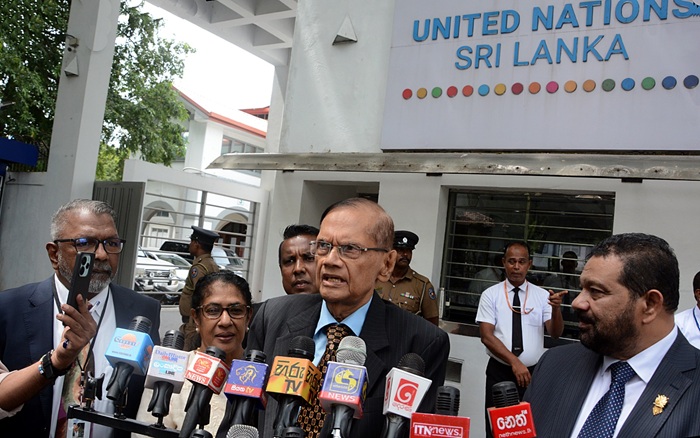
Representatives of the Democratic United Opposition met with Marc‑Andre Franche, the UN Resident Coordinator, today (15) to brief him on what they described as critical issues facing Sri Lanka.
Speaking to the media after the meeting, Professor G.L. Peiris said the opposition had conveyed strong objections to the government’s proposed judicial reforms.
“No one in Sri Lanka has asked for these reforms. The legal community, civil society, magistrates, and parliamentarians are all opposed. Whose wish is this being carried out for?” he asked.
He criticized the lack of transparency, noting that the government had not issued any clear statement on the nature or purpose of the reforms. He contrasted this with the UK’s 2021 reform process, which involved public consultations and over 1,200 responses before decisions were finalized.
Peiris added that extending the tenure of judges without similar consideration for other professionals, such as specialist doctors, was discriminatory and violated Article 12(1) of the Constitution.
“Instead of solving the country’s pressing problems, the government is creating unnecessary complications,” he said.
Also speaking to reporters, former minister Suren Raghavan said the opposition had also raised concerns about the Negombo Prison riot, which left 33 people dead, including 10 officials.
He noted that while a three‑member committee led by Justice Priyantha Jayawardena had been appointed, no interim report or official statement had been released even ten days after the incident.
Raghavan questioned the use of live ammunition instead of minimum force measures such as rubber bullets or tear gas. “International practice requires minimum force. Why was that not applied here?” he asked.
He criticized the government’s silence, saying it had offered only vague statements while public expectations remained high. He also pointed out that many ruling party MPs lacked grassroots political experience, raising doubts about their ability to respond effectively to cultural and social realities.
Referring to the deaths at Negombo Prison, Raghavan stressed the importance of protecting the right to life, a principle recognized internationally and by the UN Council.
“If even one innocent person is punished, it is far more dangerous than letting a thousand guilty go free,” he said.
Both Peiris and Raghavan emphasized that the public had expected a system change from the government, ensuring rule of law, economic stability, food security, transport facilities, and structured education.
They rejected violent protests and strikes, insisting that democracy in the 21st century must be based on consultation, participation, and listening to the people.
Raghavan appealed to President Anura Kumara Dissanayake and the government, stating, “Democracy today means consultation and participation. My request and pressure is for the leadership to adopt such a democratic framework for the good of the country.” (Newswire)