

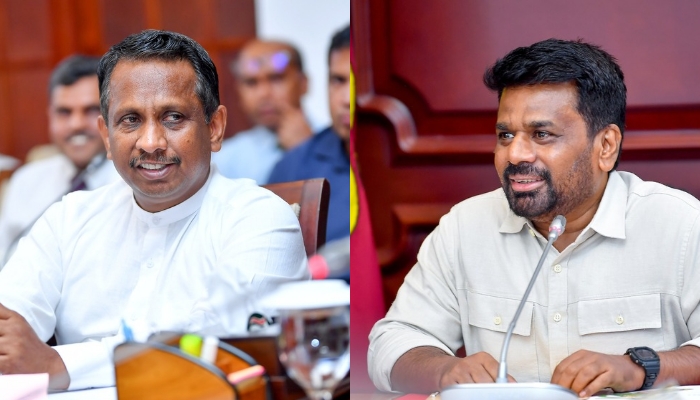
President Anura Kumara Dissanayake has instructed the relevant authorities to formulate a programme to allocate underutilised land, together with the necessary project support services, to Sri Lankan migrant workers returning home upon the completion of their overseas employment.
The President issued these instructions during a discussion held this afternoon (24) at the Presidential Secretariat to review the progress of projects implemented under the 2026 budget allocations for the Ministry of Plantation and Community Infrastructure and to consider the Ministry’s proposals for the 2027 Budget.
The meeting included a comprehensive review of the progress of development projects being implemented by the Plantation Sector, the Community infrastructure Sector and institutions under the State Plantation Companies operating within the Ministry. Discussions also focused on priorities, funding requirements and planned initiatives for 2027.
The meeting also reviewed key plantation sector initiatives being implemented under capitalallocations of Rs. 1,081 million, including the state land surveying programme, the disease management of coconut, the Kapruka Fund, initiatives to increase coconut production and the Northern Coconut Triangle Programme.
President Dissanayake also assessed the progress of ongoing infrastructure development programmes in the plantation sector. The President emphasised the importance of completing the project to construct 10,000 houses for the Malayagam community within the stipulated timeframe and handing them over to the beneficiaries without delay.
The President further noted that weaknesses in the implementation mechanisms for projects financed through foreign grants and loan assistance had resulted in certain allocated funds remaining underutilised or being returned.
President Dissanayake also reviewed the progress of the relief programme implemented to support the replanting of plantation crops, including tea, coconut and rubber that were damaged by the Ditwah disaster situation.
It was revealed during the discussion that the tea, coconut, rubber, cashew and palmyrah sectors, along with plantation infrastructure development activities, have recorded growth and improved profitability this year compared to the previous year. In particular, six state plantation companies, including Elkaduwa Plantations Limited, Kurunegala Plantations Limited, Chilaw Plantations Limited, Sri Lanka State Plantation Corporation, Janatha Estates Development Board and Kalubowitiyana Tea Factory Limited, are making significant progress in increasing their
profitability.
Special attention was also given to crop production and related crop improvement programmes implemented by the Tea Research Institute, research and development activities and initiatives launched to support the replanting of smallholder tea plantations.
It was revealed during the discussion that approximately 60,000 hectares of Sri Lanka’s tea cultivation consists of smallholder tea plantations. Of the Rs. 450.06 million allocated in the 2026 Budget for the replanting of smallholder tea plantations, Rs. 155.07 million has already been utilised.
President Dissanayake also reviewed the progress of the 500 Tea Villages Programme implemented under the Tea Small Holdings Development Authority and instructed officials to expedite its completion by integrating the initiative with other rural development programmes, such as “Prajashakthi”, being implemented at the grassroots level.
The meeting also discussed the programme to revitalise rubber cultivation, including the allocation of Rs. 137 million in the 2026 Budget for the Rubber Research Institute, as well as the progress of rubber replanting initiatives and the challenges encountered during implementation.
In addition, discussions focused on the progress of programmes and research activities aimed at developing the coconut industry, enhancing productivity in coconut plantations, promoting new product development, increasing value addition and improving product quality.
The progress of programmes implemented under the Palmyrah Development Board and the Kithul Development Board to strengthen the palmyrah and kithul industries was also reviewed during the discussion.
It was revealed that Sri Lanka is expected to meet 18,000 metric tonnes of its annual cashew requirement of 25,000 metric tonnes this year, marking a significant increase compared to the previous year. The meeting also discussed the potential to expand cashew cultivation across approximately 15,000 hectares in the Northern and Eastern Provinces.
The progress of ongoing efforts to consolidate institutions within the plantation sector and the implementation of Cabinet decisions relating to non-commercial government-owned institutions were also reviewed. The meeting further discussed the need to update agreements entered into by
previous governments when allocating lands to companies. Emphasising the importance of establishing stronger agreements regarding State-owned land allocations, President Dissanayake instructed that a committee be appointed through the Ministry of Finance to examine and address these matters.
The President also instructed officials to explore the possibility of offering courses conducted by the National Institute of Plantation Management through universities, in consultation with relevant higher education institutions.
Among those present were Minister of Plantation and Community Infrastructure Samantha Vidyarathna, Minister of Labour and Deputy Minister of Finance and Planning Anil Jayantha Fernando, Deputy Minister of Plantation and Community Infrastructure Sundaralingam Pradeep, Secretary to the President Dr. Nandika Sanath Kumanayake, Chief of Presidential Staff Prabath Chandrakeerthi, Senior Additional Secretaries to the President Russell Aponso and Kapila Janaka Bandara, Secretary to the Ministry of Finance, Planning and Economic Development Dr .Harshana Suriyapperuma and Secretary to the Ministry of Plantation and Community Infrastructure Gunadasa Samarasinghe. Chairpersons, Director Generals and senior officials of institutions under the Ministry of Plantation and Community Infrastructure also participated in the discussion.(PMD)