

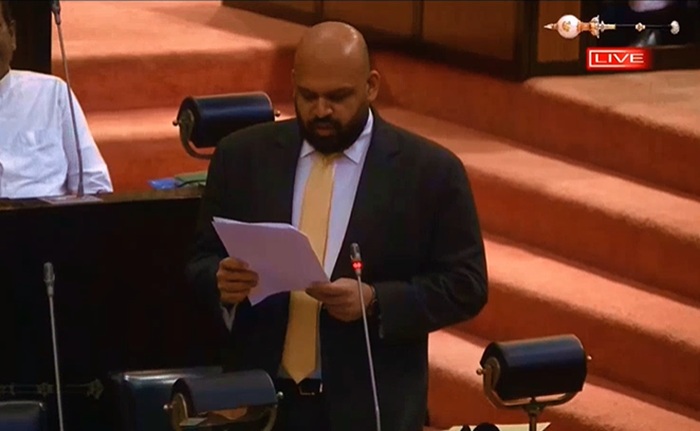
Batticaloa District MP Shanakiyan Rasamanickam today questioned why state‑owned banks apply harsh recovery laws against small borrowers while allowing politically connected and wealthy defaulters owing billions to remain untouched.
Raising the matter in Parliament through a Standing Order 27(2) Question addressed to the Minister of Finance, MP Shanakiyan noted that ordinary citizens who default on modest loans face swift enforcement through Parate Execution and other mechanisms, with homes, businesses, and vehicles seized.
In contrast, he asked what action has been taken to recover billions owed by some of the country’s largest loan defaulters, stressing that state‑owned banks lend not government money but the savings of the people of Sri Lanka, which must be protected.
Shanakiyan requested the Minister to table details of the 20 largest nonperforming loan accounts currently outstanding and the 20 largest loans written off in the past 15 years across the Bank of Ceylon, People’s Bank, National Savings Bank, Regional Development Bank, and State Mortgage & Investment Bank.
The MP asked for comprehensive information on each account, including the borrower, outstanding or written‑off amount, year of issuance, collateral, restructuring status, recovery progress, and whether legal or disciplinary action has been taken against bank officials involved. He also called for a consolidated report on recovery action, with at least an interim report within three months if full details are not immediately available.
He reminded the House of a recent court judgment against a politician who had obtained billions in loans from a state‑owned bank, used the funds for private lending, and failed to repay. He said allegations also exist that certain officials facilitated such transactions, and the public deserves to know what action has been taken.
The Minister requested additional time to compile the information.
“There cannot be one standard for the ordinary citizen and another for those with money, power or political influence. Public money belongs to the people, and accountability must be equal,” Shanakiyan concluded. (Newswire)