

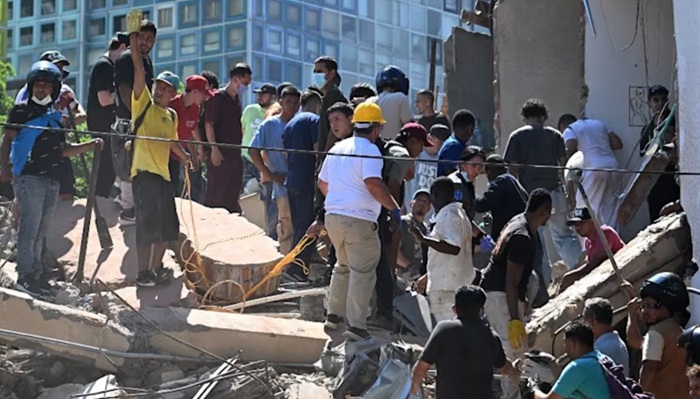
More than 100 people were killed after a powerful earthquake struck western Colombia on Monday (Aug 10), toppling buildings, damaging hospitals and infrastructure and trapping people beneath the rubble in what authorities called the country’s strongest earthquake of the century.
The quake struck just days after Abelardo De La Espriella was sworn in as president, thrusting the new administration into its first major crisis, with memories still fresh of devastating twin earthquakes in neighbouring Venezuela in June.
“The national government has all of its capabilities deployed to protect lives, assist affected communities and deliver aid wherever it is needed,” he said in a national address around 1pm local time, upon declaring a national state of emergency and giving a death toll of 111.
“The first priority is rescuing the people trapped under the rubble.”
De La Espriella visited Quibdo, the capital of coastal Choco province, where he promised rent subsidies for those who have lost homes, and then traveled to Cali, western Colombia’s largest city.
Though he had been expected to give an updated national death toll on Monday evening, De La Espriella offered only figures for Valle del Cauca province, where Cali is located, saying 35 people had died there, while 700 had been injured.
Some local media have cited a national total of 132 deaths, though the origin of the figure is unclear.
The US Geological Survey said the 7.4 magnitude quake struck at a depth of 107km. Colombia’s geological service said it was the strongest earthquake recorded in the country in the 21st century.
As night fell, rescue workers and volunteers with headlamps hurried to find people still trapped under rubble.
Authorities in Cali, Armenia and Manizales announced curfews, with Cali’s mayor saying threats of looting had forced him to deploy police and military personnel to the streets. De La Espriella promised 1,000 additional security personnel for the city.
Cali authorities said the Petronio Alvarez festival, an annual celebration of Pacific music which was due to start on Wednesday, has been postponed.
Video broadcast by Caracol Television showed a group of people pulling a small baby covered in dust from under a pile of rubble. Caracol reported the six-month-old girl and her mother were rescued from under a five-story building in Cali.
Video from Cali also showed rescue workers rappelling people out from the windows of a local hospital.
SHELTER, CLEAN WATER AMONG URGENT NEEDS: IFRC
Shelter, clean water and sanitation are among the most urgent needs following the earthquake, with some people sleeping on the streets on the first night after the disaster, according to the International Federation of Red Cross and Red Crescent Societies (IFRC).
Edwin Armenta, the IFRC’s operations manager in Bogota, said relief teams were also facing difficulties reaching and communicating with some affected communities, with roads damaged and internet connections unavailable in some municipalities.
“Probably we’re going to need additional support, but so far the information is very limited because in some municipalities the internet connection is very difficult,” Armenta told CNA’s Asia First.
Armenta added that the IFRC had launched an initial emergency operation of 1 million Swiss francs (US$1.2 million) to support the Colombian Red Cross response in affected municipalities.
RING OF FIRE
Colombia sits along the seismically active Pacific Ring of Fire and records thousands of mostly minor earthquakes each month.
Northwestern University seismologist Suzan van der Lee said the quake’s powerful magnitude, inland location and strike-slip motion may have amplified damage in populated valleys despite its considerable depth.
“This one was far below the crust, and in theory it shouldn’t cause as much shaking. At this magnitude, it did actually cause a lot of shaking,” she said, adding Colombia is particularly difficult for seismologists to analyse due to the interaction of several major tectonic plates.
The Colombian Geological Service said 21 aftershocks had been recorded by late Monday and warned that additional tremors were likely.
Colombia’s coffee region was devastated by a magnitude 6.2 earthquake in 1999 that killed more than 1,000 people, particularly around Armenia and Pereira. (CNA)