

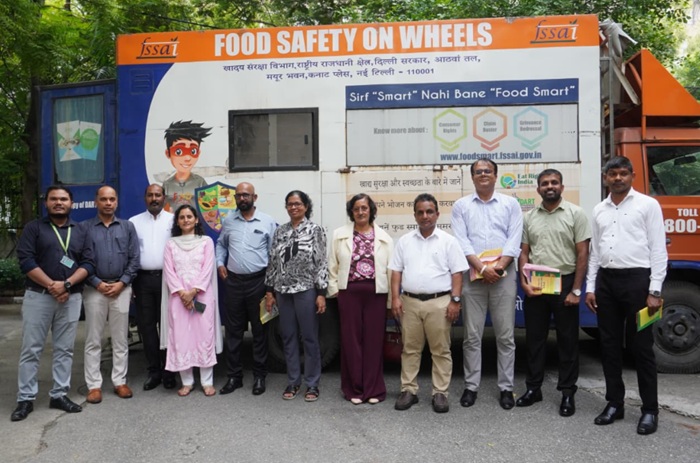
A Sri Lankan health delegation has returned from a study visit to India aimed at strengthening the country’s food safety framework, enhancing regulatory oversight, and better protecting consumers.
From July 27 to 31, 2026, officials from the Ministry of Health — including representatives of the Directorate of Environment, Occupational Health and Food Safety, the Food Control Administration Unit (FCAU), and the Medical Research Institute (MRI) — visited the Food Safety and Standards Authority of India (FSSAI) in New Delhi. The technical exchange was supported by the Ministry of Health, the World Health Organization (WHO), and FSSAI.
Over five days, participants engaged with Indian counterparts to understand how food safety systems are governed, regulated, and monitored. The programme provided exposure to India’s approaches, including risk‑based inspections, surveillance systems, digital licensing and compliance platforms, laboratory networks, and food labelling oversight.
Delegates also examined how different sectors — from regulatory authorities and laboratories to customs and trade agencies — collaborate to support food safety. They were familiarized with India’s use of digital technologies to improve efficiency, transparency, and evidence‑informed decision‑making, as well as mechanisms for monitoring food advertising and labelling, including challenges linked to online food marketing.
The exchange comes as Sri Lanka works to modernize food safety governance. Insights from the visit will inform ongoing efforts to establish a Food Safety Bureau, strengthen food labelling oversight, and advance priorities under the International Health Regulations (2005), the Joint External Evaluation (JEE), and the National Action Plan for Health Security (NAPHS).
WHO Representative to Sri Lanka Dr. Rajesh Sambhajirao Pandav said: “Strengthening food safety requires strong systems, effective regulation and continuous learning. Opportunities for technical exchange such as this allow countries to learn from one another’s experiences and identify practical approaches that can be adapted to national contexts.”
He added that as food systems evolve, partnerships and knowledge exchange remain vital tools for building stronger, more resilient food safety systems that protect health and support consumer confidence. (Newswire)