

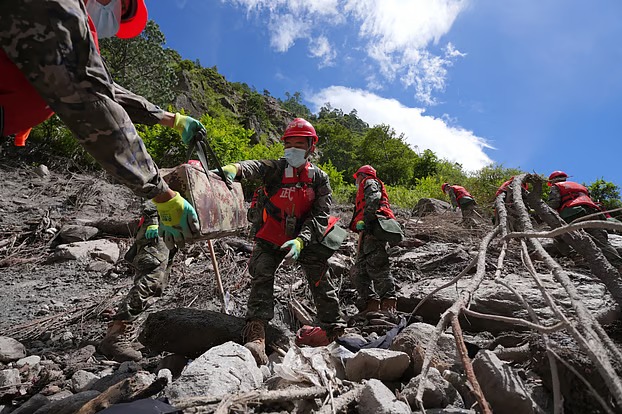
Chinese authorities have resumed rescue operations near the China-Nepal border after assessing that the risk posed by an overflowing lake formed following a glacier collapse had become manageable.
Rescue operations had been suspended earlier Friday (28) after authorities warned of the potential for the lake to burst, along with secondary hazards including landslides and avalanches.
The lake, which straddles the China-Nepal border upstream from the Gyirong border crossing, formed after a glacier collapse triggered a massive flood on Wednesday (26). The flooding devastated the border crossing, sweeping away people and vehicles, according to Chinese state broadcaster CCTV.
Chinese authorities said the lake’s water volume had exceeded 2.5 million cubic metres, up from an estimated 1.5 million to 2 million cubic metres recorded by an eight-member engineering team sent to monitor the site.
The team conducted aerial surveys and 3D modelling of the barrier lake to assess the risk. Engineers also faced difficulties reaching the site because the glacier collapse had left isolated and steep cliffs along the lake’s shoreline, CCTV reported.
Light to moderate rain has also been reported around the Gyirong border port, potentially loosening and destabilising soil and rocks in the area. Forecasts indicate that rainfall could continue over the coming week.
China warned Thursday(27) that up to 3 million cubic metres of additional water could flow into the lake over three days, increasing the risk of a breach. The expected peak flow was around Sept. 1.
The disaster has caused extensive loss of life and left hundreds of people missing on both sides of the border. The official death toll on the Tibetan side rose to five, while 558 people remained missing.
Nearly 1,000 people were still missing across the two countries, including as many as 540 foreigners from 31 countries, according to officials. (Newswire)