

The crisis confronting journalism in the Global South is no longer simply a media problem. It is becoming a democratic one. For much of the modern era, democracy rested on a familiar architecture: the executive, legislature and judiciary, with an independent media acting as the Fourth Estate, watching those who wield power and holding them accountable.
But that architecture is changing. A new force has entered the information ecosystem: citizens themselves, digitally connected and increasingly capable of creating narratives, setting agendas and mobilising political action without waiting for newspapers, television stations or radio networks to lead them.
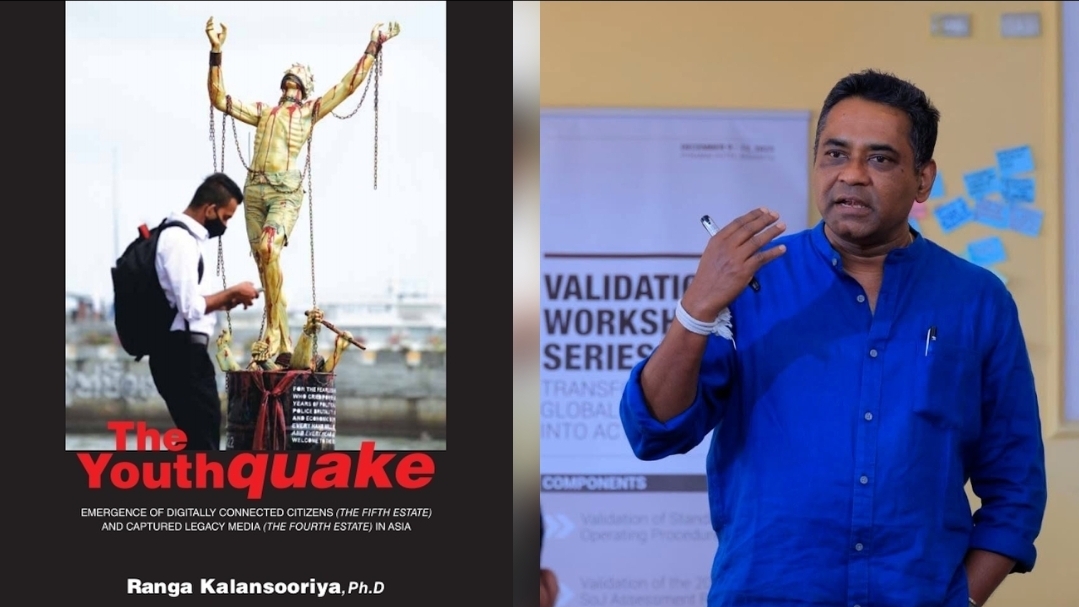
Ranga Kalansooriya, Asia Regional Adviser to International Media Support, has spent nearly two decades working across the media landscape in Asia and elsewhere. In an interview with Newswire, he argues that democracy depends on strengthening both traditional journalism and the emerging digital public sphere. If the Fourth Estate declines while the Fifth Estate remains driven by algorithms and AI without accountability, the Global South risks losing control over its own public discourse. The future, he argues, lies in making the two work together, rather than allowing one to replace the other.
The concept of the Fifth Estate is not entirely new. Oxford scholar William Dutton advanced the idea nearly two decades ago, arguing that digitally networked individuals were developing the capacity to hold governments, institutions and even traditional media accountable.
What was then largely theoretical soon became visible on the streets. The Arab Spring demonstrated the extraordinary capacity of digitally connected citizens to construct political narratives, organise themselves and challenge entrenched authority. The smartphone was becoming more than a communication device. It was becoming an instrument of political participation.
According to Kalansooriya, COVID-19 accelerated this transformation dramatically. The pandemic physically separated people while connecting them digitally. Education, work, commerce and ordinary communication moved online. Smartphones and digital networks penetrated communities that had previously remained outside the information revolution. Once that infrastructure existed, its use inevitably moved beyond education and communication. It became political.
Across parts of Asia, Kalansooriya argues, the traditional relationship between mainstream media and the public has consequently begun to reverse. Once, newspapers and broadcasters set the agenda and citizens responded. Increasingly, citizens set the agenda and mainstream media follows. Social platforms such as Facebook, YouTube, TikTok and Instagram provide the public arena in which narratives are constructed and opinion shaped. Messaging platforms such as WhatsApp, Signal and Telegram provide another layer: less visible networks through which organisation and mobilisation can take place.
This distinction is important because the Fifth Estate should not be confused with the older expression “fifth column.” The latter became associated with the Spanish Civil War and subsequently entered the language of intelligence and warfare to describe clandestine groups working from within a society on behalf of an adversary. The Fifth Estate is different. It is largely visible, decentralised and participatory.
Yet parts of the digital ecosystem can also acquire the characteristics once associated with the fifth column: closed networks, manipulation, covert mobilisation and organised disinformation. That is one of the contradictions at the heart of this transformation. The Fifth Estate can strengthen democracy. It can also destabilise it.
The Fourth Estate is running out of money
There is, however, another development that may prove even more consequential for countries in the Global South. While the Fifth Estate is becoming stronger, the Fourth Estate is becoming financially weaker.
The economic foundations that supported professional journalism for more than a century are eroding rapidly. Advertising once paid for reporters, editors, foreign correspondents, photographers and investigative journalism. Today, a substantial portion of that advertising has migrated to global digital platforms.
Kalansooriya estimates that across parts of Asia, roughly 40 to 50 percent of local advertising expenditure has shifted towards digital platforms, with the proportion exceeding 50 percent in markets such as Indonesia and the Philippines.
This is not merely advertising moving from newspapers to websites. There is an important economic distinction. When advertising moved between domestic newspapers, television and radio, the money largely remained within the national media economy. It helped finance local journalism and supported local employment. When advertising moves to multinational technology platforms, a substantial part of that value leaves the domestic media ecosystem.
The consequences are already visible. Newsrooms shrink. Experienced journalists leave. Investigative reporting becomes expensive. Suburban and rural reporting contracts. Media organisations become increasingly dependent on governments, political interests or wealthy business owners for survival.
And that creates another form of vulnerability: media capture. Kalansooriya describes mainstream media across parts of Asia as increasingly susceptible to commercial, political and sometimes illicit financial influence.
The crisis therefore becomes circular. Loss of revenue weakens journalism. Weak journalism damages public trust. Declining trust reduces audiences. Declining audiences further undermine revenue. Into the space created by that retreat comes the Fifth Estate.
A dangerous democratic dependency
This raises a question far larger than the future of newspapers. What happens to democracy when a country’s principal information ecosystem is no longer economically controlled within that country?
The Global South could find itself in an extraordinary position, Kalansooriya says. Its political conversations may increasingly take place on platforms whose ownership, algorithms, moderation policies and commercial priorities are determined thousands of kilometres away. A decision made in Silicon Valley, or another technology centre, could profoundly affect what citizens in Colombo, Kathmandu, Dhaka or Jakarta see, share and believe.
The old Fourth Estate certainly had faults. Newspapers and broadcasters could be partisan, commercially compromised or politically captured. But they existed within national legal and institutional frameworks. There were editors who could be questioned, publishers who could be sued, regulators who could intervene and professional standards against which journalism could be judged.
The Fifth Estate has no comparable architecture. As Kalansooriya puts it, it can resemble a “wild jungle.” The technology companies providing its infrastructure are commercial organisations. Their first obligation is not necessarily the democratic health of Sri Lanka, Bangladesh, Nepal or any other individual country.
This creates an uncomfortable paradox. The very technology that democratises information may simultaneously weaken the institutions historically responsible for producing verified information.
Indonesia offers another possibility
Kalansooriya’s research points to Indonesia as an especially interesting case. In several recent protest movements elsewhere in Asia, mainstream media organisations themselves became targets because protesters regarded them as part of an established and discredited political order.
Indonesia presented a different relationship. There, according to Kalansooriya, professionally produced journalism, including investigative reporting, could become source material for digitally connected citizens. The Fifth Estate picked up credible reporting produced by the Fourth Estate and amplified it through social networks.
That may offer an important clue to the future.
The relationship between old and new media does not necessarily have to be adversarial. Professional journalists have skills that remain enormously valuable: verification, investigation, sourcing, context, institutional memory and editorial judgement. The Fifth Estate possesses something different: scale, speed, participation and extraordinary powers of distribution and mobilisation.
Put together, they could strengthen democratic accountability. Separated, or turned against one another, both become vulnerable.
The Global South cannot negotiate country by country
There is another imbalance that must be confronted. Countries such as Sri Lanka, Nepal or the Maldives are individually tiny when negotiating with multinational technology companies whose revenues can exceed the economic output of small states.
National regulation alone therefore has obvious limitations. Attempts by governments to regulate social media frequently encounter resistance, technological difficulties or fears that regulation itself will become an instrument of censorship.
Kalansooriya believes the answer lies in collective action.
The Global South needs to negotiate as a bloc. Large markets such as India, Indonesia, Brazil and South Africa possess bargaining power that smaller countries do not. Technology companies cannot easily ignore markets containing hundreds of millions of users. Smaller states standing beside those countries could acquire collective leverage.
The principle is straightforward: if digital platforms derive enormous commercial value from the audiences, advertising markets and journalistic content of the Global South, some mechanism should exist to sustain the information ecosystems from which that value is derived.
Different countries are already experimenting. Indonesia has explored mechanisms for negotiating with technology companies and ways of supporting the broader media industry. South African media organisations have pursued competition arguments concerning the economic relationship between technology platforms and news publishers. Similar debates over compensation, competition and platform responsibility have occurred in Canada and Europe.
There is no universally successful model yet. But doing nothing carries its own enormous risk.
Then comes artificial intelligence
Just as societies are beginning to understand the Fifth Estate, another technological disruption has arrived.
Artificial intelligence dramatically lowers the cost of producing information. It can generate articles, photographs, video, voices and political messages at extraordinary speed and scale. Kalansooriya does not regard AI as a Sixth Estate. Instead, he sees it as something potentially more powerful: an accelerator of the Fifth.
AI can enrich and empower citizen participation. But it can equally industrialise manipulation.
A misleading social-media post once required a person to write it. Tomorrow, millions of individually tailored messages, images or videos could be produced automatically and distributed to carefully selected audiences. The distinction between authentic citizen participation and manufactured public opinion may become increasingly difficult to identify.
For countries in the Global South, the danger is amplified by another problem: regulation and public literacy are developing far more slowly than the technology itself.
Kalansooriya sees three fronts requiring attention. Governments need coherent and continually evolving AI policies. Citizens need sufficient AI literacy to question what appears on their screens. And newsrooms need ethical frameworks that allow them to use AI without surrendering the human judgement that gives journalism its value.
Sri Lanka, he argues, has the human resources to become a regional leader in this area. What it lacks is a coherent approach bringing government, technology companies, media, civil society and experts together.
Democracy needs both estates
The temptation is to frame this transformation as a contest. Old media versus new media. Journalists versus influencers. Newspapers versus social networks. The Fourth Estate versus the Fifth.
That would be a mistake. The greater threat is that the Fourth Estate collapses economically before institutions capable of performing its democratic functions emerge to replace it. A society containing millions of voices does not automatically become a well-informed society. More information does not necessarily produce better information. And the ability to speak is not the same as the ability to investigate.
Professional journalism remains one of the few institutions specifically designed to verify information prior to placing it before the public. The Fifth Estate, meanwhile, has broken the old monopoly over who gets to participate in public debate.
Democracy needs both. The Fourth Estate can provide verification, investigation, context and accountability. The Fifth Estate can provide participation, amplification, scrutiny and mobilisation. The challenge for the Global South is therefore not to protect legacy media simply because it is old, nor to restrain citizen media simply because it is disruptive. It is to build an information economy in which both can survive.
That will require new business models for journalism, greater transparency from technology companies, media and AI literacy, sensible regulation and, perhaps most importantly, collective bargaining power among countries of the Global South.
Because if the Fourth Estate disappears, the Fifth Estate will not necessarily inherit its democratic responsibilities. It may inherit only its audience. And if that audience becomes dependent upon algorithms, platforms and artificial intelligence systems controlled elsewhere, the Global South may discover that it has democratised the ability to speak while surrendering much of the infrastructure that determines who gets heard.
Kalansooriya’s central proposition is therefore less about the media than about democracy itself. The Fourth and Fifth Estates must cross-fertilise rather than destroy one another. Because if one collapses and the other remains uncontrolled, democracy itself may be the ultimate casualty.
Ranga Kalansooriya, Ph.D.
Ranga Kalansooriya brings more than three decades of experience in journalism and media development, with an international career spanning Asia and Africa. For the past 17 years, he has served as Asia Regional Advisor of IMS, building extensive experience in media development across the two regions.
A journalist by training, Kalansooriya began his career at the Sinhala-language daily Dinamina before moving to the Daily News, where he became Deputy News Editor. He trained in journalism at the Indian Institute of Mass Communication in New Delhi and later became a Reuters Fellow at Green College, Oxford University. A member of the Oxford Media Policy Summer Institute, he also holds Sri Lanka’s first PhD in Journalism.
His career has extended beyond the newsroom into media development, public service and diplomacy. He has served as Director General of both the Sri Lanka Press Institute and Sri Lanka’s Department of Government Information, undertaken a diplomatic posting in Malaysia, and served as Spokesman to the Foreign Minister of Sri Lanka.
More recently, Kalansooriya’s work has focused on what he describes as the “Youthquake” sweeping across Asia: the emergence of digitally connected citizens, particularly younger generations, as a new force in political participation and accountability. Drawing on Oxford scholar William Dutton’s Fifth Estate framework, his research examines how networked citizens are increasingly creating their own narratives, organising and mobilising outside traditional institutional structures, and acting as a check on political power.
His forthcoming book, The Youthquake in Asia, takes this exploration across the region, drawing on the Arab Spring and developments in Indonesia, Myanmar, Bangladesh, Nepal and Sri Lanka. Sri Lanka’s 2022 uprising and Bangladesh’s 2024 movement are among the cases through which the work examines the changing relationship between citizens, traditional media and political power. The book is due to be launched in early September.
Kalansooriya’s first book, Combating Terrorism and Discussing Peace – A Comparative Study on LTTE of Sri Lanka and IRA in Northern Ireland, was published in 2001. In 2020, his longstanding work in promoting media freedom and protecting journalists saw him selected as one of five finalists for the inaugural UK-Canada World Press Freedom Award, from more than 60 nominations worldwide.