

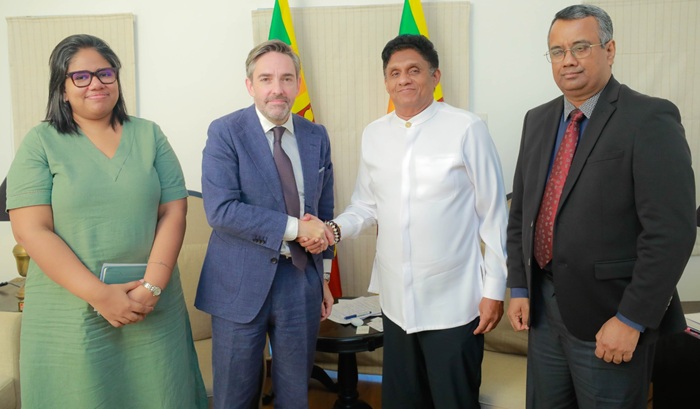
Opposition Leader Sajith Premadasa has urged Sri Lanka to adopt a unified national resilience framework that integrates democracy, economic recovery, climate preparedness, and social protection, warning that shocks in one system can quickly spread to others.
Premadasa made the remarks during a meeting with United Nations Resident Coordinator Marc‑André Franche, stressing that resilience must be built across governance, institutions, and society rather than treated as separate policy areas.
He emphasized that democracy should not be confined to elections but must be reinforced through the rule of law, separation of powers, independent institutions, parliamentary accountability, transparency, fundamental rights, and public participation.
The Opposition Leader noted that independent institutions must function regardless of who holds political power, and constitutional reforms should strengthen long‑term safeguards and balance of powers.
Highlighting the risks posed by El Niño and La Niña, Premadasa called for a shift from reactive disaster response to proactive systems based on climate forecasts, with pre‑preparedness, pre‑actions, and pre‑financial allocations.
He warned that these climate phenomena are not merely weather events but can trigger broad economic and social risks across agriculture, water security, food prices, livelihoods, energy, health, poverty, and public finance.
Premadasa proposed establishing a national programme for climate early warnings and pre‑actions by integrating UN agencies, Sri Lankan state institutions, expert bodies, universities, the private sector, and civil society. Climate risks, he stressed, must be incorporated into national economic and financial planning.
He argued that economic recovery should not be measured solely by macroeconomic stability but also by people’s purchasing power, employment, real wages, regional equity, youth opportunities, women’s economic participation, rural livelihoods, and the quality of public services.
“Sri Lanka must think more broadly about resilience. Economic, democratic, climate, and social resilience cannot be treated as separate policy areas. A shock in one system can quickly spread to others,” Premadasa said.
He concluded that Sri Lanka requires a resilience approach that engages the entire state and society, builds strong institutions, ensures an economy that benefits all, and establishes systems based on genuine pre‑actions for climate and disaster risks. (Newswire)