

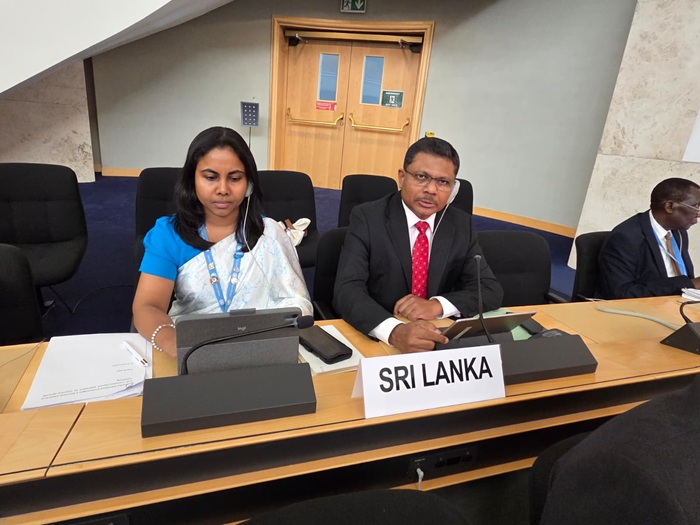
Sri Lanka has appealed to United Nations High Commissioner for Human Rights Volker Türk to ensure that country‑specific mandates are not treated as indefinite, stressing the need for periodic review and clear pathways to conclusion when national processes demonstrate progress.
Speaking at the 63rd Session of the UN Human Rights Council in Geneva on Tuesday (08), during the General Debate under Agenda Item 2, Sri Lanka’s Permanent Representative to the UN in Geneva, Ambassador Sumith Dassanayake, emphasized that Council resources must be directed toward the most pressing global challenges, including armed conflicts, displacement, and humanitarian crises.
Addressing the High Commissioner, Ambassador Dassanayake underscored that all mandates, particularly country‑specific ones, should be subject to periodic review against defined objectives and measurable outcomes.
He called for the inclusion of sunset clauses and phase‑out provisions in resolutions where appropriate, noting that credible pathways should be provided for concluding mandates when countries demonstrate progress through dialogue, cooperation, and technical assistance.
The Ambassador stressed that Sri Lanka’s national processes have shown progress in protecting and promoting human rights, and that such progress should be recognized by the Council. He added that mandates must not become open‑ended but instead reflect tangible achievements and evolving realities.
During the debate, several like‑minded countries commended Sri Lanka’s progress in advancing human rights protections for all citizens, reinforcing Colombo’s call for a more balanced and constructive approach within the Council.
The written update on the human rights situation in Sri Lanka was presented to the Council yesterday, with High Commissioner Volker Türk in attendance.
Full statement of Sri Lanka’s Permanent Representative to the UN in Geneva, Ambassador Sumith Dassanayake:
Madam Vice President,
High Commissioner,
The Human Rights Council has a wide and demanding global mandate. At a time when the international community faces grave and urgent human rights situations, including armed conflicts, humanitarian crises, displacement and global challenges, the Council should ensure that its work and resources are channelled towards pressing situations.
The UN80 reform process allows reflection on efficiency, prioritization and the effective use of resources across the United Nations system.
In this context, no Council mandate should be regarded as indefinite. All mandates, particularly country-specific mandates, should be subject to periodic review against defined objectives and measurable outcomes. Where mandates overlap, the Council should actively pursue their consolidation or rationalization.
Sunset clauses and phase-out provisions should be incorporated into country-specific resolutions where appropriate.
High Commissioner,
Where a country demonstrates progress through national processes, dialogue, cooperation and technical assistance, there should be a credible pathway to concluding the mandate.
The continuation of mandates should be justified by demonstrable need and results, not institutional perpetuation.
Sri Lanka therefore encourages a focused, objective and mandate-based approach to country-specific reporting. (Newswire)