

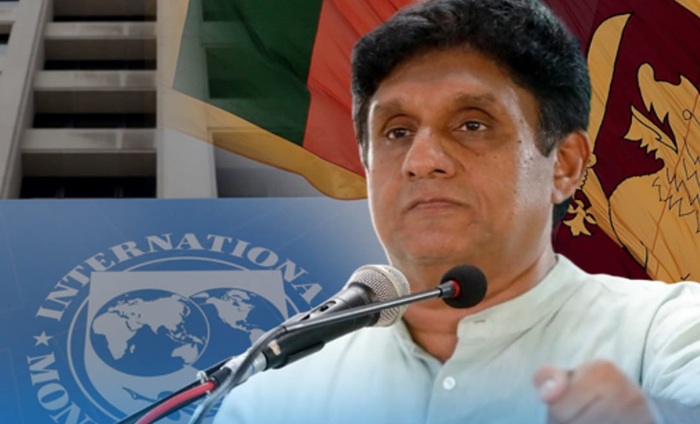
Opposition Leader Sajith Premadasa has called on the Government to pursue a successor agreement with the International Monetary Fund (IMF) after the current programme concludes in 2027, arguing that any future arrangement should focus on reducing poverty, promoting exports and easing the economic burden on Sri Lanka’s 22 million people.
Premadasa made the remarks in a special statement following comments by Minister Bimal Rathnayake that the Government intends to conclude the current IMF programme when the four-year Extended Fund Facility (EFF) expires in March 2027 and does not currently see a need for another programme linked to debt restructuring. Rathnayake has, however, said Sri Lanka would continue its normal engagement with the IMF and World Bank thereafter.
Premadasa said the conclusion of the EFF should not be interpreted as meaning that Sri Lanka’s economic recovery has been completed, claiming that the recovery process remains incomplete and that several vulnerabilities persist.
While acknowledging that a degree of economic stability has been achieved under the current programme, the Opposition Leader argued that this had come at a significant cost to ordinary people, with millions continuing to face pressure from the cost of living and other economic difficulties.
He said Sri Lanka would require a credible macroeconomic framework beyond the current programme, including measures to strengthen debt sustainability, maintain adequate foreign reserves, continue fiscal reforms, preserve creditor confidence and maintain access to international markets.
Premadasa said a successor IMF arrangement should be structured to eradicate poverty, promote exports and provide relief to farmers, fishermen, workers, entrepreneurs, the self-employed, those in the services sector, youth, women and children.
He argued that the Government should seek an arrangement that addresses what he described as the pressure imposed on the public under the existing programme while creating economic conditions that allow households to improve their living standards.
Despite his criticism of several aspects of the current IMF agreement, Premadasa said Sri Lanka should continue implementing the existing programme with discipline and credibility until its conclusion. He stressed that an appropriate framework must be in place when the programme ends to prevent the country from being exposed to renewed economic risks.
The current EFF was approved in March 2023 and is scheduled to expire on March 19, 2027. IMF staff concluded their latest visit to Sri Lanka on September 23, saying discussions on the Seventh Review would continue in the near term. The IMF said Sri Lanka’s economy continued to demonstrate resilience but warned that risks remained tilted to the downside.
Premadasa also raised concerns over Sri Lanka’s debt position, citing IMF projections on public debt and debt-servicing obligations.
The IMF’s latest published projections place Sri Lanka’s public debt at 100.1% of GDP in 2026 and 96.9% in 2027. Premadasa argued that such debt levels remain a major vulnerability and questioned whether the country would be able to comfortably meet its medium-term debt sustainability targets.
He also referred to the debt sustainability targets requiring average gross financing needs to remain below 13% of GDP and average foreign-currency debt service to remain below 4.5% of GDP over the relevant assessment period.
According to the IMF’s latest assessment, the projected average gross financing needs-to-GDP ratio for 2027-2032 stands at 12.6%, while average foreign exchange debt service is projected at 3.3% of GDP. The IMF has said debt sustainability risks nevertheless remain high.
Premadasa further criticised the handling of Sri Lanka’s restructured debt, including macro-linked bonds, claiming that arrangements reached under the previous administration and continued by the current Government could place additional burdens on the public.
Turning to foreign reserves, the Opposition Leader stressed that Sri Lanka must have sufficient buffers in place by the time the current IMF programme concludes.
He cited IMF projections that gross official reserves would reach approximately US 8.65 billion in 2026 before increasing to around US 11.78 billion in 2027. The IMF projects these levels at 73.6% and 96.9%, respectively, of its Assessing Reserve Adequacy composite metric.
Premadasa said the country should ensure that it has sufficient reserves to withstand external shocks after the EFF ends, particularly given continuing global economic and geopolitical uncertainty.
He also called for greater emphasis on investment and export-led growth, saying Sri Lanka should improve confidence among private investors, attract foreign direct investment and shift towards an economy that places greater emphasis on exports.
Premadasa said both macroeconomic and microeconomic stability would be necessary to restore confidence and place the economy on a sustainable footing.
The Opposition Leader also claimed poverty had risen to between 30% and 40% and called for a new programme specifically aimed at reducing poverty and generating employment, particularly for young people.
He said large numbers of young Sri Lankans who had completed their Ordinary Level and Advanced Level examinations, as well as university graduates, remained without employment, arguing that future economic policies should place greater emphasis on job creation.
Premadasa maintained that Sri Lanka should continue engaging with the IMF after the current programme ends, but said any future agreement should be more focused on protecting households from economic pressure while maintaining fiscal and macroeconomic stability.
He also warned that Sri Lanka must strengthen its ability to withstand external shocks arising from geopolitical conflicts and climate change, saying the country could not afford a return to the shortages and queues experienced during the economic crisis.
At a time when household incomes remain under pressure, Premadasa said Sri Lanka requires a new economic programme capable of sustaining stability while delivering tangible improvements to the lives of the public. (Newswire)