

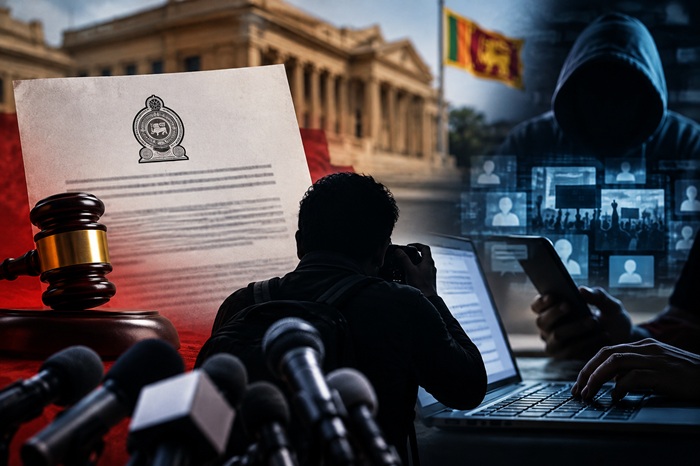
Internet Media Action (IMA) has strongly criticised the government’s proposed Protection of the State from Terrorism Bill (PSTA), warning that several provisions could severely restrict freedom of expression, media freedom and digital rights in Sri Lanka.
In a statement issued today (01), IMA expressed concern over the Bill gazetted on September 22, 2026, alleging that its provisions could pave the way for what the organisation described as a “digital dictatorship” by extending restrictive anti-terrorism measures into online spaces.
The organisation acknowledged that certain provisions of the original draft, including Clause 55 relating to the interception of communications and decryption, had been amended following domestic and international pressure. However, it maintained that the changes had failed to address its fundamental concerns over the proposed legislation.
IMA warned that several clauses could potentially expose social media users, journalists, activists and content creators to legal action over activities commonly associated with online expression and public protest.
Referring to Clause 3, the organisation raised concerns over the inclusion of offences such as unlawfully compelling the government and seriously disrupting communication systems within the definition of terrorism.
It argued that the wording could create a risk of online campaigns, petitions and hashtag-driven protests against government policies being interpreted as terrorist activities.
IMA cited the #GotaGoHome social media campaign during Sri Lanka’s 2022 public uprising as an example of how digital platforms have played a significant role in public mobilisation.
The organisation also raised concerns over Clause 9, claiming that broad wording such as “indirectly inciting” could potentially expose individuals to rigorous imprisonment of up to 15 years over certain forms of online expression, including political satire, memes, posters, TikTok videos, Reels and other creative content, if deemed to constitute offences under the proposed law.
Meanwhile, IMA claimed that Clauses 10 and 59 could result in sharing, retweeting, forwarding or linking to certain publications being treated as the circulation of terrorist material. It further raised concerns over provisions empowering the President to restrict online publications through gazette notifications.
The organisation also warned that Clause 15, which it says provides for imprisonment of up to seven years for failing to provide information, could undermine the confidentiality of journalistic sources and whistleblowers, particularly affecting investigative and citizen journalists.
Concerns were additionally raised over Clauses 61 and 74, which IMA said would enable the Defence Secretary to designate certain locations as prohibited places for 72 hours, restrict photography and videography, and classify certain security-related information, potentially limiting media reporting.
IMA further argued that although Clause 11 contains provisions intended to protect legitimate media reporting, the requirement to establish that reporting was carried out in good faith, coupled with the fear of arrest, could encourage widespread self-censorship among journalists and the public.
The organisation maintained that the proposed legislation could not be adequately addressed through isolated amendments, calling attention to what it described as inconsistencies with international human rights standards and civil liberties.
IMA also criticised the National People’s Power (NPP) government over its approach to anti-terrorism legislation, alleging that advancing the PSTA contradicted its election pledge to repeal the existing Prevention of Terrorism Act (PTA) in its entirety.
The organisation reiterated its opposition to the proposed Bill, urging greater protection for freedom of expression, media independence and citizens’ digital rights. (Newswire)