

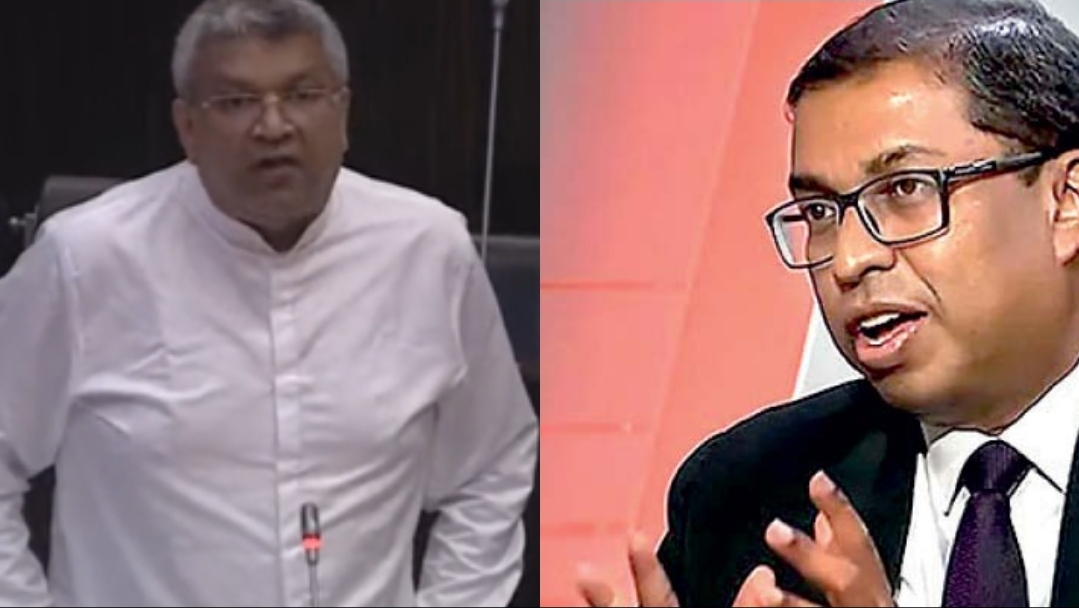
Former Bar Association of Sri Lanka (BASL) President and President’s Counsel Saliya Pieris has challenged Justice Minister Harshana Nanayakkara’s explanation of the proposed Prevention of Organised Crimes Bill, warning that its broad provisions and lack of safeguards could expose ordinary citizens to arbitrary arrests and prolonged detention.
Responding to the minister’s statement in Parliament on Tuesday (20), Pieris questioned who would determine whether a person’s tattoos or clothing resembled those associated with organized criminal groups.
“Who decides at the point of arrest whether the tattoo or clothes are similar to those used by criminal groups?” Pieris asked.
He said such decisions would initially be made by police officers who would be vested with extensive powers under the proposed legislation.
Earlier, Justice Minister Nanayakkara rejected claims that individuals could be arrested simply for having tattoos, long hair or certain clothing styles. He explained that the relevant provisions applied to characteristics associated with known members of organized criminal groups and did not criminalize personal appearance.
However, Pieris argued that the minister’s explanation failed to address the wider implications of the proposed law.
According to Pieris, the bill would permit detention orders to be issued by the relevant ministry secretary at the request of a Deputy Inspector General of Police or the Inspector General of Police, allowing suspects to be detained for up to two months without judicial authorization and potentially for up to one year thereafter.
He further claimed that even without a detention order, a magistrate would have no option but to remand a person produced under the proposed law, regardless of whether sufficient supporting material had been presented.
“If the police say the tattoo or clothing concerned is that of an organised criminal group and produces the person under this law the Magistrate will have to remand,” he said.
Pieris also raised concerns that suspects would have to seek bail from the High Court, creating additional difficulties for ordinary citizens.
He criticized provisions allowing police-recorded confessions to be admitted as evidence in court, warning that such measures could encourage torture and abuse.
The former BASL president recalled that many members of the Janatha Vimukthi Peramuna had experienced torture, abuse and prolonged detention under the Prevention of Terrorism Act (PTA) and Emergency Regulations.
He warned that laws including the PTA, Emergency Regulations and ICCPR Act had been misused under successive governments, causing considerable suffering.
Pieris also questioned the drafting process, saying that, to his knowledge, the bill had not been prepared by the Justice Ministry and had not undergone a public consultation process.
“Those who are trying to justify this new Bill as being a necessity, must recall how the PTA, the Emergency Regulations, the ICCPR Act and other laws have been abused under successive governments and the untold suffering and harm it has caused to people,” he said.
Pieris concluded by warning that those who had witnessed the misuse of such legislation and its consequences for victims could recognize the dangers posed by the new bill.
The proposed Prevention of Organised Crimes Bill was presented to Parliament for its first reading on October 20 and has not yet become law.
The Justice Minister, meanwhile, maintained that the provision concerning clothing, hand signals and tattoos was modeled on Singapore’s organized crime legislation and was intended to help identify membership in criminal organizations rather than criminalize ordinary citizens’ appearance. (Newswire)