

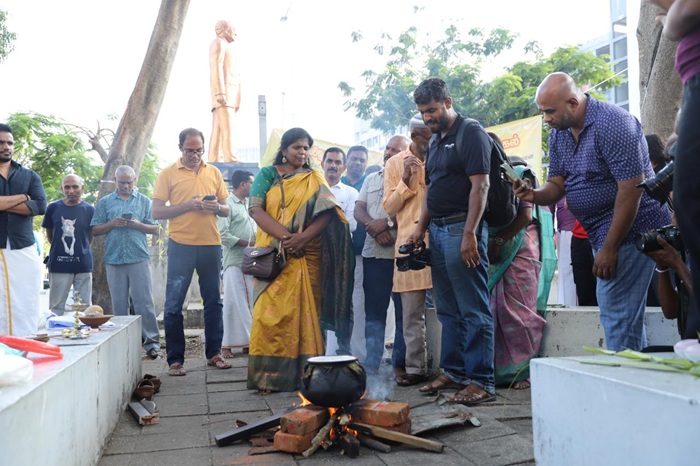
Marking the auspicious Thai Pongal festival, members of Sri Lanka’s Malaiyaha (Hill Country Tamil) community gathered at Liberty Roundabout in Colombo last afternoon (15 Jan) to demand land rights, individual housing, and justice for a community that has endured generations of structural marginalisation.
Organised by the Civil Society Alliance for Reforms for the Malaiyaha Community, the event, titled “Pongal for Rights”, brought together plantation workers, activists, and civil society representatives to highlight the long-standing injustices faced by Malaiyaha people, particularly in the wake of recent climate disasters.
Speakers at the event stated that for over two centuries, Malaiyaha workers have laboured on tea plantations and remained the backbone of Sri Lanka’s plantation economy, yet many still live in overcrowded line rooms, without land ownership, secure housing, or basic services.
The situation has worsened following the Ditwah climate disaster, which caused floods and landslides across the Central Highlands, including Kandy, Nuwara Eliya, Badulla, Matale, and Kegalle. Entire plantation communities, especially in areas of the Central hills, were severely affected, losing homes, livelihoods, and access to essential infrastructure.
Despite these losses, organisers said affected families have received inadequate state support, leaving them further marginalised.
“Our labour built this economy, but our lives remain disposable,” one organiser said. “Pongal is about harvest and dignity, yet dignity is what we are still denied.”
Participants collectively raised the following demands: Individual houses instead of line-room housing, Land with secure legal title, Establishment of new villages with proper infrastructure, State-led and civil society-supported reconstruction of disaster-affected Malaiyaha settlements.
Placards, traditional Pongal pots, and symbolic offerings were used during the gathering to connect cultural heritage with political demands for rights and recognition.
Organisers emphasised that Malaiyaha people, brought to Sri Lanka under colonial plantation systems as cheap labour, continue to face low wages, insecure tenure, and social exclusion, even decades after independence.
The event concluded with a call for the government and broader society to recognise land and housing not as charity, but as fundamental rights essential for citizenship, dignity, and climate resilience. (Newswire/ Image -Sakuna M Gamage)