

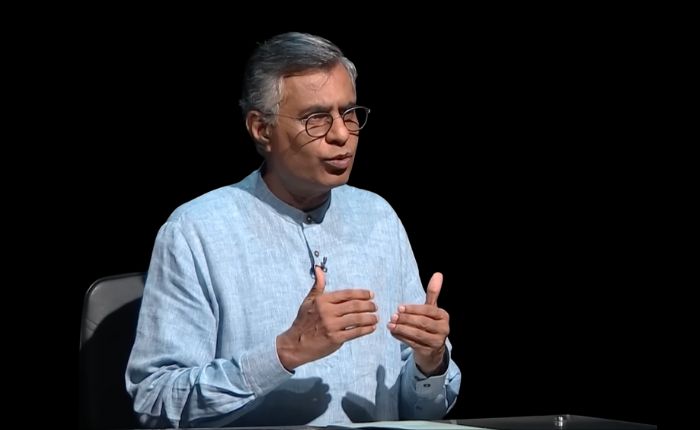
Former minister Patali Champika Ranawaka has accused the government of failing to act on early warnings about Cyclone Ditwah, despite having prior knowledge and publicly acknowledging it in Parliament.
He said authorities had at least three days to prepare between the initial alerts on November 24–25 and the cyclone’s landfall on the 28th, but failed to activate Sri Lanka’s disaster response mechanisms in time.
In a televised interview, Ranawaka claimed that the Meteorological Department had data indicating the potential for a cyclone to enter Sri Lanka as early as November 24 or 25. He said this information was acknowledged by Public Security Minister Ananda Wijepala in Parliament.
“The cyclone made landfall on the 28th, giving authorities three days to prepare,” Ranawaka said, acknowledging however, that there had already been significant rainfall even before the 25th.
He stressed that under standard protocol, the Meteorological Department is required to share such data with the Disaster Management Centre (DMC), which is then expected to coordinate with relevant authorities.
“The data they received should be shared with the Disaster Management Centre (DMC), which is the protocol. The DMC must then discuss with relevant authorities, they should have understood the seriousness of this, if so, they should inform the President through the President’s Secretary of this situation,” Ranawaka said.
He further claimed that data may have been available as early as November 10, and noted that the name “Ditwah” was assigned by Yemen earlier in November. “Satellite data is constantly received by the Met Department about such things,” he added.
Ranawaka also referred to comments made on November 12 by the Director General of the Department of Meteorology, Athula Karunanayake, who had discussed the possibility of cyclonic development during a televised talk show.
“His speech during the talk show suggests that he was fully aware of what was going to happen,” Ranawaka said.
When questioned about a statement made by Meril Mendis, Deputy Director of Weather Forecasting and Disaster Management, who claimed that Karunanayake’s comments were not in reference to Cyclone Ditwah.
“Mendis said that the risk was identified on the 23rd. By the 25th, the development into a cyclone was noted. He also says that forecasting cannot be done, as it developed rapidly,” the journalist questioned.
Ranawaka, however, argued that all weather forecasting systems had pointed to possible cyclone development and warranted early preparation. “In 2020, there was Cyclone Burevi which made landfall in Sri Lanka. There were big preparations here, although it did not cause much damage. Preparation is important,” he said.
It was also noted that the Indian Meteorological Department had issued regular updates every three hours on the developing depression and possible cyclonic activity.
Ranawaka stressed that Sri Lanka’s Disaster Management Act grants significant authority to the Disaster Management Council, chaired by the President and including the Prime Minister, representatives of line ministries, governors, chief ministers, and opposition members including opposition leader.
He argued that once early warnings were issued on the 25th, the council should have been convened, a national disaster situation declared, and emergency regulations activated.
“From the 25th to 28th — a period of three days — should have been sufficient. With past experiences Sri Lanka has seen with disasters, the country has the necessary mechanisms in place to prevent large-scale destruction,” Ranawaka said. (Newswire)