

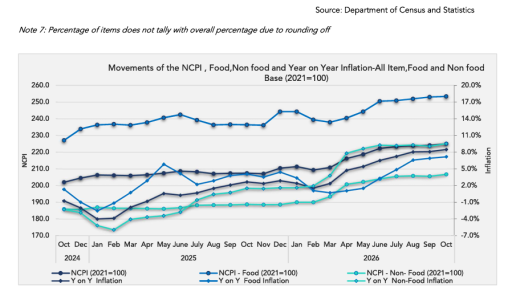
Sri Lanka’s overall year-on-year inflation edged up to 8.5% in October 2026, compared with 8.1% in September 2026, according to the National Consumer Price Index (NCPI) released by the Department of Census and Statistics (DCS).
Both food and non-food prices saw higher annual increases during the month. Food year-on-year inflation rose from 6.9% in September to 7.2% in October, while non-food year-on-year inflation climbed from 9.1% to 9.5% over the same period.
Non-food items accounted for the larger share of annual inflation in October 2026, contributing 5.29% compared with 3.21% from food items. Transport was the single biggest non-food driver at 2.45% reflecting higher annual costs for petrol (1.21%), bus fares (0.36%), diesel (0.20%), and school or preschool transport (0.19%). Housing, water, electricity, gas, and other fuels contributed 1.17%, led by housing rent (0.46%), maintenance materials (0.30%), and LP gas (0.23%).
Other non-food categories adding to annual inflation included restaurants and hotels (0.52%), education (0.39%), miscellaneous goods and services (0.26%), health (0.17%), household furnishings and routine maintenance (0.14%), and clothing and footwear (0.11%), with smaller contributions from recreation and culture (0.04%), alcoholic beverages, tobacco, and narcotics (0.02%), and communication (0.01%).
In the food basket, annual upward pressure came mainly from vegetables (0.79%), fresh fish (0.47%), dried fish (0.40%), big onions (0.38%), milk powder (0.26%), and fresh fruits (0.24%), alongside smaller increases for dried chilies (0.18%), chili powder (0.14%), green chilies (0.12%), chicken (0.11%), and eggs (0.10%). At the same time, lower year-on-year prices for coconuts (-0.48%), rice (-0.32%), and limes (-0.07%) helped ease food inflation. (Newswire)