

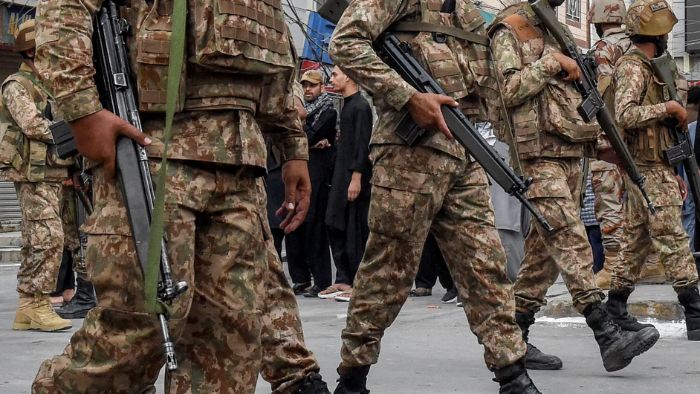
The military has long shaped the political system of Pakistan, which is often described as a hybrid civilian-military power structure. While the military last ruled in 2008, its influence in the nuclear-armed nation has been growing in recent years. A new constitutional amendment could further tip the scales in its favor.
Under changes approved by lawmakers in mid-November, Field Marshal Asim Munir has been given lifelong immunity from prosecution and his authority has been expanded from army chief to controlling all three branches of the military. Munir is widely considered the most powerful figure in Pakistan, having the final word on critical matters including foreign policy and the economy.
What’s changed under Pakistan’s 27th constitutional amendment?
Pakistan’s military command structure has been modified, putting more power in the hands of the army. A new position of Chief of Defense Forces has been created, centralizing command of the army, navy and air force under the head of the army — in other words, Munir has been installed at the helm of Pakistan’s military establishment.
Lawmakers also modified the Army Act to reset the clock on Munir’s five-year tenure as army chief. His current term will now end in 2030, instead of 2027, and he’ll be in post during Pakistan’s next general election, which is due in 2029.
The 27th constitutional amendment introduced another new position, Commander of the National Strategic Command. It’s up to the prime minister to fill this post with an army officer, on the recommendation of the army chief.
In addition, the amendment granted lifelong immunity to the president, field marshal, marshal of the air force and admiral of the naval fleet, and they can only be removed if parliament impeaches them. Lawmakers had sought to give the prime minister immunity as well, but the move was blocked by the current occupant of the office, Shehbaz Sharif, who said that a prime minister should “remain fully accountable, both before the court of law and the people.”
Holders of those top-ranking military titles will now retain their rank and privileges for life, codifying Munir’s position in the constitution. He’s Pakistan’s second-ever field marshal, having been promoted in May for his actions during the brief conflict with India.
Was the military the only focus of the constitutional changes?
The amendment reformed the judiciary, too. It established a Federal Constitutional Court that will sit above the Supreme Court and settle constitutional questions. The first group of 13 judges for this new court will be appointed by the president.
The government said the new Federal Constitutional Court will enable “timely adjudication” of big constitutional issues and ease the burden of the Supreme Court, which will now be limited to criminal and civil cases. However, some view the reforms as a way of curtailing judicial independence. Two Supreme Court justices resigned just hours after the amendment was passed.
Why was the constitution amended now?
According to Law and Justice Minister Azam Nazeer Tarar, the changes are meant to improve the “procedural clarity and administrative structure” of the armed forces, and he said that formalizing the field marshal’s role was particularly important after the military clash with India in May. Defence Minister Khawaja Asif said that parliament gave immunity to Munir “because he won the war against India for the country.”
Supporters of the amendment argue that the new Chief of Defense Forces post will make command of the army, navy and air force more efficient and unified. This could streamline decision making as Pakistan grapples with ongoing tensions with neighbors India and Afghanistan, as well as insurgencies in the west of the country. However, others have suggested that elevating the army chief above the heads of the other two forces could exacerbate inter-service rivalry.
The expansion of Munir’s powers comes as his profile is rising. He’s been at the forefront of efforts to improve Pakistan’s relations with the US, which have oscillated between periods of close cooperation and frostier ties. Munir has twice visited President Donald Trump at the White House this year and also credited him with brokering a ceasefire between India and Pakistan in May. Trump has called Munir his “favorite field marshal.”
What do the constitutional changes mean for Pakistan’s civilian government?
The army’s already significant role in Pakistan’s military and politics has become constitutionally entrenched. The amendment has effectively created a permanent, legally immune military elite that’s virtually untouchable, even after retirement.
That means it will be much more difficult for the civilian government to investigate any potential military misconduct, political interference, financial wrongdoing or even coup plotting. Pakistan has a history of the military overthrowing the government.
Together with the judicial reforms, the constitutional amendment has weakened the institutions that normally check misuse of power. The swiftness with which the changes were tabled and passed — in a matter of days rather than months — has drawn criticism. Some opposition lawmakers staged protests and walked out during the voting process, saying the amendment is unconstitutional and marks “the death of democracy.”
What’s the history of the military’s power in Pakistan?
The military has staged four successful coups since the creation of Pakistan in 1947 — when the British partitioned the Indian subcontinent — and has ruled the country for almost half of its 78-year history. There have only been two peaceful transfers of power from one civilian administration to another and no prime minister has ever completed their full five-year term.
It’s been more than 17 years since the late Pervez Musharraf stepped down as the country’s last military ruler. But the armed forces — in particular the Inter-Services Intelligence, which oversees internal security — still enjoy outsized influence over Pakistan’s security and foreign policy. The military also has significant economic clout through land ownership and shareholdings in large corporations.
Even when the military hasn’t been in direct control, it’s been an important power broker. Former Prime Minister Imran Khan — who has been in prison since 2023 on corruption charges he denies — came to power in 2018 with the help of the military. But he was ousted in a no-confidence parliamentary vote after a fallout with the army over a range of issues, including his management of the economy and perceived interference in military promotions.
Sharif has thus far managed to keep the military on side. The current prime minister said in September that “the country’s political and military leadership are on the same page.” (Bloomberg)