

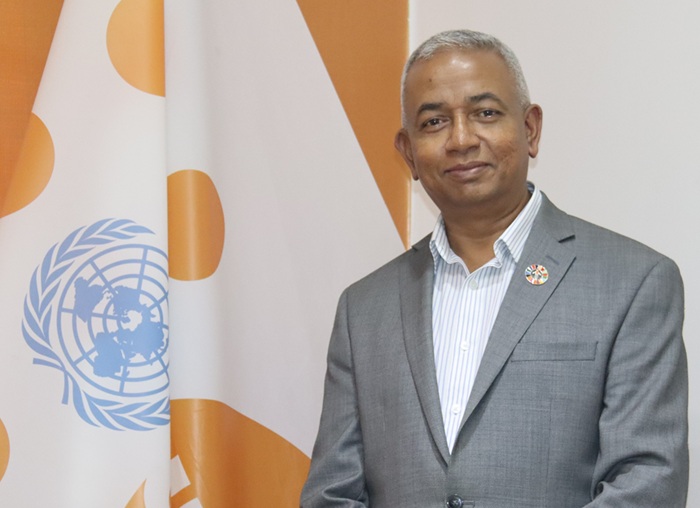
By Dr. Dayanath Ranatunga, Assistant Representative, UNFPA
On this World Health Day (7 April), we are reminded of a simple yet powerful truth: health is not static, and neither are the challenges we face. This year’s theme, ‘Together for Health. Stand with Science’ calls on us not just to trust science, but to actively use it to navigate an increasingly complex world.
When we think of ‘science’ we must look beyond laboratories, medical equipment and textbooks. In health, science is not confined to medicine alone. It is a way of thinking, a method of understanding, and a tool for making better decisions in our everyday lives. Science is not only for policymakers, but it shapes the decisions we all make every day.
Today’s health challenges are complex and interconnected, no longer predictable. From infectious diseases like COVID-19, to climate-related risks such as extreme heat, and from shifting population dynamics, including increased migration, to new forms of online violence, our responses must evolve with these changing health needs.
For instance, take maternal and newborn health. In many countries, including Sri Lanka, declining fertility rates and improved survival mean that every pregnancy carries even greater significance. Each mother and each newborn represent not just a life, but the future of families, communities, and economies.
Yet, globally, maternal mortality remains a pressing challenge. In 2023 alone, an estimated 260,000 women died from pregnancy and childbirth-related causes, equivalent to 712 deaths each day, many of which are preventable with timely, science-based interventions (UNFPA et al., 2023). This reality demands more precise, data-driven approaches to care, ensuring that services are accessible, timely, and of the highest quality.
Similarly, the nature of gender-based violence (GBV) is evolving. While physical violence remains a critical concern, new forms, such as Technology Facilitated Gender Based Violence (TFGBV), cyber harassment, and online abuse are emerging rapidly. These forms of violence may not leave visible scars, yet their mental and psychosocial impact can be profound and long-lasting, which may lead to chronic depression and even suicides.
A purely traditional response is no longer sufficient. To effectively respond to the evolving trends of violence, we need multidisciplinary approaches informed by science that integrate mental health, digital safety and survivor-centered care.
At the same time, we are witnessing a significant demographic shift in Sri Lanka and beyond. People are living longer than ever before, a testament to advancements in healthcare. But longevity without health brings its own challenges. Non-Communicable Diseases (NCDs), such as diabetes, cardiovascular diseases, and cancers, are on the rise, particularly among ageing populations.
In Sri Lanka, this burden is already evident; recent estimates indicate that nearly 13.9% of mothers develop diabetes during pregnancy due to obesity and unhealthy dietary habits, highlighting how lifestyle-related conditions are increasingly affecting even maternal health (Sri Lanka Medical Association).
This brings me to a critical question: are we investing enough in prevention?
There is a simple but powerful analogy. Think about this: in the context of health, if we spend one rupee on prevention today, how much are we able to save tomorrow?
Scientific research consistently shows that early intervention, healthy lifestyles and preventive care reduce disease and lower long-term healthcare costs. Especially, in a country like Sri Lanka, where public healthcare is freely accessible, this becomes even more important, where prevention is an economic imperative.
Science in terms of data and research shape effective policies by identifying gaps, tracking trends, and anticipating future needs, enabling governments to ensure smarter resource allocation, faster responses, and more resilient health systems.
This is why, at UNFPA, data-driven decision-making is at the heart of our work. Whether it is using Geographic Information Systems (GIS) to map how long it takes for a pregnant woman to reach the nearest health facility, or analyzing population data to guide service delivery, our goal is to ensure that no one is left behind.
Because behind every data point and every scientific figure, is a human story. As Public Health Midwife Padmakanthi from Nuwara Eliya once shared, “It is a privilege to be a mother’s most trusted guide, walking alongside her as she brings new life into the world”. The country must continue to strengthen the motivation and sense of ownership among frontline healthcare workers.
We also recognize the growing importance of digital innovation in healthcare. From telemedicine to data systems that enable real-time decision-making, digital tools are progressively transforming how care is delivered. They improve efficiency, strengthen preparedness for emergencies such as Cyclone Ditwah, and help ensure that even the most remote communities can access essential services without interruptions.
In Sri Lanka, this transformation is already taking shape. Through partnerships with the Government and support from development partners, UNFPA is strengthening training institutions such as the Provincial Health Training Centre in Batticaloa, equipping midwives not only with clinical skills, but also with digital tools and knowledge to better serve communities. This means a health workforce that is more prepared, more connected, and better able to respond to evolving health needs.
Technology alone is not the solution. It must be guided by evidence grounded in equity.
Yet, even with advancements in science and technology, not all health needs receive equal attention. Women’s health, for instance, continues to be under-researched and underfunded. Today, only 7% of global healthcare research focuses on conditions specific to women, highlighting a critical gap in how health priorities are defined and addressed.
Health does not begin in hospitals. It is shaped by the environments we live in, the choices we make, and the systems we build. Climate change, for instance, is no longer just an environmental issue – it is a growing health crisis. Extreme weather events, heat stress, food insecurity, and displacement are already affecting lives. Responding to these complex challenges requires integrated, well-coordinated and evidence-based multisectoral approaches across sectors.
As a medical professional, I have seen firsthand how science saves lives. But I have also seen how its absence, whether in policy, practice, or public understanding, can widen inequalities and leave the most vulnerable behind.
This World Health Day, let us reaffirm our commitment to science, not as an abstract concept, but as a practical tool for healthier lives and stronger communities. Let us invest in prevention, embrace innovation, and ensure that our responses evolve as the challenges we face. Because, science is not just about knowledge; it is about ensuring that everyone has the opportunity to live healthy, dignified lives, and that no one is left behind.