

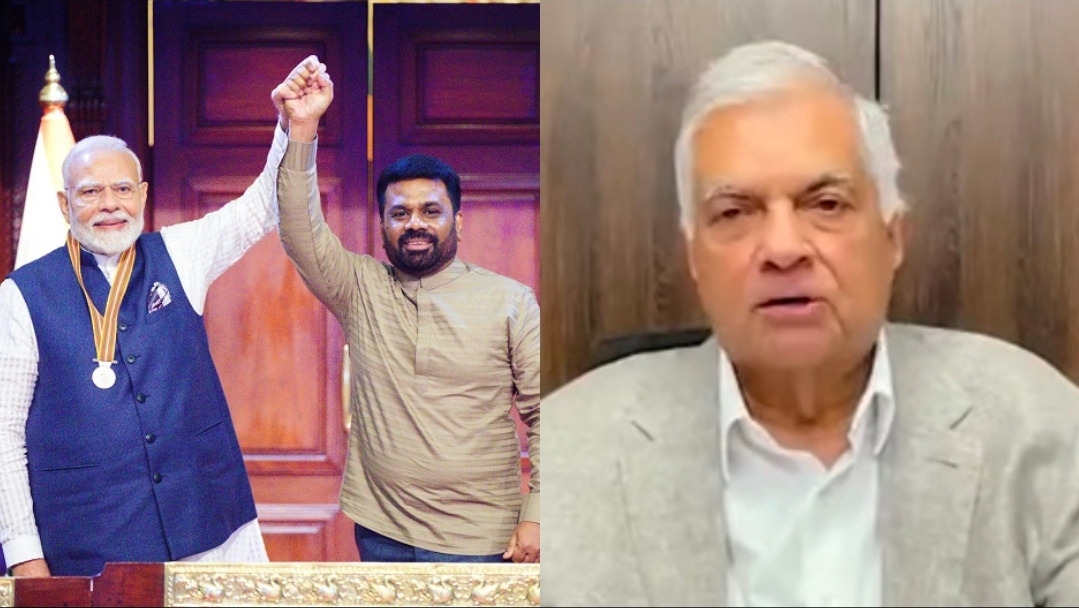
Former President Ranil Wickremesinghe has called for stronger economic cooperation with India, describing it as a key priority for Sri Lanka as global political and economic power shifts towards Asia.
Addressing the 50th webinar of the International Chamber of Commerce Sri Lanka (ICCSL), Wickremesinghe said Sri Lanka must adapt to emerging geopolitical realities through technological modernisation, regional economic integration and stronger partnerships with major powers.
He identified closer economic cooperation with India as one of the main requirements for Sri Lanka to secure its position in the emerging global order.
Wickremesinghe highlighted India’s growing economic influence, describing it as the dominant power in the Bay of Bengal region and referring to its position among the world’s three largest economies by GDP.
He said the Indian Ocean would become one of the centres of the new global order, driven by the economic rise of Asia and Africa.
The former President also pointed to the growing economic potential of the Bay of Bengal, with India playing a central role alongside Indonesia, Bangladesh and other emerging regional economies.
He said Sri Lanka should strengthen relations with Bay of Bengal countries and Southeast Asia, eventually working towards greater regional economic integration.
Wickremesinghe also referred to Indian Prime Minister Narendra Modi’s remarks at the NDTV World Summit, where Modi described the current global situation as a transition between two world orders.
According to Wickremesinghe, Modi had highlighted the increasing use of finance, trade, technology and shipping as instruments of geopolitical influence.
He also referred to Modi’s quotation of the ancient Indian strategist Chanakya on the need to prevent Matsya Nyaya, or the law of the fishes, under which the strong swallow the weak.
“We in Sri Lanka must adapt to these changes, or we will be swallowed up by bigger fish,” Wickremesinghe warned.
The former President said technological advancement was becoming central to national sovereignty, with the United States and China emerging as the two leading powers in artificial intelligence and computing.
He stressed that Sri Lanka must undertake economic and social transformation based on technological modernisation to remain competitive.
Outlining his proposals, Wickremesinghe called for Sri Lanka to become a maritime logistics centre, strengthen economic cooperation with India and build closer relationships with countries across the Bay of Bengal and Southeast Asia.
He also proposed that Sri Lanka join BRICS and strengthen relations with the United States, China, Russia and Japan.
The former President urged a review of the effectiveness of regional organisations, including the Indian Ocean Rim Association (IORA) and the Bay of Bengal Initiative for Multi-Sectoral Technical and Economic Cooperation (BIMSTEC).
He also called for accelerating the work of the Colombo Security Conclave, which he said would play an important role in the future security of the Indian Ocean.
Wickremesinghe stressed the importance of developing a technologically advanced Sri Lankan Navy equipped with small and medium-sized vessels, while prioritising the protection of undersea communication cables.
He warned that Sri Lanka could lose its relevance in the emerging global order unless it embraced economic modernisation and stronger regional partnerships.
“Either we go this way, or we fade into insignificance, like one of the small Pacific islands,” he said. (Newswire)