

Tamil Progressive Alliance (TPA) Leader, MP Mano Ganesan has urged the Government of India to simplify the process of granting Overseas Citizenship of India (OCI) status to recent Indian-origin Malaiyaha Tamils living in Sri Lanka who wish to obtain it.
Ganesan also called for restructuring the Ceylon Estate Workers Education Trust (CEWET), which operates under the Indian High Commission in Sri Lanka, by expanding its mandate to meet the current social and developmental needs of the Indian-Origin Tamil (IOT) Malaiyaha community.
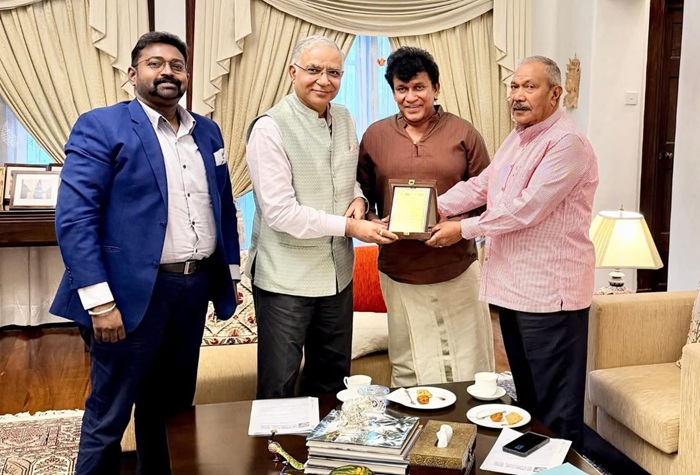
He made these appeals during a meeting with Indian High Commissioner Santosh Jha at India House in Colombo, accompanied by TPA Deputy Leader V. Radhakrishnan MP and Politburo Member Barath Arulsamy. Indian High Commission Political Counsellor Ram Babu also joined the discussions.
Taking to ‘X’, Ganesan said the TPA has already submitted detailed proposals to Indian Prime Minister Narendra Modi, External Affairs Minister S. Jaishankar, and both current and former Indian High Commissioners to Sri Lanka. “We now anticipate favourable responses from the Government of India,” he stated.
Highlighting the demographic context, Ganesan noted that approximately 1.5 million Tamils of Indian origin live in Sri Lanka, with nearly one million in plantation regions. However, only about 100,000 remain engaged in plantation labour today. “This demonstrates that the community has progressed through self-initiative into diverse professional, business, and social sectors, evolving into a recognized national minority community,” he said.
He emphasized that while many Sri Lankans trace their origins to India, the more recent Indian-origin population is identified as Malaiyaha Tamils. “Their Indian origin identity neither can nor needs to be concealed. India carries a significant moral responsibility toward Indian-origin Hill Country Tamils, which forms the basis of our engagement,” Ganesan added.
On the matter of OCI status, Ganesan urged India to grant it on a voluntary basis through simplified eligibility criteria. He noted that Prime Minister Modi had responded positively to the proposal during discussions in Colombo. He argued that optional OCI status would serve as a protective and empowering mechanism for the community, which continues to face structural disadvantages compared to Indian-origin communities in countries such as South Africa, Mauritius, Fiji, Singapore, and Malaysia.
He further observed that the 1964 Sirima–Shastri Repatriation Pact weakened the socio-economic position of the community in Sri Lanka. “Granting OCI status today would acknowledge our people’s history while expanding opportunities in education, employment, connectivity, and livelihoods, thereby strengthening the community,” he said.
Turning to education, Ganesan proposed restructuring CEWET into a new framework titled the Indian Origin Tamils – Community Development Trust (IOT-CDT). He stressed that the Malaiyaha Tamil community has moved beyond plantation-based livelihoods and requires broader institutional support.
The TPA suggested several initiatives, including:
- Increasing the value and number of scholarships.
- Establishing a Tamil-medium teacher training college for Mathematics, Science, Technology, and English.
- Creating a nursing training institute dedicated to Malaiyaha Tamil women.
- Setting up two international English-medium schools in Colombo and Nuwara Eliya, modelled on India’s Navodaya school system.
- Developing a Highlands University Campus in Nuwara Eliya District in partnership with a recognized Indian university, with the long-term goal of evolving into a full national university under Sri Lankan law. (Newswire)