

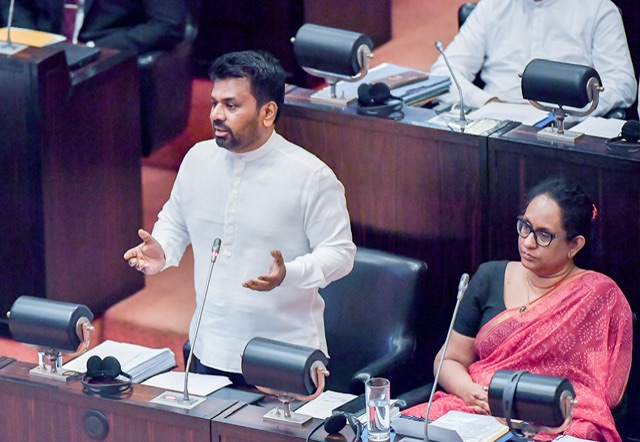
President announces Rs. 100 billion relief package for three months to ease the burden on the public amid the crisis
Full speech delivered by President Anura Kumara Dissanayake in Parliament today (2026-04-07), presenting the new economic relief package
In particular, in light of the situation that has arisen alongside the conflict in the Middle East, several sectors are currently experiencing considerable strain. Therefore, as a government, our responsibility is to focus on those affected and to initiate a programme of relief measures. In this regard, we considered two approaches.
The crisis has emerged primarily in two areas: the fuel and energy sectors. One option available to us is to sell fuel in line with its cost. This is one approach, especially as the country has already faced the consequences of heavy losses incurred by the Electricity Board and the Petroleum Corporation. Therefore, pricing fuel in accordance with cost is one proposal.The second proposal is to implement a subsidy mechanism instead of fully aligning prices with cost. If we adopt the first approach, it would not adversely affect the Treasury, the Ceylon Petroleum Corporation, or the Electricity Board. However, it would place a burden on the economy, industrialists, businesspersons and the general public. Hence, we needed to find a balanced solution.
Accordingly, we examined the impact of rising fuel prices. If adjusted to market rates, the price of a litre of diesel would exceed Rs. 600. This price includes a tax of Rs. 50. I have noted that some have proposed removing this Rs. 50 tax. However, even if the tax is removed, the price would only reduce by Rs. 50. Instead, our approach is to retain the tax while allocating up to Rs. 100 per litre of diesel from the Treasury.
This means that on or around 1 May, we will reintroduce the fuel pricing formula. This will be calculated based on actual data from the preceding month. At the next revision, a subsidy of up to Rs. 100 per litre of diesel will be provided, calculated against the actual cost. Similarly, a subsidy of up to Rs. 20 per litre of petrol will be granted.This will cost approximately Rs. 20 billion per month. We have structured this proposal for a period of three months. Accordingly, Rs. 60 billion has been allocated for diesel and petrol subsidies. This is highly significant, as we are not placing the entire burden on the public.
As a principle, subsidies should be targeted at specific groups. However, we currently lack a sufficiently accurate data system to do so. Therefore, we have decided to align the prices of super diesel and super petrol with market rates, while not applying the same adjustment to other fuel types. After considering this issue in various ways, the government will bear a cost of Rs. 100 per litreof diesel. At the same time, selected communities, particularly the fishing community, depend heavily on fuel as a key component of their livelihoods. Therefore, we explored whether additional relief could be provided to them beyond the general subsidy.
Accordingly, for boats with standard engines, regardless of whether they use petrol, diesel, or kerosene, we will provide an additional Rs. 50 reduction per litre on top of the existing Rs. 100 subsidy. A standard fishing boat will receive 25 litres per day over 25 days, amounting to 625 litres per month at this reduced rate. The Rs. 50 subsidy component will be credited directly to their bank accounts. As a result, each owner of a standard fishing boat will receive Rs. 31,250 per month. This support will be provided for a period of three months.
Furthermore, multi-day fishing vessels typically venture out to sea only once every three months. Therefore, within this three-month period, a fuel allowance of Rs. 150,000 will be provided per multi-day vessel for a single voyage. In addition to the general subsidy, we intend to implement a targeted relief programme specifically for the fishing community.
The next issue relates to fertiliser. In particular, the problem surrounding urea is that a considerable stock of fertiliserpurchased at previous prices is currently held by Agrarian Service Centres and the Department of Agriculture. We had approximately 14,000 metric tonnes of fertiliser procured at the earlier price.Iwould also like to express my appreciation to the companies involved. During the initial discussions, they agreed to supply 65% of their existing urea stocks to Agrarian Service Centres at the previous price. Following further discussions, they agreed to provide all the fertiliser they had in stock. This quantity is sufficient for two cultivation rounds of paddy farming.
However, for the third round, fertiliser would need to be purchased at higher prices. A shipment arrived yesterday, brought in by four importers, each quoting different prices. The lowest price was around USD 600 per metric tonne, while others ranged up to USD 850. Therefore, there is a risk of fertiliser prices increasing by the third round.
In light of this, we have decided to maintain the price of fertiliserat Rs. 10,200 even for the third round. The government will procure fertiliser from these companies and supply it at this fixed price. While the market price of a fertiliser bag would be around Rs. 13,500, the government will provide it at Rs. 10,200. This means an additional cost of approximately Rs. 3,000 per bag will be borne by the State. In total, this will amount to around Rs. 1.7 billion. As a result, the price of urea will be stabilised for paddy cultivation during the Yala season.
This fertiliser subsidy will be implemented through a well-structured system. Recommendations will be made based on the type of crop cultivated, whether paddy or other crops. We have also considered providing an additional subsidy, which will serve as a systematic criterion when extending other forms of assistance. Accordingly, we have decided to increase the fertiliser subsidy from Rs. 25,000 to Rs. 30,000. This subsidy incorporates other associated costs as well.
In addition, given the higher extent of additional crop cultivation during the Yala season, we have decided to increase the fertilisersubsidy for such crops from Rs. 15,000 to Rs. 18,000.
Furthermore, with regard to tea cultivation, we are already providing a subsidy of Rs. 4,000 per fertiliser bag to smallholder tea growers. In addition, we will provide a further one-off allowance of Rs. 5,000 per bag. Altogether, this will cost approximately Rs. 6.5 billion.
Next, the key issue we are facing is how to provide relief to low-income groups. At present, the only criterion we have to identify low-income earners is the Aswesuma programme. There have been certain criticisms regarding this. However, at this moment, Aswesuma remains the only systematic mechanism available to identify low-income households.
Under the existing Aswesuma scheme, the benefit levels are Rs. 17,500, Rs. 10,000, and Rs. 5,000. For the month of April, we have taken steps to increase these benefits as follows: the Rs. 17,500 allowance will be increased to Rs. 25,000; the Rs. 10,000 allowance to Rs. 15,000; and the Rs. 5,000 allowance to Rs. 7,500. Accordingly, an additional Rs. 8.5 billion will be incurred this month for this purpose.
Turning to electricity, the issue arises in three main ways. First, due to declining water levels in reservoirs, we are compelled to generate more electricity from thermal power plants. Second, there has been a significant increase in the prices of furnace oil, naphtha and diesel. Third, due to the reduced quality of coal, an issue frequently raised, there is a shortfall in expected power generation, which in turn requires us to compensate using other power plants at an additional cost.
In addition, we are now facing a further issue regarding crude oil. Our crude oil supplies were expected from Fujairah, while refined fuel is imported from Singapore and India. However, crude oil is sourced from the Middle East region. One shipment of crude oil has been delayed, and another is also delayed. We expect a shipment to arrive by mid-April. As a result, power plants may face certain risks.
Accordingly, the refinery may have to be shut down for several days. It is from this refinery that we produce the naphtha and furnace oil required. Anticipating this risk, we decided to import furnace oil separately. These shipments are expected to arrive around 13 to 15 April. However, the cost of importing furnace oil is higher than producing it through refining crude oil.
Furthermore, if the refinery is shut down for several days, and the required quantities of naphtha are not produced, we will have to rely on diesel instead. This will place an additional burden on electricity costs.
We import crude oil directly from the Middle East. However, attacks on ports in that region have begun and shipping routes are becoming disrupted. This makes the importation of crude oil extremely difficult. Nevertheless, we are confident that the letters of credit already opened will be honoured. If crude oil shortages persist, we will have to produce naphtha and furnace oil using diesel, which will further increase the cost of electricity generation.
There are several factors contributing to this cost increase:
The day before yesterday, the power plants were operating at full capacity. Normally, we expect 270 units from a plant. However, from the three plants, one produced 270 units, another 266 and the third around 244 units. This fluctuates. Although the installed capacity is 900 megawatts, only about 810 megawatts are actually generated, as approximately 30 megawatts per plant are consumed for internal operations.
At times, the expected 270 units are not achieved. The real issue lies in the quality of coal. This is not a problem with the tender process, but rather with the supplier failing to provide coal of the required standard. The coal is tested in designated laboratories. Before shipment, a laboratory report certifies that the coal meets the required standards. Based on this, we make 80% of the payment. The remaining 20% is paid after further testing in an Indian laboratory.
For some reason, the coal continues to pass both laboratory tests. While three shipments have failed, the rest have passed according to test reports. However, from a system management perspective, we are informed that the expected level of power generation is not being achieved.
Therefore, we have withheld the remaining 20% payments for certain coal shipments. In some cases, we have imposed penalties and in others we have not even released the initial 80% payment. Accordingly, if there are additional costs incurred due to having to generate electricity using diesel instead of coal because of quality issues, those costs will be recovered from the respective companies. Under no circumstances will these costs be passed on to the electricity bills of the citizens of this country.
This is our government. Such matters can be handled differently under governments that favour companies. In the first instance, when we assessed the penalty, the supplier had provided coal at USD 98 per tonne. Under the penalty, this was reduced by USD 64 per tonne, a very substantial penalty. We will impose fines and if payment is refused, legal action will be pursued. However, there are additional factors such as rising fuel prices and the need to generate more electricity using diesel.
The decline in water levels also has an impact on electricity costs. In this context, we believe that targeted relief should be provided to specific groups. The electricity tariff increase implemented on 1 April was not a result of the current crisis. It was based on projections made on 1 February. For those consuming less than 30 units, the increase amounts to Rs. 15 per month, equivalent to 50 cents per day. For the next category, it is approximately one rupee per day, and for another, about Rs. 1.50 per day. Therefore, the recent tariff increase is not a consequence of the current crisis.
However, in light of the present situation, we observe pressures arising from several areas. One option would be for the Ceylon Electricity Board to bear the full burden. Another would be for the Treasury to absorb it entirely. Alternatively, the burden could be placed wholly on the public. Of these three approaches, we have decided on a balanced method: a portion will be borne by the government, a portion by the public and a portion by the companies involved.
The cost arising from reduced electricity generation due to poor-quality coal must be borne by the supplying companies. It will not, under any circumstances, be passed on to the public. It must be absorbed within the national system management framework.
Accordingly, we have decided to provide a subsidy to consumers whose electricity usage is below 90 units, to offset the changes in the next electricity bill. For this purpose, we will allocate Rs. 5 billion per month, amounting to Rs. 15 billion over three months.Current estimates suggest that losses over the three-month period may reach approximately Rs. 32 billion. Of this, the government will bear Rs. 15 billion, while around Rs. 7 billion may arise from issues related to coal, which will be recovered accordingly. This is the approach we are taking. If there is a better alternative, we are open to hearing it.
A similar crisis arose in 2022. At that time, money was printed and distributed freely. Subsequently, inflation rose to 70%. A large volume of money was injected into the market. While distribution was possible, one must also consider the consequences. Interest rates rose to 33%, overdraft rates to 38%, and Treasury bond yields exceeded 30%. These were highly irregular conditions. In formulating this structured approach, we have taken into account inflation, bank interest rates, the public’s purchasing power and the level that the Treasury can sustainably bear.
You may recall that, in addition to addressing the destruction caused by the Ditwah catastrophe, we allocated Rs. 50 billion to meet public needs. That is what governance entails. Likewise, in response to the current crisis, the relief package I have presented amounts to Rs. 100 billion.
At this juncture, I believe we must provide relief to the people and safeguard their welfare. Accordingly, we have proposed an expenditure of Rs. 100 billion over three months, within what we can afford. However, if the situation deteriorates further, we will return to this House with additional proposals and we ask for your support in approving them. We are striving to maintain bank interest rates below 10% and inflation below 5%. Any appreciation of the US dollar will have adverse effects on us. The relief measures we have introduced are aligned with the current circumstances. We will ensure an uninterrupted supply of energy and fuel until the end of May, supported by the fuel subsidy measures.
During discussions with the Prime Minister Narendra Modi, agreement was reached to supply fuel, for which we express our gratitude. The Government of China has also indicated its willingness to provide a quantity of diesel and petrol. The Chinese Ambassador has travelled to China, held discussions with the government and informed us accordingly. The Russian Government has likewise agreed to supply fuel. Recently, the Russian Minister of Energy visited our country to discuss this, as did the Deputy Foreign Minister of Russia. They have expressed readiness to assist with fuel supplies. President Donald Trump has granted us permission to continue transactions with Russia until 11 April. Whether this will be extended remains uncertain. Nevertheless, through diplomatic channels, we are actively working to ensure continuity of fuel supplies.
In addition, such purchases require the concurrence of international banks. This is not an issue unique to us; it affects all countries globally. As a government, we are taking the necessary diplomatic steps to ensure uninterrupted fuel supplies, taking into account the views and proposals presented both within and outside Parliament.
The rupee has depreciated to some extent. However, there has been no decline in foreign remittances. In fact, remittance inflows in March this year exceeded those of previous March periods. The tourist season had been drawing to a close, and arrivals are no longer coming from conflict-affected regions but from elsewhere. While we expected around 300,000 tourists in March, only about 150,000 arrived. Consequently, there has been a shortfall, leading to reduced foreign exchange earnings.
We have held very productive discussions with the International Monetary Fund. A meeting was arranged between the IMF and party leaders in Parliament. The Speaker had sent a long list of party leaders, but only about four attended.
While any party has the right to boycott such discussions, we are engaged in a highly constructive dialogue. We are aiming to sign a staff-level agreement by Thursday. Typically, discussions are held here, and we must travel abroad to sign the agreement. However, this time there is preparedness to sign it locally. If so, both the fifth and sixth tranches will be disbursed together, enabling us to receive approximately USD 700 million before the end of May.
Furthermore, a delegation from the Asian Development Bank visited Sri Lanka in recent days. They have agreed to provide assistance amounting to USD 1.2 billion within this year. In addition, the World Bank has also expressed agreement to extend certain forms of financial support. Accordingly, the risk of a decline in foreign reserves is relatively low.
We have reduced our purchases from the open market. However, we are still obligated to make debt repayments. Therefore, there may be some reduction in foreign reserves by the end of May. Nevertheless, this can be offset through the inflows expected from the International Monetary Fund and the Asian Development Bank.
The value of the rupee has depreciated slightly. Compared to the depreciation of other currencies, however, the decline of the Sri Lankan rupee has so far been relatively modest. Import expenditure has increased somewhat due to the festive season, but this is expected to ease after the 10th of this month. Import costs may rise again around mid-May. In the meantime, we believe a degree of balance can be maintained. However, the increase in fuel prices has resulted in an additional burden of approximately USD 1.5 billion. This is why we urge all of you to reduce fuel consumption, which would in turn reduce the need for imports. If current trends continue, it will place significant pressure on the value of the dollar.
There is also an issue concerning gas. Due to heightened risk, the premium on gas has increased. Nevertheless, we will continue to ensure an uninterrupted gas supply. Issues may arise within the private sector. There are also three other companies involved in fuel distribution. It has been proposed that pricing be liberalisedfor them. Accordingly, we have opened up pricing for super diesel and super petrol and these companies have already increased their prices. That reflects the actual market price.
At present, the government controls only 57% of the fuel distribution market. It is within this share that we must manage the situation. We are also considering the potential consequences if the gap between these companies and the government widens.
For now, we have formulated a three-month plan covering fuel, fertilizer and gas. Beyond that, the situation will need to be reassessed and discussed further. We invite your ideas, proposals, and criticisms and we are prepared to consider them carefully.
President’s Media Division (PMD)
07-04-2026