

Sri Lanka Tourism says its latest assessment shows that nearly one-third of tourism‑generated value in the accommodation, travel agents/tour operators, and wellness sectors does not remain in the domestic economy, due to external, internal, and invisible leakages.
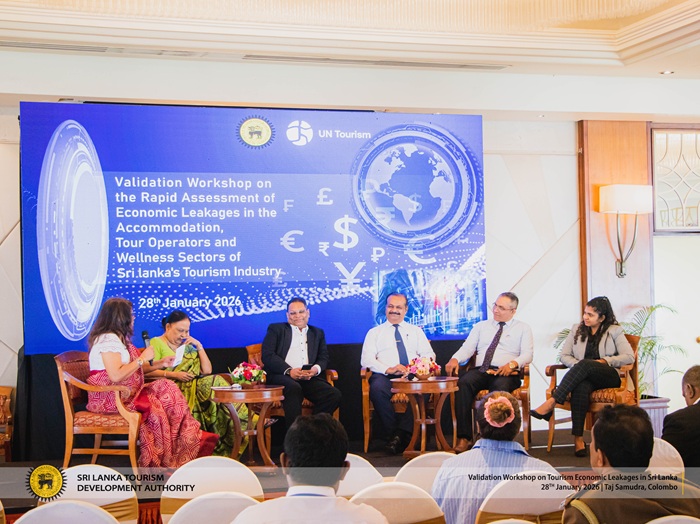
Building on these findings, the Sri Lanka Tourism Development Authority (SLTDA), in collaboration with UN Tourism, convened the country’s first national, multi‑stakeholder validation workshop on economic leakages in the tourism sector on 28 January.
The workshop was based on the Rapid Assessment of economic leakages in key tourism segments. Officials emphasized that the figures should be seen not as a sign of weak impact, but as evidence of untapped potential.
They highlight opportunities to strengthen domestic value retention, deepen local supply chains, and increase tourism’s contribution to incomes, employment, and fiscal revenues.
Moreover, the assessment covers only three segments of the tourism value chain. Other activities such as casinos, crafts and selected leisure services are likely to increase the overall volume of recoverable value, reinforcing the case for targeted, pragmatic action rather than concern about tourism’s role in the economy.
Tourism generated USD 3.17 billion in receipts in 2024, making it Sri Lanka’s third-largest source of foreign exchange. However, a significant share of this value does not remain in the domestic economy due to structural factors including offshore bookings (with OTA and international operator commissions being structural features of global tourism markets), high import dependence, fragmented local supply chains and high informality.
Key findings included:
- Informality across the three sectors accounts for an important share of economic leakages and related fiscal losses. However, precise quantification remains ongoing, given limited visibility on the full scale of unregistered operators, the extent of offshore-held revenues, and the fact that some market segments are more influenced by informal actors than others.
- Procurement-related leakages largely driven by imports of food, equipment, vehicles and utilities, consumables, furniture and textiles exceeded USD 800 million per year. These leakages are not solely supply-side issues: visitor behaviour also matters, as informed tourists are more likely to favour locally sourced products and services when origin and impacts are clearly communicated
- Leakage rates above 50% were observed primarily in the spa and wellness segment, driven largely by reliance on foreign therapists and imported packaging for retail products.
- By contrast, Ayurveda demonstrated a significantly stronger local economic impact, with deeper local supply chains, greater value retention, and more socially responsible practices, including gender-appropriate service provision.
From diagnosis to action
The workshop was designed as a pragmatic validation exercise focused on turning evidence into action and identifying realistic opportunities for progress:
- What could be implemented within existing institutional mandates
- What could be achieved in the short and medium term
- What actions required sequencing or broader coordination beyond sector-level authority
The objective was clear: not to debate whether leakages exist, but to collectively identify what can be done and how Sri Lanka can actively capture greater value from its tourism economy.
Three thematic panels addressed:
- Formalisation, digitalisation and incentives
- Strengthening local value chains and sourcing
- Sustainability, skills and destination positioning
With the support of industry associations, the outcomes of the workshop will feed directly into the preparation of a three-year implementation roadmap led by SLTDA. The roadmap will prioritise practical and achievable measures, including clearer and progressive formalisation pathways, realistic opportunities for import substitution, and strengthened consumer awareness through better use of digital tools.
A key focus will be on improving market credibility and access, where continued access to platforms, promotion and partnerships will increasingly depend on compliance with SLTDA registration and quality requirements, ahead of any enforcement or sanctioning measures. Improved inter-institutional coordination will support this transition.
A strategic shift for Sri Lanka’s tourism sector
As arrivals continue to recover, Sri Lanka’s challenge is no longer only to grow visitor numbers, but to ensure that more tourism value stays in the country and benefits Sri Lankans. This workshop marked a first concrete step toward that goal. (Newswire)